
When recovering from an injury, surgery, or chronic pain condition, many people eventually ask: How does post-rehabilitation training differ from regular physical therapy sessions?
The short answer is this:
Physical therapy restores basic function and reduces pain.
Post-rehabilitation training rebuilds strength, stability, endurance, and long-term resilience.
At Redefine Fitness in Mount Sinai and Stony Brook, NY, post-rehabilitation training is not an extension of therapy, it is the structured bridge between being “cleared” and being truly strong, capable, and confident again.
The Role of Physical Therapy in Recovery
Physical therapy (PT) is a medically guided process designed to:
- Reduce pain and inflammation
- Restore joint range of motion
- Improve neuromuscular control
- Re-establish baseline function
- Help patients return to daily activities
Once these goals are met, discharge typically follows.
However, being pain-free does not automatically mean the body is strong, balanced, or resilient.
What Is Post-Rehabilitation Training?
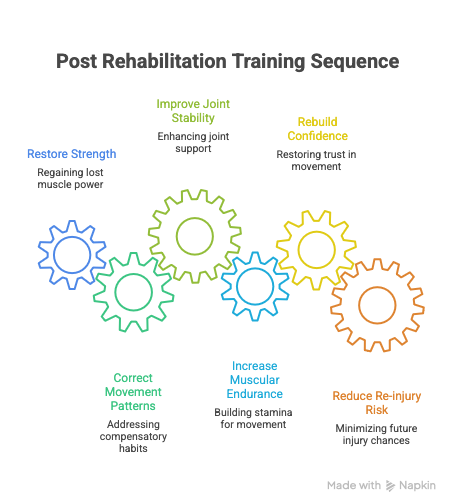
- Restoring strength lost during injury
- Correcting compensatory movement patterns
- Improving joint stability
- Increasing muscular endurance
- Rebuilding confidence in movement
- Reducing long-term re-injury risk
Core Differences
| Category | Physical Therapy | Post-Rehabilitation Training |
|---|---|---|
| Primary Goal | Restore function & reduce pain | Build strength & resilience |
| Intensity | Conservative | Progressive |
| Duration | Short-term | Ongoing |
| Insurance-Based | Often | No |
| Focus | Symptom resolution | Performance development |
| Load Progression | Limited | Structured overload |
| End Point | Medical discharge | Long-term capability |
Restoration vs. Performance Development
Physical therapy focuses on regaining lost function.
Post-rehabilitation training focuses on building above baseline.
Controlled Exercises vs. Functional Integration
In therapy, exercises are often isolated and controlled.
In post-rehabilitation training, exercises become multi-joint and functional.
Pain Management vs. Load Tolerance
Physical therapy prioritizes symptom reduction.
Post-rehabilitation training prioritizes increasing tissue capacity and building strength.
Why Proper Progression Matters
Recovery follows the principles of General Adaptation Syndrome.
The Importance of Stability After Rehabilitation
| Area | Therapy Focus | Post-Rehab Focus |
|---|---|---|
| Knee Injury | Quad activation | Single-leg stability & loaded lunges |
| Shoulder Rehab | Rotator cuff | Scapular stability & pressing progressions |
| Lower Back | Neutral spine drills | Deadlift variations with bracing |
The Role of Stretching and Mobility
- Dynamic mobility pre-session
- Active range of motion drills
- Targeted release work
- Stability-based flexibility integration
Psychological Confidence After Injury
- Lift heavier weights
- Squat deeply
- Move quickly
- Jump
- Carry load
What a Post-Rehabilitation Session May Include
- Warm-up (RAMP protocol)
- Controlled compound movement
- Accessory stability circuits
- Progressive overload integration
- Mobility or recovery finish
Who Benefits Most from Post-Rehabilitation Training?
- Individuals discharged from physical therapy
- Adults returning to exercise after injury
- Clients with chronic low back pain
- Post-surgical patients
- Athletes returning to sport
- Individuals who feel “cleared but weak”
Conclusion: Moving Beyond Recovery
- Physical therapy restores function.
- Post-rehabilitation training builds capacity.
Learn more or schedule an assessment today.
👉 Get Started
Mount Sinai Location:
271-1 Route 25A, Mount Sinai, NY 11766
Stony Brook Location:
1113 North Country Road, Stony Brook, NY 11790
Recovery is the starting point. Strength is the destination.