If you have been told your bones are thinning, or you have watched a parent lose height and independence, it is natural to move less out of caution. The instinct makes sense, but the science points the other way. Bone is living tissue. It responds to what you ask of it. Ask nothing of it, and it slowly gives ground. Ask the right amount, in the right way, and it holds and adapts. Strength training is one of the most direct ways to send bone that signal.
At Redefine Fitness, we are a medical-fitness studio, not a gym. Every session is private and one-on-one, built and adjusted by a Fitness Specialist trained in the same science our staff test against our internal Training Master Guide. This is education, not a diagnosis or a prescription. It is meant to help you train intelligently alongside your physician and care team, never instead of them. What follows is how we think about training when protecting bone strength is a priority.
Why bone gets stronger when you load it
Muscle, tendon, and bone all share one rule: they adapt to the demands placed on them. This is the foundation of everything below. Broadly, exercise science describes bone as a dynamic tissue that is constantly being broken down and rebuilt. When a muscle pulls hard on the bone it attaches to, and when your skeleton carries meaningful load, that mechanical stress is a signal for the rebuilding side of the equation to keep pace. Take the load away, through bed rest, inactivity, or simply doing less every year, and the maintenance signal fades.
This is why walking, while genuinely good for you, is often not enough on its own for bone. Your skeleton has already adapted to carrying your body weight across a flat floor. To ask more of it, you have to progressively give it more than it is used to. That is where structured resistance training and its principles come in.
Progressive overload: the principle that does the work
If there is one idea that separates training that changes your body from movement that simply passes the time, it is progressive overload. The concept is simple: for the body to keep adapting, the stress placed on it has to gradually increase over time. A weight that challenged you in month one becomes your warm-up by month three, precisely because you adapted to it. If the demand never rises again, the adaptation stalls.
We manage that increase through what we call the FITT levers: frequency, intensity, time, and type. You can train a movement a little more often, add a little load, add reps or time under tension, or change the variation of the movement itself. For someone training with bone strength in mind, intensity and load usually carry the most weight, because meaningful mechanical stress is exactly the signal bone responds to. The art is adding it in small, controlled steps so the challenge is real but the movement stays clean and safe.
Specificity: your body adapts to exactly what you practice
Training follows the SAID principle, which stands for specific adaptation to imposed demand. Put plainly, a body asked to sit all day gets very good at sitting all day. A body asked to stand up from a low chair, carry a heavy bag, or brace under a loaded bar gets better at those exact things. Bone and the muscles around it strengthen along the lines of the demand you place on them.
That is why we build training around what your life actually requires. We organize movement into a handful of fundamental patterns: squat, hinge, lunge, push, pull, carry, and rotate. A loaded carry challenges the hip, spine, and grip together. A hinge teaches you to bend from the hips and load the posterior chain safely, which is one of the highest-value skills for anyone worried about their back. Training these patterns under gradually increasing load is far more useful than chasing isolated machine exercises, because it builds strength in the positions your day demands.
Stress, recovery, and why rest is part of the plan
Adaptation does not happen during the workout. It happens after it. The body follows a pattern called general adaptation syndrome, which moves through three phases. First is the alarm phase, when a challenging session temporarily leaves you tired and sore and your performance dips below baseline. Second is the resistance phase, when, given enough recovery, the body rebuilds not just to where it was but slightly above it. This rise above your previous baseline is called supercompensation, and it is the entire point. Third is the exhaustion phase, which is what happens when demand keeps coming with no room to recover: progress reverses and injury risk climbs.
The practical takeaway is that recovery is not the opposite of training, it is where training pays off. As a general rule, we aim to challenge each major muscle group about twice a week and to leave roughly forty-eight hours of recovery between hard sessions for the same muscles. For bone and for strength, consistency across months beats intensity in any single week. There is also a humbling flip side, called reversibility: adaptations you stop maintaining will slowly regress. Bone strength is not a project you finish. It is a practice you keep.
What a session actually looks like
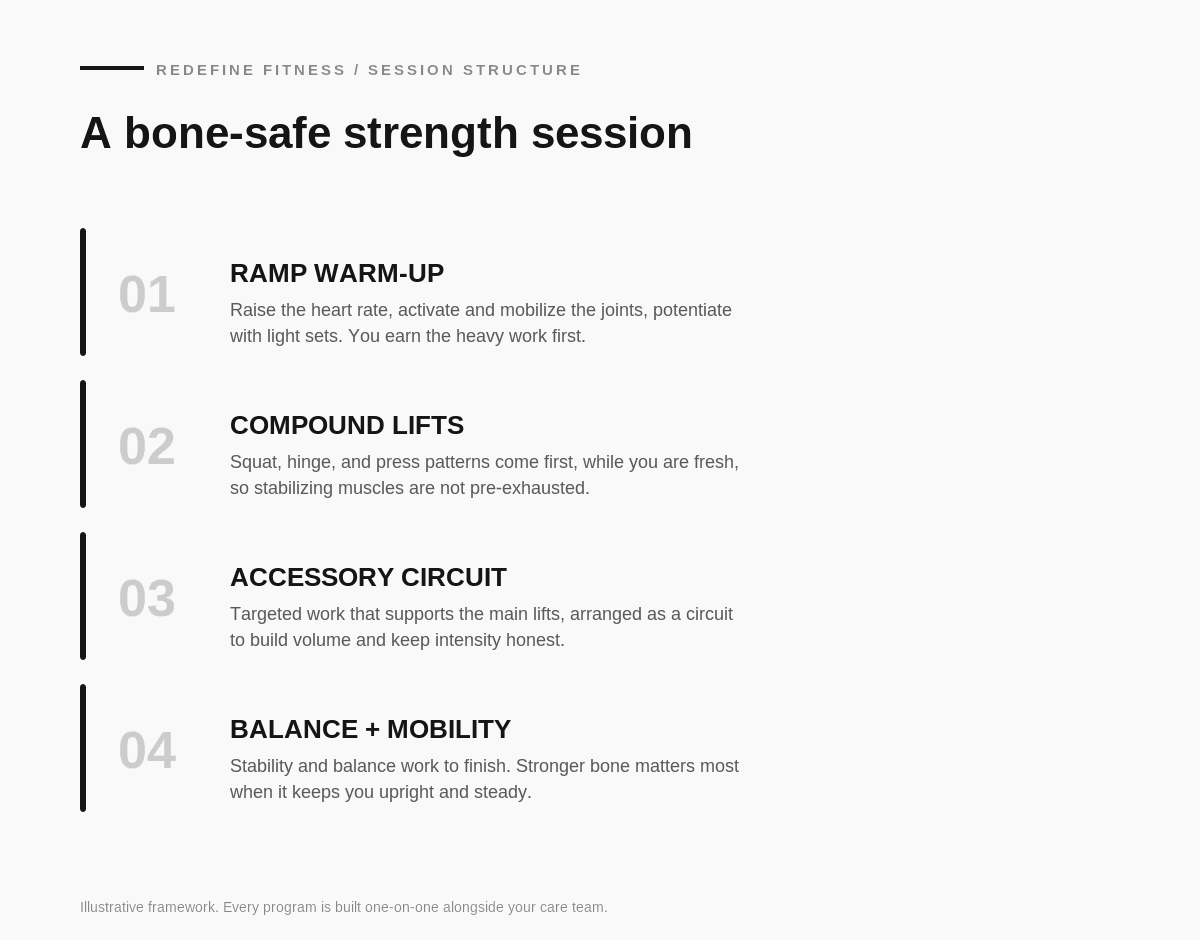
A well-built session has a shape. We start with a warm-up that follows what we call RAMP: raise the heart rate with a few minutes of light movement, activate and mobilize the joints and muscles you are about to use, and potentiate with one or two light sets of the main lift. Skipping straight to a heavy weight is one of the easiest ways to strain something. If you are going to load a movement, you earn it with the lighter sets first.
Next come the compound movements, the exercises that use multiple muscle groups at once, like a squat, a hinge, or a press. We place these first for a specific reason: they demand the most from you, and doing them while you are fresh keeps the smaller stabilizing muscles from being pre-exhausted, which lowers injury risk. After the compounds, we add isolation or accessory work, often arranged as a circuit to make good use of limited time and keep the heart rate up. We finish with mobility and, importantly for bone health, balance work.
How hard is hard enough? We read your body rather than guess. If the lifting portion of a rep is fast and controlled and you can still breathe and hold a short conversation, there is room to progress. If you are shaking, grinding, and fighting for every rep, that is the signal to regress and rebuild. Progress exists to make you stronger. Regression exists to keep you safe. Both are tools, and a good session uses them on purpose.
Balance and stability: the other half of the equation
Stronger bone matters most when it keeps you upright. That is why we treat balance and stability as core training, not an afterthought. Stability, in simple terms, is the body’s ability to resist: to hold a position or control a movement despite forces trying to move you. An unstable body is a weaker body and often a body in pain, because instability quietly pushes joints into compromised positions during everyday tasks like walking or carrying groceries.
We build stability two ways. We strengthen the trunk and teach proper bracing, which creates a solid base for every other movement, and we deliberately introduce controlled instability to the joints that need it, for example a balance hold that asks the ankle to keep correcting itself. For anyone focused on protecting their skeleton, this is where strength quietly turns into confidence: a body that can catch itself is far less likely to end up on the floor.
What we avoid, and why we coordinate with your care team
Training intelligently means knowing what not to do. If you have diagnosed osteoporosis, low bone density, or a history of fracture, certain movements are not automatically appropriate for you, and some, such as heavily loaded rounded-back bending or high-impact jumping, may need to be modified or set aside entirely. Which ones, and how, is an individual question. No article can answer it for you, and that is not false modesty, it is the whole reason our sessions are one-on-one.
Bone density is measured and diagnosed by your physician, often through a scan and a score. That is their domain, and we stay in ours. If you have had a bone density test or carry a diagnosis, bring it into the conversation so your program can be built around your actual medical picture. We train alongside your physician and, where relevant, your physical therapist. Please talk with your provider before starting a new program, especially if you have a bone health diagnosis, a recent fracture, or other medical conditions. Our job is to handle the thinking behind the training so that you can execute it with confidence and consistency.
Train for bone strength on Long Island
If you want a program built around your body, your history, and your goals, we would be glad to talk. Everything at Redefine is private and one-on-one, delivered with you, at the standard you would expect if it were done for you. You bring the effort. We handle the plan.
We train clients at two Long Island studios: Mount Sinai at 271 Route 25A, and Stony Brook at 1113 North Country Road. If you are getting stronger later in life, you may also find our guide on strength training after 55 useful, and you can see how we work on our services page.
Book your complimentary consultation and let’s build a plan that keeps you strong, steady, and independent for the long run.