Parkinson’s disease changes how the brain delivers movement signals to the body. It does not change the fact that the body still adapts to training. That distinction is the difference between assuming nothing can be done and building a program around what actually responds.
Redefine Fitness is a medical fitness company, not a gym. Our Fitness Specialists work privately, one on one, with clients living with Parkinson’s, and that programming looks very different from a standard strength routine. This guide covers what changes, why, and what a structured session actually looks like. It is education, not medical advice, and it is built to work alongside your neurologist and physical therapist rather than in place of them.
What Parkinson’s Actually Changes About Movement
Parkinson’s is a neurological disease. Over time, the neurons that produce dopamine begin to die. Dopamine is one of the neurotransmitters involved in initiating and regulating movement, so as those levels fall, movement becomes harder to access.
Here is the point most people outside the field miss: the person knows exactly what they want to do. The intention is intact. The signal simply does not reach the muscles as quickly or as consistently as it did before onset. That is a delivery problem, not a motivation problem, which is why encouragement to “just push through it” lands so poorly.
Because the signal is inconsistent, Parkinson’s presents inconsistently. Four patterns show up often enough that we plan around them: shrinking up, slowing down, occasional freezing, and loss of balance. Each has a different cause, and each needs a different training answer.
Why “Tightness” With Parkinson’s Is Not a Flexibility Problem
Shrinking up describes muscles sitting in a semi contracted state because the nervous system is not regulating tone properly. It feels like tightness to the client and it looks like tightness from the outside. It is not tightness in the usual sense.
This distinction has real consequences. The instinctive response to a tight muscle is to stretch it aggressively, and here that does not help and can make things worse. The muscle is not short. It is being held. What does help is controlled, intentional movement through a full range of motion, repeated with time and patience. Range comes back by being used, not by being forced.
Parkinson’s also pulls people into flexion over time: rounded shoulders, forward head position, a more closed hip and knee. So we deliberately train extension at every joint we reasonably can, to work against that pattern and preserve access to a larger working range.
Freezing and Falls Are Timing Problems
Freezing is the sensation of being stuck mid step or mid transition. It tends to appear when changing direction, approaching doorways, or starting movement after being still. The underlying issue is the nervous system struggling to switch tasks efficiently.
The workaround is external cueing. In exercise science research, people who freeze while walking often move more consistently when given a rhythmic external task, for example clapping while they walk. The clapping gives the nervous system one continuous task to hold, so the transition stops functioning as a transition. We use that principle constantly: verbal call outs, counted rhythm, visual targets, reactive claps.
Balance failures follow the same logic. When a client loses balance, the corrective signal telling the right muscles to fire arrives late. It is not an inability to balance. It is a delayed correction. That is why falls cluster in transitions: standing up, turning, stopping, stepping through a tight space. Our programming and our spotting both concentrate there, because that is where the risk lives.
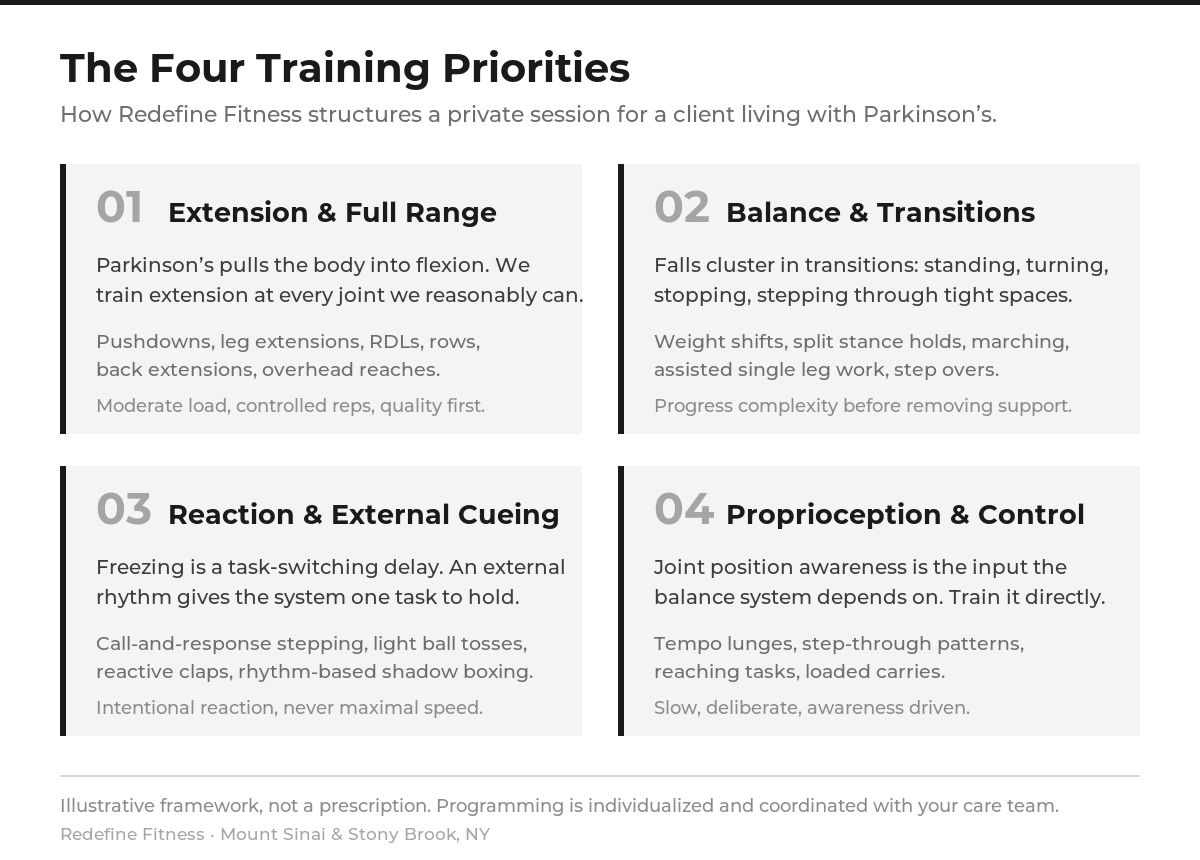
The Four Training Priorities We Build Around
1. Extension and large range of motion
Examples include tricep pushdowns, leg extensions, Romanian deadlifts or trap bar deadlifts, back extensions and supermans, rows, and overhead reaches when appropriate. Load stays moderate and reps stay controlled. The priority is quality and consistency, not intensity.
One coaching note matters enormously here: because Parkinson’s reduces movement size, a cue that looks normal to a Fitness Specialist will be under shot by the client. So we cue bigger and longer than feels necessary, and take every opportunity to extend range that the movement allows.
2. Balance, progressed in the right order
Start in stable environments with clear support options: weight shifts, split stance holds, marching patterns, and controlled single leg work with assistance. The rule we hold to is progress complexity before removing support. Taking the support away first is how people get hurt.
3. Reaction and speed work
This does not mean maximal speed. It means intentional, externally cued reaction. Light ball tosses, call and response stepping, and reacting to a verbal or visual cue all train a quicker neural response in a setting where a miss is safe and supervised.
4. Proprioception and control
Slow, controlled work that demands awareness of joint position and of pressure through the feet and hands. Controlled tempo lunges, step through patterns, and reaching tasks work well here. Awareness of where a limb sits in space is the input balance depends on, so it gets trained directly rather than assumed.
Movements our Fitness Specialists use regularly with these clients include single leg pole switches, wall reach squats and sit to stands, marching with opposite hand to knee taps, step overs to rehearse transitions, seated medicine ball throws, loaded carries with verbal call outs, step backs with verbal call outs, rhythm based shadow boxing, diagonal band chops, step turn step drills, and sporadic reactive hand claps.
The Standard Training Principles Still Apply
Worth stating plainly, because it often gets lost: a Parkinson’s program is still a training program. The same principles our Fitness Specialists study in our New York State approved apprenticeship curriculum govern it.
Specificity, the SAID principle. The body makes specific adaptations to imposed demands. Ask for large range extension and reactive stepping, and those improve. Ask for nothing, and the body adapts to that too. Sitting is a stimulus with its own adaptations.
Individuality. No two people respond to the same stimulus the same way, and Parkinson’s amplifies that. Symptoms fluctuate day to day and even hour to hour with medication timing, so the plan gets adjusted in the room, based on what shows up that morning.
Progressive overload and FITT. Progression happens by changing frequency, intensity, time, or type. With Parkinson’s, type and time are usually the first levers we move. Complexity and control get advanced well before load does.
General adaptation syndrome. Training imposes a stress that drops performance below baseline (the alarm phase). Recovery then lifts the body above its prior baseline (the resistance phase, also called supercompensation). Pushing too far without recovery produces decline instead (the exhaustion phase). That productive window is narrower with a neurological condition in the picture, so we watch it rather than chase fatigue for its own sake.
Reversibility. Progress regresses when it is not purposefully maintained. That is the strongest argument for consistency over intensity, and why we would rather see someone train reliably for years than heroically for six weeks.
Why Coaching Style Is Half the Program
Pace is critical. Rushed reps, rushed transitions, and stacked cues overwhelm the nervous system and make freezing more likely. One cue, then wait. Silence between reps is completely fine. Letting a client finish a movement before speaking is better than filling the space.
There is also a lot happening that is not obvious from the movement itself. Parkinson’s often comes with reduced facial expression, lower voice volume, fatigue, anxiety, and low mood. The social feedback a Fitness Specialist normally reads to gauge a session is harder to come by, so the relationship takes more deliberate effort and more direct questions.
This is the honest case for private, one on one work. In a group setting the cueing is generic, the pace is set by the room, and nobody is positioned to catch a delayed balance correction. Every session we run is one client and one Fitness Specialist, which is what makes real time adjustment and reliable spotting possible at all.
How a Session Is Structured
Sessions follow the architecture we use across the studio, adapted for the priorities above. The warm up follows RAMP protocol: raise heart rate with light cardio, activate and mobilize the relevant muscle groups and joints, then potentiate with one or two light sets of the primary movement. Potentiation is the step people skip and the one that matters most for injury risk. We also program in weekly blocks, training every muscle group at least twice per week with a minimum of forty eight hours of recovery between sessions for a given group.
Compound movements come before isolation work, so the muscles involved in the larger lift are not pre exhausted going into it. Accessory work follows, often as a circuit so one muscle group rests while another works. The session closes with controlled cool down work and, where tissue has tightened, targeted release.
Where This Fits Alongside Your Care Team
We are not physicians. We do not diagnose, prescribe, or manage medication, and nothing here substitutes for care from your neurologist, physical therapist, or primary care provider. What we do is training, and training is the piece of the picture most often left unstructured.
Before anyone begins, our Fitness Specialists clarify a short list: whether you are cleared for exercise, your medication timing and how symptoms track against it, your fall history, and any symptoms that should stop a session. That information shapes the program from day one, and we keep the lines open with the providers already involved in your care.
Research in exercise science consistently associates regular, structured physical activity with better mobility, better balance, and greater retained independence in older adults and in people living with movement conditions. That is what our programming is organized around: keeping function accessible for as long as possible.
Training With Parkinson’s on Long Island
Redefine Fitness operates two private studios on Long Island: Mount Sinai at 271 Route 25A and Stony Brook at 1113 North Country Road. Every session is private and one on one, and the model is done with you at a done for you standard. We handle the assessment, the programming, the progression, and the cueing. You show up and execute the system with a Fitness Specialist beside you the entire hour.
If age related strength loss is also part of the picture, our guide to strength training after 55 covers the foundational programming in more depth, and our full personal training and nutrition coaching services show how the pieces fit together.
Start With a Conversation
If you or someone in your family is living with Parkinson’s and is not sure where structured training fits, the first step is a conversation, not a workout. See if you’re a fit and we will walk through your history, your current symptoms, what your care team has advised, and whether our approach is the right fit. If it is not, we will tell you so directly.
Working through this yourself? Read the balance and fall prevention guide.
Common questions
How much should someone with Parkinson’s exercise?
The Parkinson’s Foundation and ACSM recommendations describe a weekly mix: aerobic activity, strength training two to three days a week, plus balance, agility and multitasking work, and flexibility work. The combination matters more than any single element.
Can exercise slow Parkinson’s progression?
Exercise is recommended as part of care and is associated with better function and quality of life. Claims about altering disease course are a medical question and belong with your neurologist. What structured training reliably supports is strength, balance, gait and confidence.
Is it safe to strength train with Parkinson’s?
Yes, with supervision appropriate to your balance and fall risk. Machines, seated variations and supported positions let someone train hard without balance being the limiting factor, then more challenging positions are introduced as control improves.
What kind of exercise helps balance most in Parkinson’s?
Work that challenges balance deliberately and safely: direction changes, reaching outside the base of support, single leg stance with support available, and tasks that add a cognitive element. Balance improves when it is trained, not as a side effect of walking.
Sources
- Parkinson’s Foundation and ACSM Exercise Recommendations for Parkinson’s Disease
- Physical Activity Guidelines for Americans, 2nd edition — U.S. Department of Health and Human Services
Educational content from the Redefine Fitness specialist team. Not medical advice, and not a substitute for diagnosis or treatment by your physician.