
A hip replacement gives you a new joint. It does not give you back the strength, mobility and confidence that years of hip arthritis quietly took away. That part is built, not installed, and it is built in the months after your surgeon and physical therapist have finished their work. This guide explains what a hip replacement changes, what it does not, and how a medical fitness program rebuilds the hip using the training science we teach in our New York State approved Fitness Specialist apprenticeship curriculum. It is general education, not medical advice. Your surgeon and physical therapist set the rules for your hip. We train inside them.
Why the hip is a different problem than the knee
The hip and the shoulder are both ball and socket joints designed for mobility. The difference is scale. The pelvis gives the hip the stability the shoulder blade gives the shoulder, but the hip also carries the weight of the entire upper body. The bones are thicker, the connective tissue is stronger, and the muscles are far more massive. The hip has flexors, extensors, adductors, abductors, internal rotators and external rotators, and they have to be large and powerful because the hip is built around the largest and densest bones in the body.
That is why a replaced hip is not “fixed” the day the implant goes in. The joint surface is new. The muscles that move it, stabilize it and protect it spent years working around a painful, stiff joint, and they have to be retrained to match.
What arthritis took before the surgery
Hip arthritis is a wearing down of cartilage inside the joint. As it progresses, the joint capsule typically loses synovial fluid and begins to constrict around the joint. People feel it down the side of the hip, struggle badly with mobility, and often lose internal rotation almost entirely. Walking can produce a grinding or clunking sensation. Long before anyone books a surgeon, the body has already started protecting the joint.
Protection has a cost. When a joint becomes less stable or more painful, the nervous system stiffens the surrounding muscles to guard it. The hip flexors, the adductors, the low back musculature and the glutes are not shortened in a structural sense as much as they are overactive in a neurological sense. The central nervous system limits how far those muscles are allowed to lengthen in order to protect the joint. After surgery the joint no longer needs that protection, but the nervous system does not know that yet. Retraining that guarding pattern is a large part of what the months after surgery are for.
Add reversibility, the principle that progress regresses if it is not purposefully maintained, and the picture is clear. Most people arrive at surgery with a weaker, stiffer, more guarded hip than they had five years earlier. The surgery addresses the joint. The training addresses everything else.
First rule: your surgeon’s precautions come first
Every hip replacement comes with movement precautions, and they vary with the surgical approach and the surgeon. Some patients are asked to limit deep hip flexion, crossing the midline or certain rotations for a period of time. Those rules are not ours to set or relax. They come from your surgeon, and a Fitness Specialist builds around them rather than testing them.
Some techniques we use for other hip problems are simply off the table after a replacement. Our curriculum is explicit about it: a banded femur distraction that might help a client with a tight, impinged hip is something you do not do on a replaced hip. A medical fitness program is supposed to know the difference, which is why a health history and movement screening come before any exercise at Redefine.
Physical therapy owns the early phase after surgery. Our work starts when your surgeon and physical therapist have cleared you for progressive exercise, and it runs alongside your care team, never instead of it. A symptom that belongs to a clinician goes back to the clinician.
The training principles that govern the rebuild
The same principles we teach every apprentice apply to a replaced hip. They just get applied more carefully.
Specificity. The body makes specific adaptations to imposed demands, the SAID principle. A body that is asked to sit, favor one leg and take short steps becomes very good at sitting, favoring one leg and taking short steps. A body asked to hinge, squat, step and carry under gradually increasing load becomes good at those. After surgery, the demand you impose is the hip you get.
Progressive overload. Stressors must increase over time for adaptations to increase over time. The four levers are the FITT principle: frequency, intensity, time and type. On a replaced hip, intensity is rarely the first lever we pull. Time under control, range of motion and movement type usually move first, and load follows.
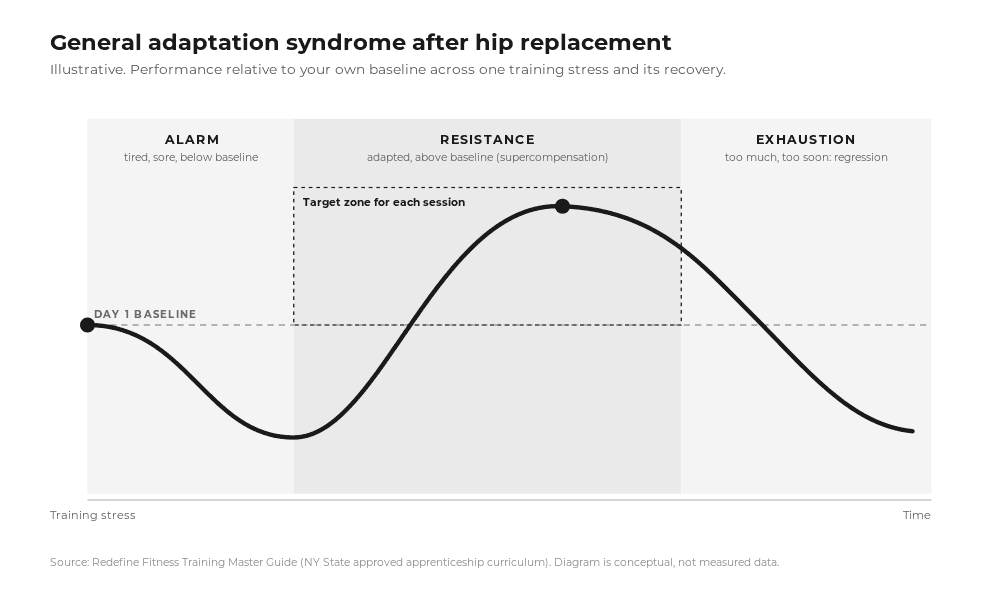
General adaptation syndrome. The body responds to a training stress in three phases. In the alarm phase performance drops below baseline: you are tired, sore and worn down. In the resistance phase the body adapts and rises above baseline, which is supercompensation. Push too far for too long and you reach the exhaustion phase, where performance regresses. The entire craft of programming a post-surgical hip is staying in the resistance phase: enough demand to adapt, never so much that a still-sensitive joint and the tissues around it are pushed into exhaustion.
Individuality and diminishing returns. No two people respond to the same stimulus the same way, and progress slows as you approach your ceiling. A 58 year old four months out and a 72 year old a year out are not on the same program, even if the exercise names look similar.
How a session is actually built
Warm up with a purpose. Every session opens with the RAMP protocol: a few minutes of light cardio to raise heart rate, dynamic mobility and soft tissue work to activate and mobilize the hips and the joints around them, and one or two light sets of the day’s main movement to potentiate the muscles that are about to work. On a replaced hip, the mobilize step is not optional. It is where lost internal rotation and hip extension get reintroduced, gently and inside your precautions.
Compound before isolation. We place compound movements before isolation movements so that the muscles that stabilize and assist a big lift are not pre-exhausted before they are needed. Practically, this means a supported hinge or a box squat comes before a side-lying abduction, not after.
Train the patterns, not the joint. We progress seven functional movement patterns: squat, hinge, lunge, push, pull, carry and rotate. Four of them carry most of the weight after a hip replacement.
- Hinge. The hinge trains the glutes and hamstrings to extend the hip while the spine stays neutral. It is the pattern that makes standing up, picking things up and walking uphill feel normal again.
- Squat. Sitting and standing is a squat. Depth is governed by your precautions and your control, not by what you did before surgery.
- Lunge. Split stance and step patterns are where the hip abductors, especially the muscles on the side of the hip, learn to hold the pelvis level on one leg. Stairs, curbs and uneven ground live here.
- Carry. Loaded walking is the most underrated pattern for a replaced hip. It trains the hip to stabilize under load with every step, which is exactly what daily life asks of it.
The other hip matters too. Years of favoring one side means the “good” hip has been doing extra work, often with its own compensations. A program that only trains the replaced side builds a new imbalance on top of an old one.
How we know when to progress, and when to back off
We cannot feel your exertion for you, so we read it from cues. The first cue is the length of time the concentric portion of a movement takes. If you can get the weight up quickly and cleanly, it is time to progress. If the concentric phase is taking far too long, it is time to regress. The second and third cues are muscle shake and breathing. If you are shaking and fighting for every rep, we back off. If you can hold a conversation and breathe easily, we can add.
We regress to prevent injury. We progress to get better. On a replaced hip, both directions are used constantly, and neither one is a failure. It is a done-with-you program held to a done-for-you standard: a Fitness Specialist makes the call in the room, every set, from your health history and your screening, not from a template.
Three mistakes we see most often
Going back to the old routine. The hip that finished physical therapy is not the hip you had ten years ago. Returning to a pre-surgery program, or one built for someone with two original hips, ignores specificity and usually ignores your precautions.
Doing the same home exercises forever. Physical therapy homework is built for a phase. Without progressive overload the same three exercises stop producing adaptation, and reversibility slowly takes back the gains.
Skipping strength for “just walking.” Walking is essential, and it is also a low-load, single-plane activity. It will not by itself rebuild the abductors, extensors and rotators that keep the pelvis level and the implant well supported. Strength work does that.
A realistic timeline
Adaptation is not linear. The first weeks after clearance are about restoring patterns and mobility inside your precautions. The following months are about load. Beyond that, the goal is the same as for any client over 55: strength, balance and bone health maintained on purpose, because reversibility never stops applying. Progress is measured against your own Day 1 baseline, not a chart.
A note on nutrition
This is general best practice rather than curriculum content. Rebuilding muscle around a replaced hip is a construction project, and adequate protein, total calories and hydration are the materials. At Redefine, a Registered Dietitian is part of the plan, so nutrition is built alongside the training and coordinated with what your physician has already told you.
What a medical fitness program looks like after hip replacement
Every client at Redefine starts the same way: a health history, a biometric analysis and a movement screening on Day 1, reviewed against standards set by our Nurse Practitioner Clinical Advisor. From there a Fitness Specialist builds a private, one-on-one program around your precautions, your other joints and your goals, structured with RAMP, compound before isolation, the seven patterns and the progression cues above. The program changes as you do.
We are not a gym and we are not therapy. We are the space between: the place you go once you have been cleared, and you want the strength that the surgery made possible.
If you or someone you care about is months out from a hip replacement and ready to build on it, we would like to talk. Our studios in Mount Sinai and Stony Brook serve clients across Long Island. Book Your Call and we will walk you through exactly what a program would look like for you. You may also want to read our guides on exercise after knee replacement, strength training for knee and hip arthritis, and strength training after 55.