Most people who stall in the gym are not lazy and not unlucky. They are repeating the same stimulus and expecting a different result. Strength is not built by effort alone. It is built by a specific sequence: a challenge the body has not fully met before, enough recovery to adapt to it, and then a slightly bigger challenge. Exercise scientists call the engine behind that sequence progressive overload.
At Redefine Fitness, every program is built on this principle, and our Fitness Specialists are taught it through a New York State approved apprenticeship curriculum before they ever write a plan for a member. This guide explains it in plain language: why it works, the five principles that govern it, the four levers a program can pull, and how a specialist decides when to make something harder or easier. It is general education, not medical advice, and it is meant to be used alongside your physician or care team.
What progressive overload actually means
Progressive overload is the idea that stress on the body has to increase over time for adaptation to keep happening. Lift the same weight for the same repetitions at the same pace for a year and the body has no reason to change. It already adapted. Ask for a little more, in a planned and measured way, and it responds.
Two words in that definition matter. Progressive means small, deliberate steps, not a sudden jump. Overload does not mean exhaustion or pain. It means a demand slightly above what the body is currently used to. A program that overloads too aggressively is not a harder program. It is a poorly designed one.
The cycle underneath it: stress, recovery, adaptation
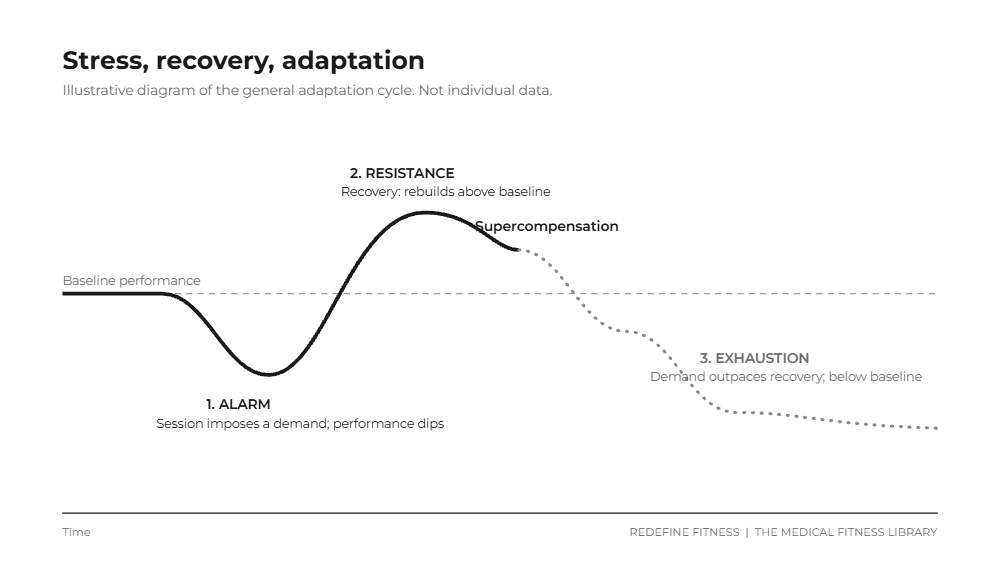
Training is a stressor, and the body responds to stressors in a predictable pattern. Exercise science describes it with the general adaptation syndrome, which has three phases.
First is the alarm phase. A session imposes a demand, and for a short time performance drops below baseline. You are tired, possibly sore, and your muscles are worn down. This is the cost of the session, not the benefit.
Second is the resistance phase. With rest, food, and sleep, the body recovers and rebuilds slightly above where it started. Muscles are stronger and the same task now feels easier. This rise above baseline is called supercompensation, and it is the entire point of training.
Third is the exhaustion phase. If demands keep arriving faster than the body can adapt, performance drops below baseline again and stays there. This is what overtraining looks like: lingering soreness, stalled or lost progress, and a higher chance of getting hurt.
A good program repeatedly delivers the alarm phase, then protects the resistance phase, and stays well away from the exhaustion phase. That is the job.
Five principles every sound program follows
Progressive overload does not work alone. It sits inside a set of training principles that shape every decision a specialist makes.
Individuality. No two people respond to the same stimulus in the same way. Age, training history, sleep, stress, health history, and genetics all change how much work is productive. A plan copied from someone else, or from a social media post, ignores the most important variable: you.
Specificity. The body adapts to exactly what it is asked to do. Exercise scientists call this SAID, short for specific adaptations to imposed demands. A body asked to sit all day becomes very good at sitting all day. A body asked to squat, hinge, and carry becomes good at those. If your goal is climbing stairs without a rail, your training should look like climbing stairs under load, not just isolated machine work.
Progressive overload. The stimulus has to increase over time, or the adaptation stops.
Diminishing returns. The closer someone gets to their current ceiling, the slower progress comes. A beginner may add strength every week. Someone three years in may measure progress in months. This is normal, not failure, and it is why plans need to change as you do.
Reversibility. Adaptations fade if they are not purposefully maintained. Strength gained over twelve weeks can erode when training stops for an extended stretch. The practical lesson is that consistency matters more than any single hard session.
Four levers a program can pull: FITT
Overload does not just mean adding weight. The FITT framework lists four ways to increase demand, and a thoughtful program rotates through them.
Frequency: how often you train a movement or muscle group. Intensity: how heavy or how demanding the work is. Time: how long the work lasts, including the number of sets and repetitions. Type: what the exercise is, such as moving from a supported version to an unsupported one, or from a two legged to a single leg variation.
This matters because the right lever depends on the person. A powerlifter progresses by lifting heavier. An athlete may progress explosiveness. An older adult may progress balance and the ability to stand up from a low surface. A general population member may progress simply by training twice a week without missing. Same principle, very different expressions. For a closer look at how this plays out later in life, see our guide to strength training after 55.
How a specialist knows when to progress, and when to back off
Progression is a judgment call, and it is made in real time, not just on paper. Because a specialist cannot feel your effort from the outside, they read cues.
Concentric speed. The concentric phase is the lifting part of a repetition. If a load moves up quickly and smoothly, it is probably ready to increase. If the lift is slow and grinding, the load is too high for today, and the right move is to regress.
Muscle shake. Some trembling near the end of a hard set is normal. If you are shaking and fighting for every repetition from the start, that is a signal to scale back.
Breathing. If you can hold a conversation and breathe easily between efforts, there is room to progress. If you are gasping and cannot speak, there is not.
The guiding rule is simple: you regress to stay safe, and you progress to get better. Neither one is a setback. Both are normal parts of the same plan, and a specialist who never regresses anyone is not paying attention.
Why the session itself is built in a certain order
Overload works best when each session is structured, not improvised. A few features of a well built session are worth knowing.
A warm up with a purpose. Exercise science uses the RAMP model: raise heart rate with light cardio, activate and mobilize the joints and muscles you are about to use, then potentiate with one or two light sets of the main movement. It takes minutes and prepares the body for the real work.
Compound before isolation. Big multi joint movements such as squats, rows, and presses come first, while you are fresh. Isolation work, which targets a single muscle, comes after. Doing it the other way around pre fatigues the smaller muscles that stabilize and assist the big lifts, which raises injury risk and lowers the quality of the main work.
Seven movement patterns. Well rounded training covers squat, hinge, lunge, push, pull, carry, and rotate. The broader your goals, the broader your training should be. It becomes more specific only as goals or limitations require it. If you are working around a specific joint or back issue, our guides on strength training with lower back pain and exercise for knee and hip arthritis show how those patterns get adapted.
How often should you train?
There is no single perfect split, and anyone claiming one is selling something. But the logic is consistent. Each muscle group needs enough weekly exposure to adapt, and enough recovery between exposures to supercompensate.
For someone training once or twice a week, full body sessions every time make sense. That covers every major muscle group twice a week at modest volume, which is far better than leaving a muscle group out and creating imbalances. At three sessions a week, an upper body, lower body, and full body rotation hits every area about twice weekly. A bodybuilding style split that trains each muscle only once a week can add volume to a single session, but it often does so at the expense of frequency, and for most people frequency is the more valuable resource.
Whatever the schedule, the goal is the same: enough stress to trigger adaptation, enough rest to let it happen.
Signs you may be overreaching
Because the exhaustion phase is the one to avoid, it helps to recognize it. Common signs of doing too much, too fast include soreness that does not clear before your next session, strength or performance that is going down instead of up, unusual fatigue, poor sleep, and aches that sharpen instead of fading. The fix is usually structural, not heroic. Reduce load or volume, protect sleep and nutrition, and let the resistance phase happen. Any sharp, unexplained, or persistent pain, or symptoms such as chest discomfort or dizziness, should go to your physician, not through a harder workout.
If you have a health condition or a surgical history
Everything above applies with more care, not less, when you are managing a health condition, recovering from surgery, or taking medication that affects how you respond to exercise. The principle of individuality becomes the lead. Your starting point, your clearance, and your limits should come from your healthcare providers, and your program should be built to work alongside them, not around them. Our specialists begin with your health history, a movement screening, and a plan that progresses at a pace your body can actually use. If you have recently had a hip procedure, our guide to exercise after hip replacement covers what that progression can look like once you are cleared.
The takeaway
Progressive overload is not complicated, but it is easy to get wrong. Too little change and nothing happens. Too much and the body cannot keep up. The skill is in the dosage, the timing, and the reading of the person in front of you. That is why we build programs one on one, at both of our Long Island studios in Mount Sinai and Stony Brook, and why every plan changes as you do.
Sources
- U.S. Department of Health and Human Services. Physical Activity Guidelines for Americans, 2nd edition.
- American College of Sports Medicine. Position Stand: Progression Models in Resistance Training for Healthy Adults. Medicine & Science in Sports & Exercise, 2009.
This article is general education and is not medical advice. It does not diagnose, treat, or replace the care of your physician or other healthcare provider.
Ready to see how a program built around you would work? Book your 15 minute call. We build the plan from your health history, at our Mount Sinai or Stony Brook studio.