
Creatine used to be a locker room supplement. Today it is one of the most researched nutrition products in exercise science, and a growing share of that research focuses on women in midlife and after menopause. If you are over 40 and you have heard that creatine can help you hold on to muscle, the short answer is that the evidence is real, it is modest, and it depends almost entirely on one thing: whether you are also doing resistance training.
This guide covers what creatine monohydrate is, what the trials in older adults and postmenopausal women actually measured, what it does not do, and who should talk with a physician before trying it. It is general education. It is not medical advice, and it works alongside your healthcare providers, not instead of them.
What creatine actually is
Creatine is a compound your body makes on its own from amino acids, mostly in the liver and kidneys, and also gets from food, mainly meat and fish. Almost all of it is stored in skeletal muscle, much of it as phosphocreatine.
Phosphocreatine is the fastest energy reserve your muscles have. During short, hard efforts, like the last few repetitions of a set, climbing stairs, or getting up from a low chair, it helps regenerate ATP, the molecule that powers every muscle contraction. Supplementing with creatine raises those stores in muscle. More stored phosphocreatine can mean slightly more quality work per set, and over weeks, that extra work is where the training effect comes from.
That last point matters. Creatine is not a muscle builder on its own. It is a support for the work that builds muscle.
Why this matters more after 40
Adults begin losing muscle mass and strength gradually from midlife onward, and for women the menopause transition is a period when losses in muscle and bone tend to accelerate. Muscle is not only about appearance. It is the tissue that lets you carry groceries, get off the floor, protect your joints, and stay steady on your feet. It is also metabolically active tissue that helps your body manage blood sugar.
Resistance training is the established, first line strategy for holding on to muscle with age. The question researchers have been asking for the last two decades is whether creatine adds anything on top of training. That is the right question, and it is the one the best studies were designed to answer.
What the trials show
Here is the evidence that holds up, starting with the broadest and ending with the most specific to women after menopause.
Older adults, men and women combined
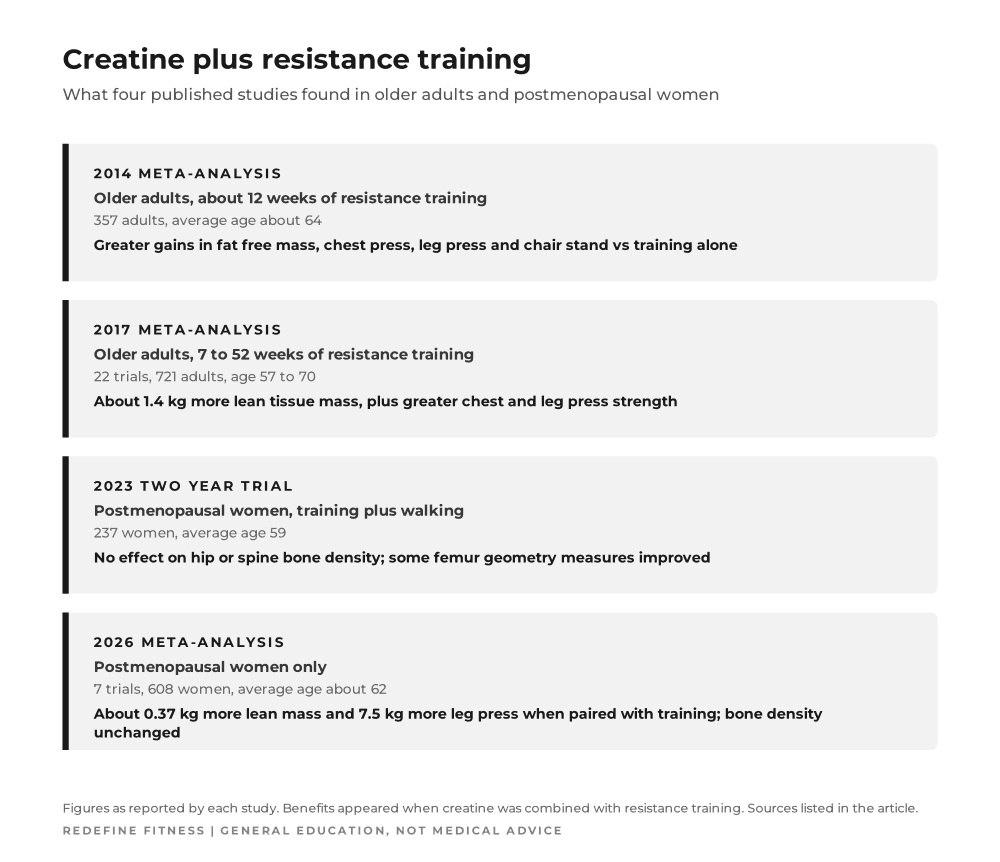
A 2014 meta-analysis in Medicine and Science in Sports and Exercise pooled placebo controlled trials of older adults, average age about 64, who did resistance training with either creatine or a placebo for an average of about 12 weeks. The creatine groups gained more fat free mass and more chest press and leg press strength than training alone, and did better on a 30 second chair stand test. Fat mass did not differ between groups. The authors called the results encouraging and noted that more studies were needed.
A larger 2017 meta-analysis followed with 22 randomized trials and 721 participants, mean age 57 to 70 across studies, training two to three days a week for 7 to 52 weeks. Creatine during resistance training produced about 1.4 kg more lean tissue mass than training with a placebo, along with greater gains in chest press and leg press strength.
Postmenopausal women specifically
The most relevant evidence for women over 40 is newer. A 2026 systematic review and meta-analysis in the Journal of the International Society of Sports Nutrition looked only at randomized, placebo controlled trials in postmenopausal women: seven trials, 608 women, mean age about 62, lasting 12 to 104 weeks.
The findings were honest and useful:
- Lean mass favored creatine, by a small margin of about 0.37 kg.
- Leg press strength improved more with creatine, by about 7.5 kg, in the three trials that measured it.
- The benefit showed up when creatine was combined with resistance training. Trials using low doses without resistance training showed no measurable effect.
- Bone density did not change overall.
- Side effects were mild and similar to placebo, and kidney markers were unchanged.
The authors described the gains as small but meaningful. That is the right way to read them. Creatine is a margin, not a shortcut.
What creatine does not do
Good evidence also tells you where the limits are.
It does not replace training. Every meaningful result above came from people who were lifting. Without a progressive resistance program, there is little reason to expect a benefit.
It has not been shown to improve bone density. The largest single trial, a two year randomized study of 237 postmenopausal women published in 2023, found no effect of creatine on bone mineral density at the hip or spine compared with placebo, even with resistance training three days a week and regular walking. It did report favorable changes in some measures of femur geometry and a faster walking time, but if bone density is your concern, creatine is not the answer. Loading your skeleton through training, adequate calcium, vitamin D and protein, and a conversation with your physician are.
It is not a weight loss supplement. Early on, some people see the scale rise slightly because creatine draws water into muscle cells. That is not fat gain, and the meta-analyses above found no increase in fat mass.
It is not a hormone and does not act like one. Creatine is not an anabolic steroid, a point the International Society of Sports Nutrition addressed directly in its 2021 review of common misconceptions.
Why training is the real engine
At Redefine Fitness, our training is built on a small set of exercise science principles that explain why creatine only works when the training does.
Progressive overload. Muscle adapts to the demand placed on it. For adaptation to continue, the stimulus has to increase over time, by adjusting frequency, intensity, time or type of training. Creatine may let you complete a little more work at a given load, which is only useful if the program is designed to keep asking for more.
Supercompensation. A hard session temporarily drops your capacity below baseline. With enough recovery, the body adapts and rebuilds slightly above where it started. The program’s job is to apply enough stress to trigger that adaptation without tipping into exhaustion. Supplements do not change that balance. Sleep, nutrition and smart programming do.
Individuality. No two people respond to the same stimulus the same way. Some people respond to creatine more than others, and many factors, including diet, training history and health conditions, shape the result. That is why we build every plan from your health history instead of a template.
Reversibility. Adaptations fade when they are not maintained. Starting creatine and stopping training will not hold your progress. Consistency will.
If you want the deeper version, we explain these principles in our guides to progressive overload and recovery and supercompensation.
Safety, and who should ask first
Creatine monohydrate has one of the larger safety records in sports nutrition. The International Society of Sports Nutrition’s position stand and its later review conclude that it is generally well tolerated at the doses commonly studied, and the 2026 review in postmenopausal women found adverse events similar to placebo with unchanged kidney markers.
That said, “generally well tolerated in healthy adults” is not the same as “right for you.” Talk with your physician before starting creatine if any of these apply:
- You have kidney disease, reduced kidney function, or a history of kidney problems.
- You take medications that affect the kidneys, or several prescription medications.
- You have diabetes, liver disease, or another chronic condition you are managing with a care team.
- You are pregnant, trying to become pregnant, or breastfeeding.
One practical note: creatine can raise blood creatinine, a lab value used to estimate kidney function, even when the kidneys are working normally. If you take it, tell your physician so your lab results are read in context.
What about dosing?
The International Society of Sports Nutrition’s 2021 review describes the commonly recommended dose as 3 to 5 grams per day, or about 0.1 g per kilogram of body weight per day, and notes that a loading phase is not required. In the postmenopausal trials, benefits were seen when at least 5 grams a day was paired with resistance training.
Those are the doses that were studied, not a prescription. Your physician should confirm whether creatine is appropriate for you, and if you train with us, our Registered Dietitian can help you decide how it fits into the rest of your nutrition plan. Creatine monohydrate is the form with the strongest evidence; if you have questions about a specific product, ask your Fitness Specialist or our Registered Dietitian.
The order of priorities
If you are a woman over 40 and your goal is to keep your strength for the next 30 years, this is the order that the evidence supports:
- A progressive resistance training program, two to three days a week, built around the major movement patterns.
- Enough total protein, spread across your meals.
- Sleep and recovery that let you adapt to the work.
- Then, and only then, a supplement like creatine, cleared by your physician, to add a small margin to the work you are already doing.
For more on training through this stage of life, read our guide to strength training through menopause.
How Redefine Fitness approaches it
Redefine Fitness is a medical fitness company, not a gym. Every client trains privately, one on one, with a Fitness Specialist, on a plan built from their health history. A Registered Dietitian is on the plan, and a Nurse Practitioner Clinical Advisor stands behind our standards. We work alongside your physician, not instead of them.
We have two private studios on Long Island, in Mount Sinai at 271 Route 25A and in Stony Brook at 1113 North Country Road. January spots are limited at each studio.
If you want a program that builds muscle first and treats supplements as the margin they are, start with a conversation. Book Your Complimentary Consultation.
Common questions
Is creatine safe for women over 40?
In healthy adults, creatine monohydrate is generally well tolerated at commonly studied doses, and a 2026 review of trials in postmenopausal women found side effects similar to placebo with no change in kidney markers. If you have kidney disease, take several medications, or manage a chronic condition, ask your physician before starting.
Does creatine help with menopause?
Creatine does not change menopause itself. In postmenopausal women who also did resistance training, it produced small additional gains in lean mass and leg strength. It has not been shown to improve bone density.
Will creatine make me gain weight?
Some people see a small rise on the scale early on because creatine pulls water into muscle. Studies in older adults found no increase in fat mass.
Do I need to lift weights for creatine to work?
Yes, based on the current evidence. The benefits in older adults and postmenopausal women appeared when creatine was combined with resistance training. Trials without training showed no measurable effect.
Sources
- Naddafha S, et al. Creatine monohydrate for lean mass, strength, and bone density in postmenopausal women: a systematic review and meta-analysis. J Int Soc Sports Nutr. 2026.
- Chilibeck PD, et al. A 2-yr randomized controlled trial on creatine supplementation during exercise for postmenopausal bone health. Med Sci Sports Exerc. 2023.
- Chilibeck PD, et al. Effect of creatine supplementation during resistance training on lean tissue mass and muscular strength in older adults: a meta-analysis. Open Access J Sports Med. 2017.
- Devries MC, Phillips SM. Creatine supplementation during resistance training in older adults: a meta-analysis. Med Sci Sports Exerc. 2014.
- Antonio J, et al. Common questions and misconceptions about creatine supplementation: what does the scientific evidence really show? J Int Soc Sports Nutr. 2021.
- Kreider RB, et al. International Society of Sports Nutrition position stand: safety and efficacy of creatine supplementation in exercise, sport, and medicine. J Int Soc Sports Nutr. 2017.
- Smith-Ryan AE, et al. Creatine supplementation in women’s health: a lifespan perspective. Nutrients. 2021.
This article is general education and is not medical advice. Redefine Fitness does not diagnose, treat, or prescribe. Talk with your physician before starting any supplement or exercise program, especially if you have a medical condition or take medications.