Most people expect to gain five pounds between Thanksgiving and New Year’s Day. The research says the real number is smaller, and that is not the good news it sounds like. The pound most adults do gain over the holidays tends to stay, and over the years it adds up.
This guide covers what the studies actually measured, why the holidays matter more for adults over 40, and how to hold your strength and your habits through a busy season without white knuckling it. It is general education. It is not medical advice, and it works alongside your healthcare providers, not instead of them.
What the research actually measured
The study behind most holiday weight headlines was published in the New England Journal of Medicine in 2000. Researchers at the National Institutes of Health weighed 195 adults four times: in early fall, in mid November, in January, and again in late February or March.
Here is what they found:
- Before the holidays (October to mid November), average weight barely moved: about 0.18 kg, which was not statistically meaningful.
- During the holidays (mid November to January), average weight rose about 0.37 kg, a little under one pound. That change was statistically significant.
- After the holidays (January to March), weight did not come back down. The average change was a loss of only 0.07 kg.
- The following fall, the 165 people who came back had not lost it either.
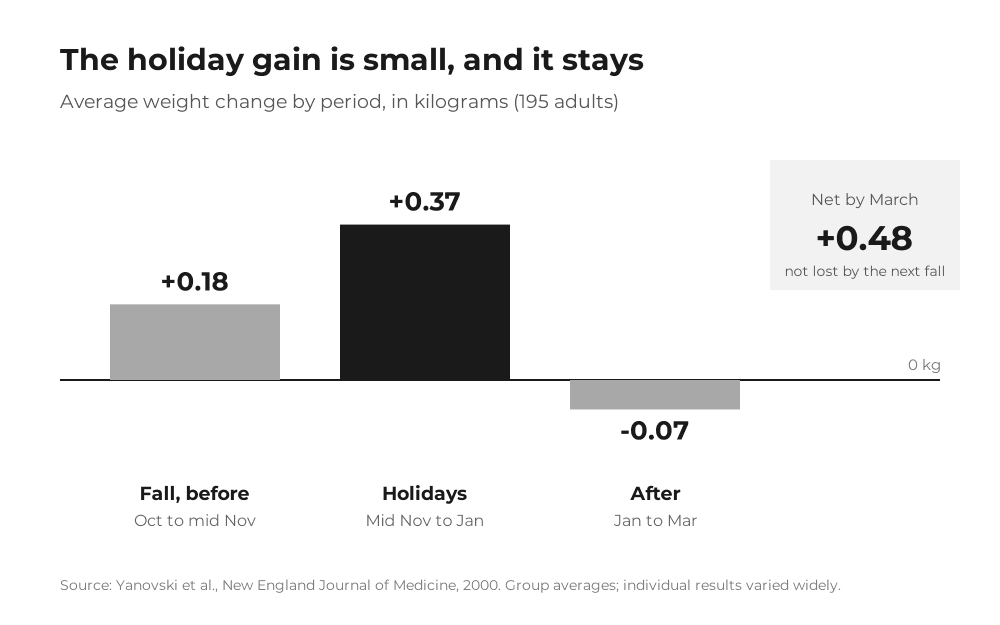
So the five pound story is a myth. But the real finding is more important: in this study, more than half of the weight gained across the whole year arrived between mid November and January, and it was not lost in spring. The authors concluded that this small holiday gain probably contributes to the slow weight gain many people see across adulthood.
Two honest limits. The participants were a convenience sample, not a nationally representative group, so they are not a perfect picture of everyone. And averages hide a wide range: some people gained a lot more than a pound. A later review of holiday studies in adults found gains of roughly 0.4 to 0.9 kg across the season, consistent with the original finding.
Why the holidays matter more after 40
A pound a year does not sound like much. Over ten holiday seasons it is ten pounds that never had a reason to arrive. For women in their 40s and 50s, the timing is worse, because two slow trends are already running in the background.
The first is muscle. Adults lose muscle gradually with age unless they train it, and muscle is the tissue that does much of the work of moving you, stabilizing your joints, and handling blood sugar after a meal. The second is the menopause transition. Mayo Clinic notes that weight gain often starts in perimenopause and continues at about a pound and a half a year through the 50s.
Put those together with weeks of skipped sessions and richer food, and the holiday season becomes the part of the year where the slide is fastest. That is why we treat it as a training block with its own plan, not a pause.
The real risk is stopping, not the cookies
Every training program rests on a few principles. One of them is reversibility: the adaptations you built start to fade if they are not purposefully maintained. Strength, balance, and work capacity are all on that list.
The good news is that maintaining is far cheaper than building. A 2021 review in the Journal of Strength and Conditioning Research looked at the minimum dose of exercise needed to hold on to strength and fitness when time gets tight. Its main conclusion was that intensity is the variable that matters most. You can cut how often you train and how much you do, as long as the work you keep is still challenging.
For older adults, the review suggests that holding muscle size may take up to two strength sessions a week with two to three hard sets per exercise. That is a realistic target for a busy December.
How to hold your ground through the holidays
The FITT principle gives you four levers: frequency, intensity, time, and type. During the holidays, pull the ones you can afford to pull and protect the one you cannot.
- Protect intensity. Keep the loads that challenge you. A shorter session at the right effort beats a long session at half effort. Your Fitness Specialist uses cues like the speed of each rep and your breathing to keep that effort honest without pushing into pain.
- Trim time before you trim days. A 30 minute session built around the big movement patterns (squat, hinge, push, pull, carry) covers most of what matters. Put compound movements first so the important work gets done before you run out of time or energy.
- Set a floor of two days a week. Put them on the calendar now, before the invitations arrive. Treat them like an appointment you would not cancel.
- Weigh yourself regularly. In a 2018 randomized trial published in The BMJ, adults who weighed themselves regularly and received simple holiday strategies finished the season about half a kilogram lighter than a comparison group that only got a healthy living leaflet. The difference was modest, but it was real, and it cost almost nothing.
- Walk after the big meals. A short walk after a large meal is an easy way to add movement on days when a full session will not happen.
- Keep protein at each meal and keep an eye on drinks. This is general best practice rather than a prescription. If you have diabetes, kidney disease, or another condition that affects how you eat, your plan should come from your physician and a Registered Dietitian.
None of this asks you to skip the parties. It asks you to decide in advance what stays non negotiable.
What a holiday block looks like at Redefine
Every client at our Mount Sinai and Stony Brook studios trains privately, one on one, on a plan built from their health history. In a holiday block, the plan does not disappear. It gets shorter and more focused.
- Sessions are built around the movements you need most, with intensity kept where it produces results.
- Progress is checked against a measured baseline, not against how you feel on a busy week.
- Your Registered Dietitian adjusts the nutrition side of the plan for real holiday weeks, not ideal ones.
- When a condition or medication changes what is safe, we work alongside your care team.
For more on why strength matters at this stage of life, read our guides to strength training through menopause and strength training after 55. For the training science behind the advice above, see progressive overload explained and recovery and adaptation explained.
Start before January does
Most people wait until January to start. By then the holiday pound is already on the scale, and the studios are at their busiest. We hold a limited number of January spots at each location, and people who start planning now get first choice.
Shopping for someone else? Our personal training gift cards are good for any service, including training, stretch, sauna and nutrition, and they never expire.
Book your complimentary consultation. We will talk through your goals, your history, and what a structured plan would look like for you, at our Mount Sinai or Stony Brook studio. No pressure, no obligation. Book a Consultation.
Common questions
How much weight do people really gain over the holidays?
Less than most people think. In the NIH study published in the New England Journal of Medicine, adults gained about 0.37 kg, a little under one pound, between mid November and January. Reviews of later studies report roughly 0.4 to 0.9 kg. The concern is not the size of the gain but that it usually is not lost afterward.
Can I keep my strength if I train less over the holidays?
Usually, yes, if the work you keep is challenging. Research on maintenance training suggests that intensity matters most, and that older adults may need up to two strength sessions a week with two to three hard sets per exercise to hold muscle. Shorter, focused sessions are a reasonable plan for a busy season.
Is it better to pause training until January?
No. Fitness adaptations reverse when they are not maintained, and restarting from a lower baseline takes longer than holding on. Two short sessions a week through the holidays keeps you closer to where you were.
Should I diet through the holidays?
A strict diet tends to fail during the busiest social weeks of the year. Simple habits, like regular self weighing, protein at each meal, and watching drinks, have better evidence behind them. If you have a medical condition that affects your nutrition, get your plan from your physician and a Registered Dietitian.
Sources
- Yanovski JA et al. A prospective study of holiday weight gain. New England Journal of Medicine, 2000
- Díaz Zavala RG et al. Effect of the holiday season on weight gain: a narrative review. Journal of Obesity, 2017
- Mason F et al. Effectiveness of a brief behavioural intervention to prevent weight gain over the Christmas holiday period: randomised controlled trial. The BMJ, 2018
- Spiering BA et al. Maintaining physical performance: the minimal dose of exercise needed to preserve endurance and strength over time. Journal of Strength and Conditioning Research, 2021
- Mayo Clinic. The reality of menopause weight gain
This article is general education. It is not medical advice and not a substitute for diagnosis or treatment by your physician.