
Most people who start a structured program follow the same arc. The first weeks bring fast, visible change. Then progress slows, and many people conclude that something is wrong with the program or with them. In exercise science, this pattern is expected. It follows a small set of training principles that every well designed program is built around: individuality, specificity, progressive overload, diminishing returns, and reversibility.
Understanding these principles changes how you judge your own progress. It explains why a program that worked for a friend may not suit you, why a plateau is information rather than failure, and why consistency matters more than intensity in any single week. This guide walks through each principle in plain language, the way it is taught in our NY State approved apprenticeship curriculum for Fitness Specialists.
This article is general education. It is not medical advice, and it does not replace guidance from your physician or other healthcare providers. If you have a health condition, build your exercise plan alongside your care team.
Principle 1: Individuality
No two people respond to the same stimulus in the same way. Two adults can follow an identical program for twelve weeks and finish with different results. Genetics, age, sleep, stress, nutrition, training history, and health history all shape the response.
This is the principle that makes a one size fits all plan a weak starting point. A fixed template assumes that everyone has the same recovery capacity, the same movement history, and the same limits. Real people do not. At Redefine Fitness, every program begins with a health history review and a movement screening, because the starting point sets the plan. That is also why our sessions are private and one on one rather than group based: a program can only be individual if the session is.
The practical takeaway for you: stop comparing your rate of progress to anyone else’s. The only useful comparison is your own training log from last month.
Principle 2: Specificity (the SAID Principle)
SAID stands for Specific Adaptations to Imposed Demands. The body adapts to exactly what it is asked to do, and not much else. Ask it to lift heavy loads and it becomes stronger. Ask it to walk long distances at a steady pace and it improves its endurance. Ask it to sit for ten hours a day and it becomes very good at sitting.
That last example is not a joke. The principle works in both directions. A body that is rarely asked to squat, hinge, or carry gradually loses comfort and ability in those patterns. A body that practices them regularly keeps them.
Specificity has a practical rule: the more general your goal, the more general your training should be. Someone who wants to stay strong, mobile, and independent for decades benefits most from a broad base built on the seven foundational movement patterns: squat, hinge, lunge, push, pull, carry, and rotate. As goals become narrower, such as preparing for a specific sport or working around a past injury, training becomes more targeted. Specificity should narrow with purpose, not by accident.
For more on the movement patterns, see our guide to the seven movement patterns.
Principle 3: Progressive Overload
For the body to keep adapting, the demand placed on it has to increase over time. If you lift the same weight for the same repetitions for a year, your body has no reason to change. Overload does not mean maximum effort. It means a gradual, planned increase in challenge that stays within what you can recover from.
The standard way to organize that increase is the FITT framework, which gives four levers to adjust:
- Frequency: how often you train a given pattern or muscle group.
- Intensity: how heavy, how fast, or how demanding the work is.
- Time: how long the session, set, or hold lasts.
- Type: which exercise or variation you use, such as moving from a supported version to an unsupported one.
Changing one lever at a time keeps progress measurable and manageable. Our Fitness Specialists read three practical cues to decide when to progress and when to back off. The first is the speed of the lifting phase of a rep. If the weight moves up quickly and smoothly, the load is probably ready to increase. If it crawls, the load is probably too high for that day. The second is visible muscle shake: when someone is shaking and fighting for every rep, that is a signal to regress. The third is breathing: if you can hold a conversation easily between efforts, the work may be too light to drive change.
The guiding rule is simple. Progress to get better, regress to stay safe. To go deeper, read our explainer on progressive overload.
Principle 4: Diminishing Returns
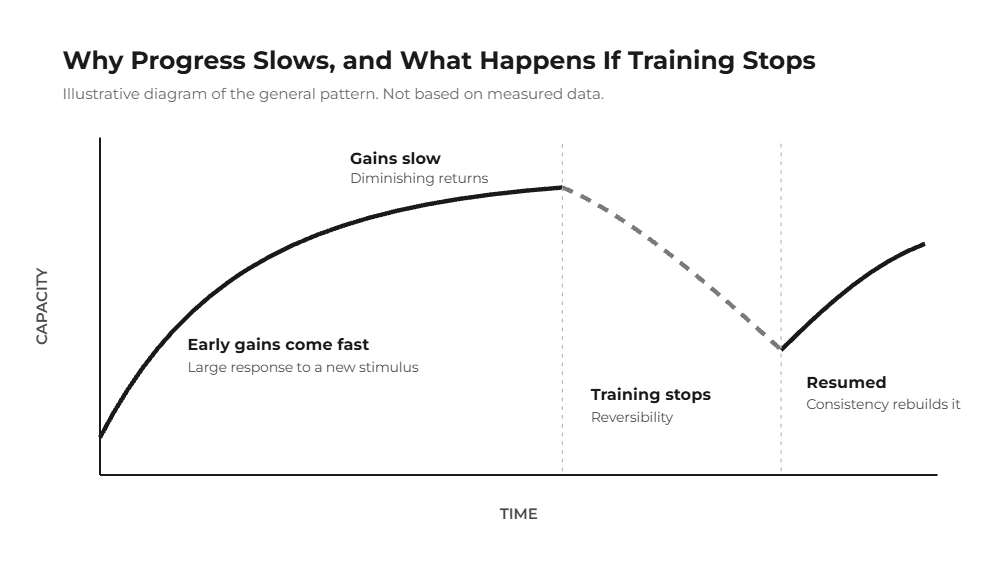
As you get closer to your current potential, the rate of progress slows. This is the principle that catches most people off guard. A new client may add meaningful strength in the first several weeks, partly because the nervous system quickly learns to use muscle more efficiently. Later, the same effort produces smaller visible changes.
This is not a sign that training has stopped working. It is a sign that your body has already adapted to much of what it was asked to do. The trajectory is a curve that flattens, not a straight line that keeps climbing at the same angle.
Three practical responses are worth knowing:
- Measure over longer windows. Compare months, not days. Week to week noise hides real progress.
- Track more than one outcome. Strength, balance, walking tolerance, sleep, and how daily tasks feel all matter, and they do not all plateau at the same time.
- Change a lever deliberately. When progress stalls, use the FITT levers above rather than simply adding more of the same work.
Recovery is part of this picture too. The body adapts during the rest period after training, not during the session itself, which is why overloading without recovery tends to backfire. We cover that process in our guide to recovery and supercompensation.
Principle 5: Reversibility
Adaptations are maintained only while the demand continues. If training stops or drops sharply, the body gradually returns toward its earlier baseline. This is sometimes summarized as “use it or lose it,” though the reality is more gradual than that phrase suggests.
Reversibility is the principle behind a familiar story: a person trains consistently, takes a long break because of travel, illness, or a busy season, and finds the first session back harder than expected. That is normal. The encouraging side is that the body usually responds quickly when training resumes, as the diagram above illustrates.
It also explains why a maintenance mindset has real value. Training does not have to be maximal every week to hold on to what you have built. A smaller, consistent dose often preserves more than an ambitious plan that gets abandoned after three weeks. This matters even more as we age. Our guide to strength training after 55 goes deeper on keeping capacity for the long term.
Putting the Five Principles Together
These principles work as a system rather than as separate rules. Individuality tells you where to start. Specificity tells you what to practice. Progressive overload tells you how to keep moving forward. Diminishing returns tells you what to expect and when to adjust. Reversibility tells you why showing up regularly is the single most reliable lever you control.
A useful way to apply them is to ask five questions every few weeks:
- Is this plan built around my history, schedule, and limits, or around someone else’s?
- Does my training match what I actually want to be able to do?
- Which FITT lever did I last change, and what happened?
- Am I judging progress over a window long enough to see it?
- If I had to hold this schedule for another year, could I?
That last question matters most. The best program is the one you can sustain.
Common Mistakes
Changing everything at once. Adjusting frequency, load, and exercise selection in the same week makes it impossible to know what worked.
Treating a plateau as a verdict. A plateau usually means the current stimulus has been absorbed. It calls for a planned change, not for quitting.
Copying another person’s program. It ignores individuality. A plan that suits a twenty five year old athlete may be a poor fit for a person managing joint pain or returning after surgery.
Skipping the unglamorous basics. Warm ups, recovery, and sleep rarely feel like training, yet they decide whether the other principles can work. See our guide to the RAMP warm up for a clear structure.
How This Looks Inside a Medical Fitness Program
Redefine Fitness is a medical fitness company, not a gym. Every client trains privately, one on one, with a Fitness Specialist, on a program built from their health history. A Registered Dietitian is part of the plan, and a Nurse Practitioner serves as Clinical Advisor behind our standards. Our approach is done with you, at a done for you standard: you do the work, and the planning, progression, and adjustments are handled for you.
In practice, that means the five principles are applied for you in each session. Your Fitness Specialist reads the cues, chooses which lever to adjust, and keeps the plan moving as your body adapts, so you are not guessing. Our work is always intended to complement your healthcare providers, never replace them. You can learn more about our services, or visit either Long Island studio: Mount Sinai or Stony Brook.
Key Takeaways
- Fast early progress followed by a slowdown is the normal pattern, not a problem.
- Your body adapts to what you repeatedly ask of it, so train the patterns you want to keep.
- Progress by changing one FITT lever at a time and watching the cues.
- Consistency protects what you have built, and a smaller steady plan beats a perfect plan you abandon.
- Work with your healthcare providers when you have a health condition, and let your exercise plan support that care.
If you would like a plan built around your history rather than a template, we would be glad to talk.
Book Your Complimentary Consultation
This article is for general education only and is not medical advice. Always consult your physician before beginning an exercise program.