Most people treat the warm up as a formality. A few minutes on a bike, a couple of arm circles, then straight to the heavy work. In exercise science, it is closer to the opposite: the warm up is the part of the session that decides how safely and how well the rest of it goes. It is also the part most often skipped when time runs short, which is exactly when it matters.
This guide explains what a warm up is actually meant to do, the four stage framework known as RAMP, how dynamic and static stretching differ, and how to build a short, repeatable routine around the seven basic movement patterns. It is general education, not individual medical advice, and it is designed to work alongside your care team, not instead of them.
Why a Warm Up Exists at All
A warm up has one job: move your body from resting state to ready state. At rest, heart rate is low, muscle and connective tissue are relatively stiff, and the nervous system is not primed to recruit muscle quickly. Loaded movement from that starting point asks tissues to do more than they are prepared for.
A well built warm up addresses three things in sequence. It raises circulation and body temperature so muscle tissue is more pliable. It moves the joints you are about to load through the range of motion the session will require. And it rehearses the movement itself, with light resistance, so the nervous system has already practiced the pattern before the work gets heavy.
This connects directly to a principle covered in our guide to progressive overload: training works by applying a stress the body can recover from and adapt to. A warm up does not add training stimulus. It protects your ability to apply that stimulus well.
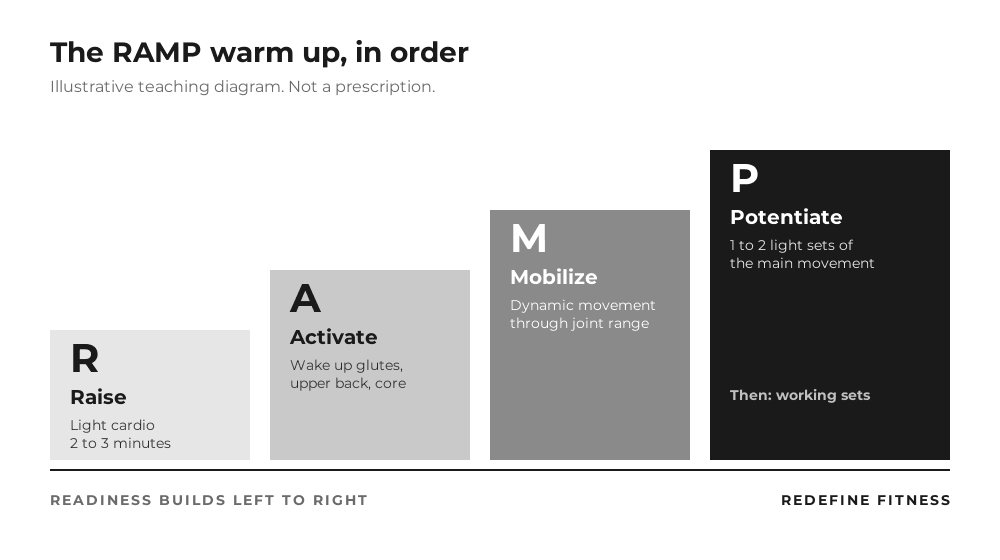
The RAMP Framework: Four Stages
RAMP stands for Raise, Activate and Mobilize, Potentiate. It gives the warm up a logical order instead of a random collection of stretches. Each stage has a distinct purpose.
R: Raise
Begin with a few minutes of light cardio, such as an easy walk, a stationary bike, or a treadmill at a conversational pace. The goal is to lift your heart rate and breathing gradually, increase blood flow to working muscle, and bring body temperature up. This is not conditioning. If you are breathing hard before the session starts, you have done too much.
A and M: Activate and Mobilize
Next, prepare the specific muscles and joints the session will use. Activation means waking up muscle groups that tend to be underused, such as the glutes and the muscles around the shoulder blades, with simple controlled movements. Mobilization means moving joints through their available range of motion with dynamic stretches and, where appropriate, light myofascial release using a ball or foam roller.
Rhythmic rolling over broad muscle groups like the quads, hamstrings, and calves encourages circulation. For a specific tight spot, steady pressure held for roughly 30 to 90 seconds, until the tissue feels like it softens, is a common approach. Around any area of nerve sensitivity, the goal is never to press directly on it. If something produces sharp, radiating, or numb sensations, stop and raise it with your care team.
P: Potentiate
This is the stage most often skipped, and the one worth protecting most. Potentiation means performing one or two light sets of the main lift or movement you are about to train, at a fraction of the working load. Think of an empty bar or a light dumbbell before your first real set.
Why does it matter? Going from zero straight to a demanding load asks muscle and tendon to absorb force they have not yet felt that day. A light rehearsal set lets your nervous system practice the pattern, find the groove, and recruit muscle more efficiently when the load rises. If you can only keep one stage on a rushed day, keep this one.
Dynamic or Static: The Right Stretch at the Right Time
Stretching is not one thing. Exercise science separates it into types, and each has a place.
- Dynamic stretching is movement based, with no held positions. Leg swings, hip circles, high knees, and shoulder circles are common examples. It improves active range of motion, the range you can reach under your own muscle control.
- Static stretching holds an end range position, typically for 10 to 60 seconds. It can improve passive range of motion, the range you reach with help from gravity, a strap, or a partner.
- Ballistic stretching uses momentum to carry a joint past its usual range. It carries more risk and is best reserved for experienced athletes under direction.
- PNF stretching (proprioceptive neuromuscular facilitation) alternates contracting and relaxing a muscle against resistance to reach a deeper position, usually with a partner or prop.
The practical rule is simple. Before training, favor active range of motion: dynamic movement, light release work, and no extended holds. Lengthening a muscle well beyond its normal range right before loading it is not what the session needs. After training, passive work is a better fit: static holds, PNF, and release work, because the heavy lifting is done and the goal shifts toward comfort and long term range.
Why Range of Motion Matters Beyond the Gym
Range of motion is not a flexibility contest. It is access to the positions daily life asks of you: reaching a high shelf, getting down to the floor and back up, bending to put on shoes, turning to look behind you while driving.
When a joint is restricted, the body finds another way to complete the task. It borrows motion from a neighboring joint, shifts weight, or rotates somewhere it normally would not. These workarounds are less efficient and place unusual demands on tissue that was not designed for them. Over time, the workaround becomes the habit.
There is also a safety case for moving through full, comfortable range regularly. Everyone eventually ends up in an awkward position by accident, such as a misstep on a curb or a slip on a wet floor. A body that has visited a wide range of positions before is better prepared for that moment than one that has not.
A Simple Warm Up Built on the Seven Movement Patterns
Nearly every training session draws on seven basic patterns: squat, hinge, lunge, push, pull, carry, and rotate. A repeatable warm up built from these patterns takes the guesswork out, because you rehearse what the day will use. Here is a template that takes roughly five minutes and fits most sessions.
- Raise (2 to 3 minutes): easy walking or a stationary bike, finishing with a slightly quicker pace.
- Hip and trunk (about 1 minute): leg swings front to back and side to side, holding a wall or rail if needed, then slow hip circles.
- Squat and hinge (about 1 minute): a few bodyweight squats to a comfortable depth, then a hip hinge with a light stick or broomstick along the spine, feeling the hips travel back.
- Push and pull (about 1 minute): arm circles, a wall push up, and a band pull apart or a rowing motion with a light band.
- Rotate (about 30 seconds): slow, controlled trunk rotations, hips facing forward.
- Potentiate (1 to 2 sets): your first exercise of the day at a light load for 5 to 8 easy repetitions.
If your session has a different focus, shorten what does not apply and add more of what does. A day built around pulling movements deserves extra shoulder blade and upper back preparation. A leg day deserves more time on the hips and ankles.
Adjusting the Warm Up for Your Situation
The framework stays the same across people. The details change.
Older adults often benefit from a longer Raise stage and a gentler pace, with more attention to ankle, hip, and shoulder mobility. Our guide to senior strength training after 55 covers how priorities shift with age. People managing joint conditions may need to avoid certain positions or depths, and the right modifications should come from your care team. Anyone returning from surgery or injury should follow the clearance and limits their provider has set before applying any general routine.
What About the Cool Down?
A cool down has a different purpose. It helps bring heart rate down gradually, regulates blood pressure after effort, and gives you a window for passive work. A slow walk followed by gentle static stretching or release work is a sound approach.
Be honest about its value, though. If the session was light, a long cool down adds little. When time is limited, it is often a better use of those last minutes to finish with a bit more effort or a short core block than to rush through a token stretch. The warm up is the stage you protect.
How We Approach It at Redefine Fitness
At Redefine Fitness, every session at our Mount Sinai and Stony Brook studios begins with a warm up built on the same logic described here, adjusted to the person in front of us. Your Fitness Specialist asks how you feel that day, notes what is sore or tight, and uses that to shape the first circuit while you move. Programming starts from your health history and movement screening, not from a template.
Training is private, one on one, and designed to work alongside your physician and other providers. If you want to see how your own movement looks before you build a routine, the Biometric Analysis and Movement Screening is where we start. You can also find your studio in Mount Sinai or Stony Brook.
The Takeaway
A good warm up is short, ordered, and specific: raise the body gradually, prepare the joints and muscles you are about to use, and rehearse the main movement at a light load. Keep it active before training and save the long holds for afterward. If you do nothing else, protect the potentiation set.
This article is general fitness education and is not medical advice. Check with your healthcare provider before starting or changing an exercise program, especially if you have a health condition or are recovering from surgery or injury.
Book your 15 minute call. We build the plan from your health history, at our Mount Sinai or Stony Brook studio. Book Your Call