Most people think progress happens in the gym. In exercise science, that is only half true. The session is the stimulus. The improvement happens afterward, during recovery, when the body rebuilds to meet the demand you placed on it. Train without enough recovery and the plan stalls. Recover without enough training and nothing changes.
This guide explains how that cycle works, using the general adaptation syndrome framework, the idea of supercompensation, and the training principles that surround them: individuality, specificity, progressive overload, diminishing returns, and reversibility. It also covers how weekly training frequency changes the way rest is planned, and what you can do between sessions to support it. It is general education, not individual medical advice, and it is designed to work alongside your care team, not instead of them.
Training Is a Stress, and Adaptation Is the Response
Every training session is a deliberate stress. You ask muscles, joints, and the nervous system to do more than they are used to. The body responds to that demand by getting better at meeting it. This is the foundation of strength training, and it rests on one idea: adaptation follows stress, but only when there is enough recovery for the adaptation to occur.
Exercise science describes this response with the general adaptation syndrome, or GAS. It has three phases, and understanding them explains almost every training decision about rest, volume, and pacing.
The Three Phases of the Adaptation Cycle
1. Alarm
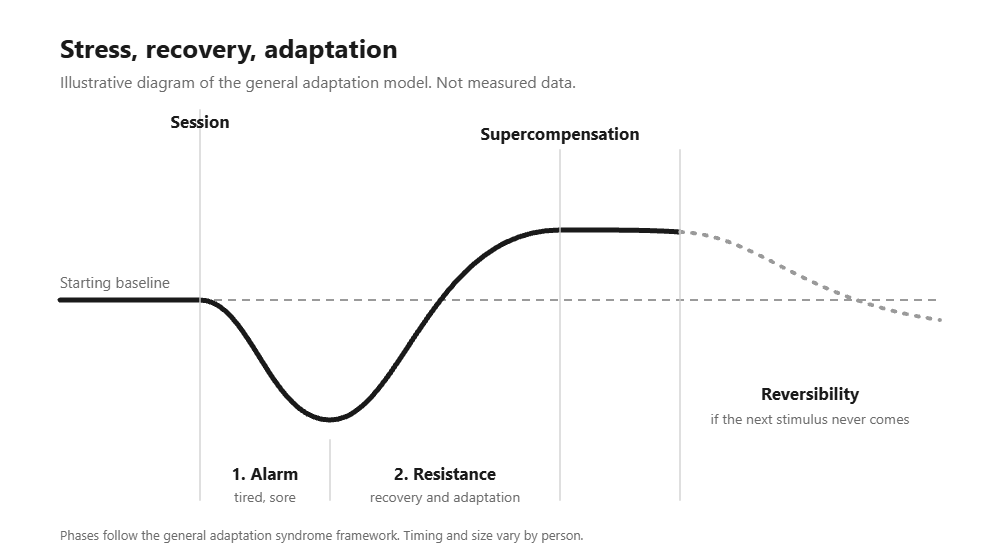
The alarm phase begins when the body meets an imposed demand. Right after a hard session, you sit slightly below your starting performance level. You may be tired, a little sore, and your muscles are worn down. This dip is normal and expected. It is not a sign that something went wrong, and it is not the point where you have gotten stronger. It is simply the cost of the stimulus.
2. Resistance
The resistance phase is the adaptation. With enough time, food, and sleep, the body recovers and rises above where it started. Muscles recover and become more capable, you can work for longer, and the same effort feels more manageable. Exercise science calls adapting above the starting baseline supercompensation. This is the phase every program is built to reach.
3. Exhaustion
The exhaustion phase appears when the body is asked to adapt to more than it can currently handle. Instead of rising above baseline, performance drops below it. Typical signs include persistent soreness, feeling flat or worn down, losing strength instead of gaining it, and a higher chance of irritated joints. Pushing through exhaustion does not produce more adaptation. It usually costs progress.
The Real Job of a Program
The goal of a well designed program is to repeat a cycle: apply a stress, allow the body to recover and adapt, then apply a slightly larger stress. Staying near the edge between resistance and exhaustion is what drives progress, and that progress is not a straight line. Some weeks you will land a little under the demand needed to adapt. Other weeks you will overshoot. Over months, the overall direction is up.
This is why more is not automatically better. Doubling your training volume does not double your results. Past a certain point it pushes you from resistance into exhaustion. The same logic explains why a program that never changes stops working: without a larger demand, there is nothing new for the body to adapt to. Our guide to progressive overload covers how the demand is raised in a controlled way.
Five Principles That Shape Every Response
Exercise science describes a short list of principles that govern how people respond to training. They explain why recovery cannot be one fixed recipe for everyone.
- Individuality. No two people respond to the same stimulus in the same way. Age, training history, sleep, stress, nutrition, and health history all change how much recovery a given session requires.
- Specificity (SAID). The body makes specific adaptations to specific demands. SAID stands for specific adaptations to imposed demands. A body asked to run adapts to running. A body asked to squat adapts to squatting.
- Progressive overload. Demand has to increase over time for adaptation to keep happening. Frequency, intensity, time, and type, known as the FITT levers, are the ways to do it.
- Diminishing returns. As you progress, the rate of progress slows. Beginners improve quickly. Experienced lifters gain more slowly and need more careful programming.
- Reversibility. Adaptations fade if they are not maintained. Take away the stimulus for long enough and the body drifts back toward where it started.
Reversibility is worth a second look because it is the other side of recovery. Rest between sessions builds you up. Rest that stretches into weeks without a stimulus does the opposite. The goal is not maximum rest. It is the right amount of rest, repeated consistently.
How Weekly Frequency Changes the Plan
How you arrange recovery depends heavily on how often you train. As a general framework used in program design:
One to two sessions per week. Full body sessions are the usual approach. Each session covers all of the major movement patterns, so every muscle group is trained about twice a week. Volume per session may be modest, which is fine. A little of everything is better than ignoring key muscle groups and creating imbalances.
Three sessions per week. An upper, lower, full body rotation is a practical option. It still reaches each muscle group about twice a week. The familiar push, pull, legs split trains each area only once a week, which gives more volume per session but gives up the benefit of a second weekly exposure.
Four or more sessions per week. More options open up, including an upper and lower split, a day built around strength, a day built around power, and a dedicated mobility and recovery day. With more sessions, planned lighter days matter more, because the total stress is higher.
None of these is the single correct answer. The best structure depends on your goals, your schedule, your health history, and how you respond. Our guide to the warm up shows how each individual session starts, and the rest of the week is where recovery fits around it.
What Supports Recovery Between Sessions
Recovery is not passive. Several habits meaningfully support the adaptation phase. These are general best practices rather than guide specific prescriptions, and your care team should guide anything tied to a health condition.
Sleep
Sleep is where much of the recovery work happens. Public health guidance for adults is seven or more hours per night. If your sleep is short or broken, your training may need to be lighter until it improves.
Protein and total food intake
Muscle needs raw material to rebuild. Eating enough total food, and spreading protein across the day, supports the resistance phase. If you have a kidney condition, diabetes, or you take medication that affects appetite, ask your physician or a Registered Dietitian what is appropriate for you before changing how much you eat.
Easy movement on off days
Rest days do not have to mean sitting still. A walk, light mobility work, or an easy ride keeps blood moving and joints used to moving, without adding another heavy stress.
How to Tell If You Are Recovering Well
You do not need a lab test to read the cycle. Practical signals include:
- Signs you are adapting: your usual weights feel steadier, you finish sessions with energy to spare, soreness fades within a day or two, and your performance holds or improves from week to week.
- Signs you may be heading toward exhaustion: soreness that lingers for several days, weights that feel heavier than usual for more than a session or two, disrupted sleep, low motivation, and joints that feel irritated rather than simply worked.
Muscle soreness alone is not a good measure of a productive session. You can adapt well without being sore, and you can be very sore without having trained effectively. Look at the trend over several weeks, not a single day.
Progression and regression decisions in a session follow the same logic. A fitness specialist watches cues such as how fast a repetition moves in the lifting phase, whether the muscle starts to shake, and how breathing changes, and adjusts the load accordingly. That is a real time way of keeping you between too little stress and too much.
Adjusting Recovery for Your Situation
The framework is the same across people, but the details change. Older adults often need more time between demanding sessions, and benefit from steady, repeatable training more than occasional hard effort. Our guide to senior strength training after 55 covers how priorities shift with age. Hormonal changes can also change recovery needs, as discussed in our guide to strength training through menopause. People with joint conditions may need extra recovery around the joints involved, as covered in our guide to knee and hip arthritis. Anyone returning from surgery or injury should follow the clearance and limits their provider has set before applying any general plan.
Frequently Asked Questions
How many rest days do I need each week?
There is no single number. Many people do well with at least one to two days a week without hard training, and more if sleep, stress, or age reduce recovery. The better question is whether your performance is steady or rising over several weeks.
What happens if I take a few weeks off?
Because of reversibility, some of your adaptations will fade, and the longer the break the more that happens. Many people regain ground faster than they built it the first time, so a restart at a sensible, lighter level is usually the right approach. Talk with your provider if the break was due to illness or injury.
Should I train through soreness?
Mild muscle soreness is normal and usually fine to train around. Sharp, joint centered, or worsening pain is different, and it is a reason to stop and check with your provider.
See How a Plan Is Built Around You
At Redefine Fitness, every program is private, one on one, and built from your health history, with a Registered Dietitian on the plan and a Nurse Practitioner Clinical Advisor behind our standards. Our curriculum is a New York State approved apprenticeship, and the way we balance stress and recovery is part of it. We work alongside your care team, not in place of it, at our Mount Sinai and Stony Brook studios. See our Mount Sinai and Stony Brook pages for details.
Ready to talk it through? Book your 15 minute call and we will show you how your week could be structured.
Sources
- Physical Activity Guidelines for Americans, 2nd edition, U.S. Department of Health and Human Services
- American College of Sports Medicine Position Stand: Progression Models in Resistance Training for Healthy Adults, Medicine & Science in Sports & Exercise, 2009
- About Sleep, Centers for Disease Control and Prevention