Lower back pain is one of the most common reasons adults pull back from exercise, and for decades the standard advice was rest. Current exercise science points the other way. For most people, a progressive, well supervised strength program is one of the most useful things you can do for a back that aches, provided it is built correctly and works alongside your physician or physical therapist rather than replacing them. This guide walks through the training science we teach our Fitness Specialists through our New York State approved apprenticeship curriculum: why the lumbar spine gets overloaded in the first place, why stability comes before load, and how to progress without flaring things up.
One note before we start: this article is education, not medical advice. If you have an active injury, new symptoms, or an existing diagnosis, your care team leads and we follow their clearance.
Why the Lower Back Gets Overloaded
The lumbar spine, vertebrae L1 through L5, is built differently from the rest of your spine for a reason. These are the largest, bulkiest vertebrae in the body because they have to withstand the pressure and weight of everything above them, with discs between each segment to cushion the load the spine absorbs.
Here is the design problem. The lumbar spine connects what we think of as the upper body and the lower body, so it has to allow rotation, lateral bending, flexion, and extension. At the same time, it lacks the built in stability that other regions enjoy: the thoracic spine is braced by the ribcage and the sacral spine by the pelvis, while the lumbar spine has neither, and it carries the weight of the upper body all day. That combination of high mobility demand, low structural support, and constant load is why the lumbar region is the most frequently injured portion of the spine.
The muscles that manage this region are worth knowing by name. The erector spinae extend the spine, the multifidus provides segmental stability, and the quadratus lumborum handles lateral flexion. Just below, the sacroiliac joint, the most stable synovial joint in the body, barely moves at all. Its small amount of motion exists for shock absorption, transferring the load of the upper body into the lower body like a keystone of a bridge, but inverted.
The practical takeaway: your lower back needs both mobility and stability, and neither shows up by accident. They are trained deliberately.
Stability Before Load
In our curriculum, stability is defined as the body’s ability to resist unwanted motion, and the base we build stability from is the trunk. The mechanism is intra-abdominal pressure: the pressure you hold in your braced core creates a solid fixed point for the muscles in a movement to work from.
The analogy we teach is a water bottle. An open, empty bottle is easy to crush. Seal that same bottle full of air and it becomes remarkably hard to compress. Your trunk works the same way. A proper brace, one that expands your stomach outward into your hands when you place them above your hips, turns your midsection into that sealed bottle. On a loaded movement like a squat or deadlift, that brace is often the difference between a strong, safe repetition and a compromised one.
This is why so much of early core training for people with cranky backs is anti-movement work rather than endless flexion. Exercises like contralateral planks (bird dogs), Pallof holds, supermans, and bridges teach the trunk to resist motion under load, which is exactly the job it performs while you lift, carry, and live. An unstable body is a weak body, and it is often a body in pain. Building the brace first gives everything that follows a foundation.
The Hip Hinge: The Skill That Protects Your Back
Of the fundamental movement patterns we program around, squat, hinge, lunge, push, pull, carry, and rotate, the hinge matters most for back health. A hinge means bending through the hips while the spine holds its position. The alternative, bending through the spine itself, asks the smallest and least supported structures to do the heavy lifting.
The Romanian deadlift is the clearest example: performed with minimal knee bend, the movement is almost pure hip extension. The glutes, hamstrings, and adductor magnus produce the force, while the spinal muscles work isometrically, holding position rather than moving. The back’s job in a well executed hinge is to be a rigid lever, not a hinge itself.
Modern life makes this harder. If you sit most of the day, the common pattern is tight hip flexors paired with weak glutes, and the fix runs in both directions: strengthen the glutes and release the tight hip flexors. Pelvic position matters here too, because the tilt of your pelvis directly alters the curvature of your lumbar spine. Accessory work like hip thrusts, glute bridges, and lateral band walks builds the engine that lets your hips, not your back, do the bending.
How to Load Without Flaring Up
Strength is an adaptation, and adaptations follow rules. Three of them shape every program we write for someone training around a sensitive back.
First, specificity. The SAID principle, specific adaptations to imposed demands, says the body adapts precisely to the stress you give it. Train the brace and the hinge, and the body gets better at bracing and hinging. It cuts the other way as well: avoid all bending and loading, and the body adapts to that too, by becoming less tolerant of it. Reversibility is the formal name for that decline, and it is why total rest so often disappoints.
Second, progressive overload managed through the FITT levers: frequency, intensity, time, and type. Stress must increase over time for adaptation to continue, but intensity is only one dial. For a sensitive back, we often progress frequency or time first and let load climb last.
Third, recovery is where the adaptation actually happens. General adaptation syndrome describes the cycle: a training stress temporarily drops you below baseline (the alarm phase), recovery lifts you above it (the resistance phase, also called supercompensation), and too much stress without recovery tips you into the exhaustion phase, where progress reverses and injury risk climbs. Practically, that means training each muscle group about twice per week with at least 48 hours between sessions for the same muscles, ordering compound movements before isolation work so nothing important is pre-exhausted, and never skipping a proper warm up. We use the RAMP protocol: raise your heart rate, activate and mobilize the working muscles, then potentiate by rehearsing the day’s main movement with light loads before touching anything heavy.
Progress or Regress? Reading the Signals
Knowing when to add weight and when to pull back is the difference between steady progress and a setback, and you do not need lab equipment to make the call. We teach our Fitness Specialists to watch three signals during a set.
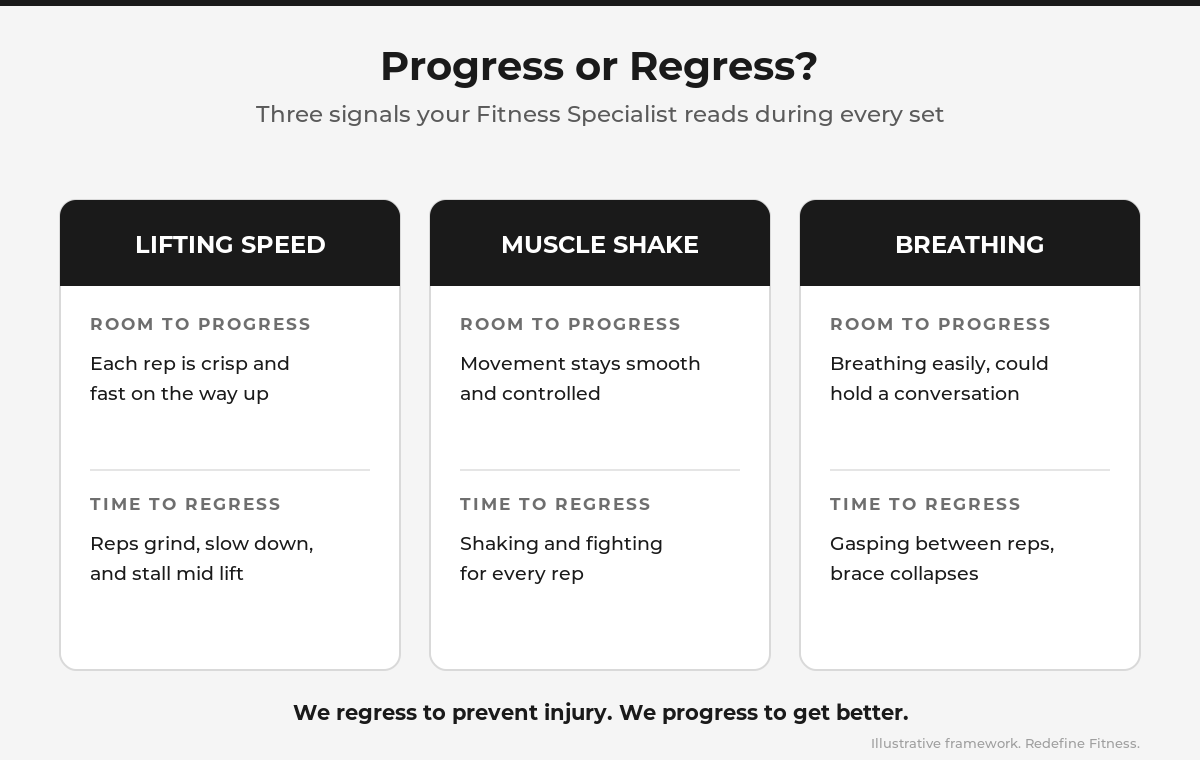
The speed of the lifting portion of each rep: crisp and fast suggests room to progress, grinding and slow suggests it is time to regress. Muscle shake: fighting and shaking through every rep is a regression cue. Breathing: if you can breathe easily and hold a conversation between efforts, you likely have headroom. The rule underneath all three is simple. We regress to prevent injury, and we progress to get better.
Progressions are also earned, not assumed. In our system a client earns the barbell back squat by first owning a goblet squat at the equivalent of the empty bar, and a first deadlift starts light with training plates, with jumps in weight set by how fast and clean the reps look. Small jumps, repeated for months, outrun big jumps that end in a layoff.
Where Your Care Team Comes In
A core rule in our curriculum is blunt: do not work through pain. Discomfort from effort is part of training. Pain that is sharp, radiates down a leg, or comes with numbness, tingling, or weakness is different, and it belongs in front of your physician or physical therapist before it belongs in a gym.
Good fitness professionals know where their lane ends. We do not diagnose, and we do not replace medical care. What we do is coordinate with it: once your provider clears you for exercise, a structured strength program is how you rebuild capacity, confidence, and a back that tolerates real life. Fitness that works alongside your healthcare team beats fitness that pretends to be one.
What This Looks Like at Redefine Fitness
Redefine Fitness is a medical-fitness company, and training around low back pain is close to the center of what we do. Every program starts with a private assessment: how you move, how you brace, how your hips hinge, and what your history and your care team tell us about where the limits are. From there, your Fitness Specialist builds and supervises a fully individual program in a private one on one setting, applying the same principles in this article at the pace your back actually tolerates. No group classes, no templates, no guesswork.
Our Fitness Specialists are trained through our New York State approved apprenticeship curriculum, the same source this article draws from, and you can see the full range of our services here. We train clients at two Long Island studios: Mount Sinai at 271 Route 25A and Stony Brook at 1113 North Country Road.
If your back has been the reason you stopped training, it does not have to stay that way. See if you’re a fit and we will build the plan together.
Working through this yourself? Read the low back pain guide: the direction self test, the daily reset and the red flags.
Common questions
Should you strength train with lower back pain?
Current guidance for non specific low back pain favours staying active and using exercise rather than rest. NICE recommends a group of exercise approaches, including strength and resistance work, as a first line option. What matters is that the programme is built around your presentation and progressed sensibly, not that a particular exercise is avoided forever.
Which exercises are safest for a painful lower back?
There is no universally safe list. The useful question is which direction of movement eases your symptoms and which provokes them, then building the early programme around the easing direction. Loaded carries, hip hinging taught properly, and anti rotation core work are common starting points because they train the trunk to resist movement rather than create it.
When should back pain be seen by a doctor before training?
Before starting, get medical review if you have unexplained weight loss, fever, a history of cancer, bladder or bowel changes, numbness in the saddle area, or progressive weakness in a leg. Those are red flags for conditions outside a training scope of practice.
Does core strength prevent back pain from returning?
Trunk strength and endurance are protective, but so are load tolerance in the hips and legs, general activity levels, and sleep. Programmes that only train the core tend to plateau. The point is a body that tolerates more, not a stronger midsection in isolation.
Sources
- Low back pain and sciatica in over 16s: assessment and management (NG59) — NICE
- Physical Activity Guidelines for Americans, 2nd edition — U.S. Department of Health and Human Services
Educational content from the Redefine Fitness specialist team. Not medical advice, and not a substitute for diagnosis or treatment by your physician.