
The shoulder is the most mobile joint in the body, and that mobility is exactly why it gives so many Long Island adults trouble. A shoulder that catches when you reach overhead, aches at night, or has quietly lost the range to scratch your own back tends to get used less and less. The instinct is to protect it by keeping the arm low and still. Decades of exercise science point the other way. Structured strength work, built around the muscles that stabilize the joint, is one of the most useful things you can do for a cranky shoulder. This guide explains why, using the same training science we teach in our New York State approved Fitness Instructor apprenticeship curriculum.
Why “Just Rest the Shoulder” Backfires
Resting a sore shoulder feels logical, and for a genuinely acute injury it can be the right first step. But prolonged rest sets off a training principle called reversibility: progress begins to regress the moment it stops being maintained. Strength and range of motion that took months to build fade within weeks of disuse. At the shoulder this matters more, not less, because the joint depends on its surrounding muscles for stability far more than a hip or a knee does. Let those muscles weaken and the joint loses the very support system that keeps it centered and safe. Stiffness compounds it, since a shoulder that is not moved through its full range tightens and gets pulled into worse positions.
The honest caveat, straight from our curriculum: some shoulder problems are structural and belong in front of a physician first. A shoulder that dislocates, gives out, or produces sharp catching pain deep in the joint is not a loading problem to push through. Diagnosis comes first, then training works within it.
What Is Happening Inside the Shoulder
To understand a shoulder you have to look at four structures: the scapula (shoulder blade), the clavicle (collarbone), the humerus (upper arm bone), and the rib cage the whole system sits on. The ball and socket itself, called the glenohumeral joint, is remarkably shallow. Where the hip socket is deep and reinforced to carry your body weight, the shoulder socket is more like a golf ball resting on a tee. That design buys enormous range of motion and gives up built in stability in return.
So what holds it together? The joint capsule, filled with synovial fluid that lubricates the joint, the labrum, a ring of cartilage that deepens the socket slightly, and above all the muscles and tendons that surround it. The stars are the four rotator cuff muscles: the supraspinatus, infraspinatus, teres minor, and subscapularis. They originate on the scapula and wrap onto the humerus, actively holding the ball centered in that shallow socket through every reach and rotation. Our curriculum states it plainly: the stability of the shoulder comes from the muscles, the ligaments, and the tendons, and damage to any of those compromises the whole joint.
One more piece is easy to miss. The scapula has to slide and rotate along the rib cage and thoracic spine for the shoulder to move properly overhead. If the mid back is stiff, the shoulder pays for it. That is why we treat the shoulder as a system running from the thoracic spine out to the arm, not an isolated ball and socket.
Strong Muscles Are the Shoulder’s Support System
That anatomy leads directly to the core strategy for an irritable shoulder, and it comes straight from our curriculum: strengthen the muscles that stabilize the joint without piling excessive load onto the joint itself, restore mobility across every direction the shoulder is meant to move, and use soft tissue work such as myofascial release on the tissues that have tightened around it.
Because the socket is so shallow, the rotator cuff and the scapular stabilizers are not optional accessories. They are the suspension system. The better conditioned they are, the more precisely they keep the humeral head centered, and the less the joint surfaces and tendons grind and pinch during ordinary reaching. The supraspinatus, the weakest of the four cuff muscles, runs through a narrow bony corridor called the subacromial space and is especially vulnerable when posture, inflammation, or overuse crowd that space. And the upper traps tend to overwork, hiking the shoulders toward the ears, when the lower traps that should stabilize the scapula are weak. The fix follows a principle we use everywhere: strengthen the underactive muscle, then release and stretch the overactive one.
Common Shoulder Complaints and Their Mechanical Context
Only your physician can diagnose what is happening in your shoulder. What we can explain is the mechanical context, because it shapes how training should look. Three patterns are worth understanding.
Impingement. The subacromial space narrows, often from rounded posture or inflammation, and the structures running through it get pinched. People describe a struggle to lift the arm overhead and a pinch or tingle when they do. The mechanical goal is to depress the humeral head and restore posture: mobilize the joint, stretch the tight lats that round the shoulders forward and shrink that space, and rebuild the scapular control that holds it open.
Shoulder arthritis. Cartilage inside the joint wears down, range of motion becomes restricted, and external rotation in particular gets weak, so reaching behind the back becomes hard. The mechanical approach is to stretch and strengthen without loading the joint excessively, keeping the surrounding muscles strong so the worn surfaces absorb less raw force. Even without a specific diagnosis, that same combination of tight lats, a stiff thoracic spine, and dominant upper traps quietly costs many people their overhead reach.
The Training Principles That Make It Work
A shoulder-friendly program is not a random set of gentle exercises. It is built on the same foundational principles as any well designed program. Five matter most here.
Individuality. No two shoulders respond to the same stimulus identically. Two people with the same diagnosis on paper can need very different programs, which is why assessment comes before exercise selection.
Specificity. The body makes specific adaptations to specific stressors, a principle known as SAID: specific adaptations to imposed demands. If the goal is confident overhead reaching and stable carrying, training has to load those patterns at tolerable intensities rather than avoiding them.
Progressive overload. Stressors must increase over time for adaptation to continue. The levers are described by the FITT principle: frequency, intensity, time, and type. With a sensitive shoulder we choose gentler levers first, nudging frequency or time before intensity.
General adaptation syndrome. The body adapts to stress in phases. A session temporarily drops performance below baseline, then recovery lifts it above baseline, an effect often called supercompensation. Push too hard for too long without recovery and the body enters an exhaustion phase: lingering soreness, lost progress, and higher injury risk. Around an irritable shoulder, the job is to create enough stress to adapt without tipping into that third phase.
Diminishing returns and reversibility. Progress slows as you advance and fades if it is not maintained. Both principles argue for consistency over intensity, which is what most touchy shoulders tolerate best.
What a Shoulder-Friendly Strength Session Looks Like
Structure does a lot of the protective work. Here is the session architecture we use, and why each piece is there.
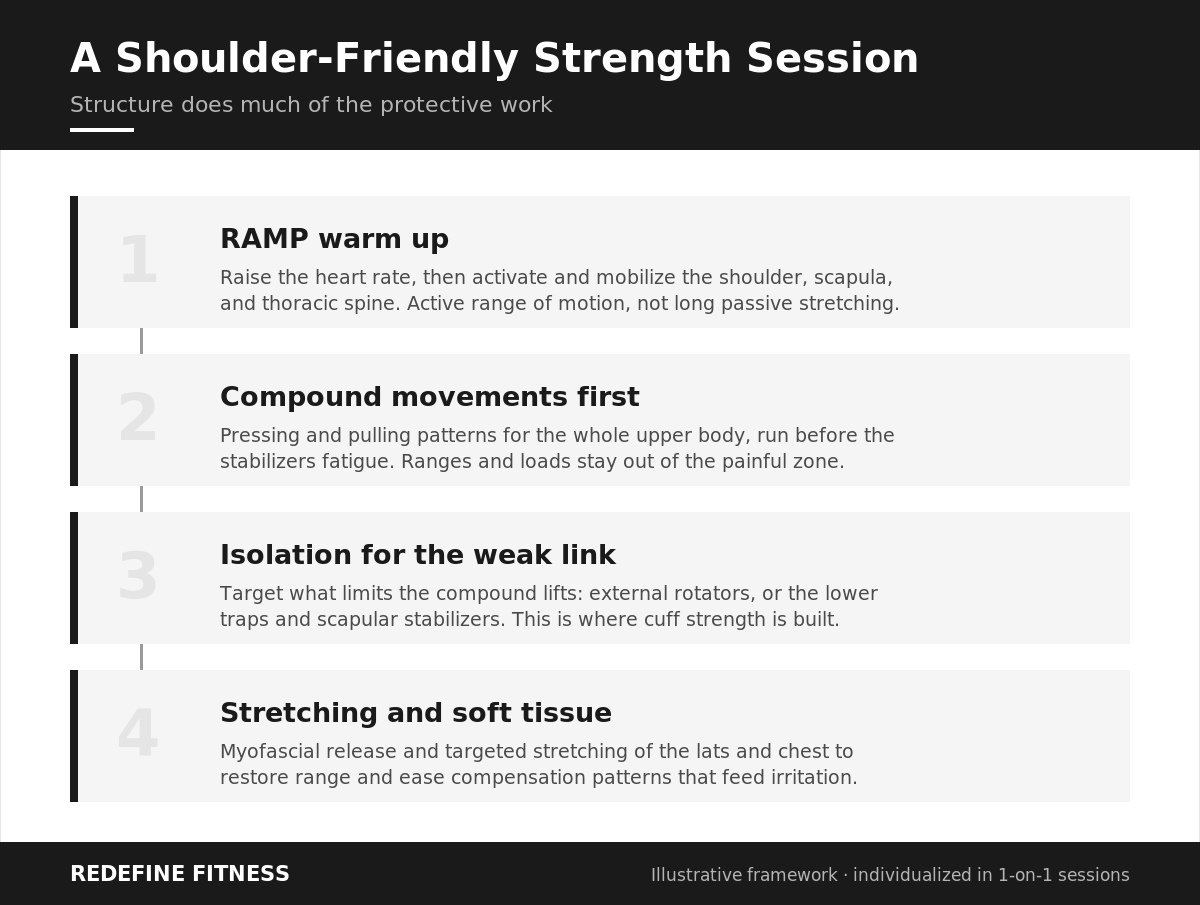
1. A RAMP warm up. Raise, activate and mobilize, potentiate. A few minutes of light cardio to raise the heart rate, then dynamic movement and myofascial release to activate and mobilize the shoulder, scapula, and thoracic spine, then a light set or two of the day’s main movement to potentiate it. Before a session, active range of motion work is preferred over long passive stretching, which can take tissues past their usual range and raise injury risk during the workout.
2. Compound movements first. Compound exercises use several muscle groups at once: pressing and pulling patterns that train the shoulder in the context of the whole upper body. They come first so they are not sabotaged by pre-fatigued stabilizers, which protects both performance and the joint. For a sensitive shoulder we bias toward ranges and angles that stay out of the painful zone and control depth and load rather than chasing maximal weight.
3. Isolation work that targets the weak link. Isolation exercises train one muscle group at a time and should be chosen to improve your compound movements. If external rotation is the limiting factor, the infraspinatus and teres minor get the work. If the scapula drifts and the shoulders hike up, the lower traps and scapular stabilizers do. This is where rotator cuff strength is built deliberately rather than left to chance.
4. Stretching and soft tissue work to finish. Restricted range of motion forces the body into compensation patterns that often feed shoulder irritation. Slow, steady pressure through foam rolling or similar myofascial release, along with targeted stretching of the lats and chest, improves tissue pliability and can reduce pain signaling.
A note on honesty: our curriculum does not prescribe fixed set and rep formulas for shoulder issues, because dosage is individual. As general best practice, not curriculum doctrine, many people do well with two or three upper body sessions per week on nonconsecutive days, and isometric holds are often comfortable when the shoulder is irritable. Your program should be built around your response, not a template.
How to Progress Without Flaring Up
Progression around a sensitive shoulder is a judgment skill, and it is one of the main things a supervised program buys you. We watch objective cues. If the lifting phase of a movement is fast and crisp, it is time to progress. If it grinds on far too long, or the muscles begin to shake, it is time to regress. And we respect a rule that runs throughout our curriculum: stop if there is intense pain. Pushing through sharp shoulder pain is how a manageable issue becomes an injury.
Progression also has to match the goal. For most adults the priority is confident, pain-free range in daily life: lifting a bag into an overhead bin, reaching a top shelf, sleeping without an ache. Progress there means more controlled movement through a gradually larger range at gradually higher loads, not maximal numbers.
Why Assessment Comes First
Because individuality is the first principle, every program should start with an assessment, not a workout. For shoulders, our curriculum looks well beyond the joint itself. We check posture and how the shoulders sit at rest, and we look at thoracic mobility, since a stiff mid back robs the shoulder of the range it needs overhead. We also test external rotation directly: lying on your back, elbows tucked to your sides and hands pointing up, then letting the hands fall toward the floor. A shoulder with healthy range gets the hands nearly to the floor, and a restricted or uneven side tells us where to focus before any load is applied.
This is the difference between a medical-fitness program and a generic workout plan. In our private 1-on-1 sessions, a Fitness Specialist builds the program around what your body actually shows us, done with you, at a done for you standard.
Training Alongside Your Care Team
Strength training for a shoulder is not a replacement for medical care. It works alongside it. Your physician diagnoses and manages the condition. If you have been through physical therapy, we pick up where discharge left off, working within any restrictions you bring us. If you are returning to exercise after surgery or a long layoff, our guide to exercising with joint pain and after joint surgery covers that transition in detail.
Move Better, With a Plan Built for Your Shoulders
A stiff or aching shoulder does not need to be babied into weakness. It needs better movement: assessed first, loaded intelligently, progressed patiently, and coordinated with your care team. That is what we build every day at our Mount Sinai studio at 271 Route 25A and our Stony Brook studio at 1113 North Country Road.
If a shoulder has been quietly shrinking what you can do, start with a conversation. Book Your Call and we will map out what a shoulder-friendly program looks like for you.
Working through this yourself? Read our condition guides.
Common questions
Can you strength train with shoulder pain?
In most cases yes, with modified selection and range. The shoulder tolerates load well when the load respects the range that is currently comfortable. Overhead work is often the first thing to modify and the last thing to return, while horizontal pulling and scapular work usually continue throughout.
What actually causes most shoulder stiffness?
Most non traumatic shoulder complaints in adults relate to how the shoulder blade and thoracic spine move, plus load tolerance in the rotator cuff. Treating the painful spot in isolation rarely holds. Diagnosis belongs to your physician; the training response is about restoring capacity in the system around the joint.
How long does it take to improve shoulder function?
Meaningful improvement in range and comfort usually shows over six to twelve weeks of consistent, progressive work. Strength changes in the rotator cuff follow the same timelines as any other muscle group.
When should shoulder pain be assessed medically first?
Get it looked at before training if you cannot lift the arm at all, if pain followed a fall or dislocation, if there is night pain that wakes you consistently, or if there is numbness or weakness down the arm.
Sources
- Physical Activity Guidelines for Americans, 2nd edition — U.S. Department of Health and Human Services
- 2019 ACR/Arthritis Foundation Guideline for the Management of Osteoarthritis of the Hand, Hip, and Knee
Educational content from the Redefine Fitness specialist team. Not medical advice, and not a substitute for diagnosis or treatment by your physician.