If you are living with Type 2 diabetes or have been told your blood sugar is creeping toward prediabetes, you have almost certainly been told to exercise. What you were probably not told is which kind of exercise, and why. Most people hear that word and picture walking or the treadmill. Cardio matters, but it is only half of the picture, and for blood sugar it may not be the more important half.
This is a fitness education guide, not medical advice. Your medication, your bloodwork, and your diagnosis belong with your doctor. What follows is the strength and movement side of the equation, and specifically why resistance training deserves a central place in how you think about your metabolic health. The training principles below are the same ones our Fitness Specialists study through the education curriculum behind our New York State approved apprenticeship program.
Your muscles are the front line of blood sugar
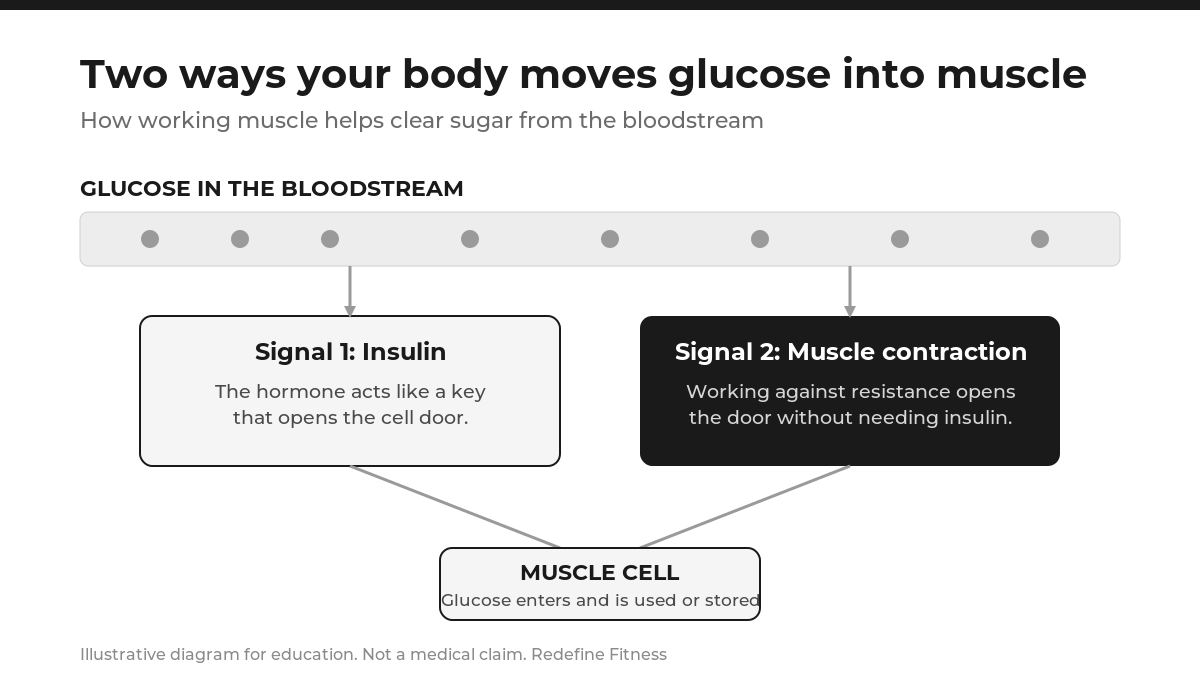
Here is the piece that rarely gets explained. Skeletal muscle is the largest site in the body for clearing glucose out of the blood. When you eat, sugar enters your bloodstream, and your muscles are the primary place that sugar is meant to go, to be used for energy or stored for later. The more muscle you carry, and the more often you use it, the larger and more responsive that storage system becomes.
There are two ways glucose gets pulled out of your blood and into a muscle cell. One is driven by insulin, the hormone that acts like a key at the cell door. The other is driven by muscle contraction itself. When a muscle works against resistance, it opens that same door through a separate pathway that does not depend on insulin being present. This is why movement is so closely tied to how the body manages blood sugar, and why sitting still all day works against you on a level most people never see.
Why muscle is the asset worth building
Think of your muscle as a bank of storage space for the sugar in your blood. A body with more trained, active muscle has more room to put that sugar and a more efficient system for moving it there. A body that has been losing muscle quietly for years, which is the default as people age and get less active, has less of that capacity right when it needs it most.
This is the part that makes strength work matter so much for anyone managing glucose. Cardio burns energy while you are doing it, and that is valuable. But building and keeping muscle changes the size of the system itself. It is the difference between emptying a cup faster and owning a larger cup. Both help. Only one of them compounds over the years. Protect and build your muscle now and you are strengthening the exact tissue your body relies on to handle blood sugar for the rest of your life.
SAID: your body adapts to exactly what you ask of it
One of the first principles in our curriculum is specificity, often called SAID, which stands for specific adaptations to imposed demands. The body makes specific adaptations to the specific demands you place on it. A body asked to sit still all day gets very good at sitting still. A body asked to work against meaningful resistance gets stronger, holds more muscle, and becomes better at the jobs muscle does, including managing fuel.
This is why walking, while genuinely good for you, is not a full substitute for strength work here. Walking asks your body for endurance. It does not send a strong signal to build and keep muscle. If the goal is a bigger, more responsive system for handling blood sugar, the specific demand that produces that specific adaptation is resistance training: challenging your muscles against load. Cardio and strength are not interchangeable. They ask the body for different things, and both belong in a complete plan.
Progressive overload: why a tracked plan beats just moving more
Doing some resistance training is the floor. Keeping the benefit over months and years takes a plan that grows with you. That is progressive overload, another core principle from the curriculum: the demand has to gradually increase over time for adaptation to continue. A workout that never changes slowly becomes maintenance, and your body stops being asked to build anything new.
In practice we manage this through what the curriculum calls the FITT levers: frequency, intensity, time, and type. You progress by training a little more often, adding load, adjusting how much work you do or how you do it, or changing the movement itself. The point is that it is deliberate and tracked, not random. This is one of the clearest lines between following a generic printout and following a program that is adjusted to you, session by session, as your strength changes.

Recovery is where the adaptation happens
A principle we teach called general adaptation syndrome explains how the body responds to training stress over time. It moves through three phases. In the alarm phase you impose a demand and performance dips: you feel tired and sore. In the resistance phase the body recovers and rebuilds slightly stronger than before, a process often called supercompensation. Push too hard with too little recovery and you reach the exhaustion phase, where the body can no longer adapt and progress stalls or slips backward.
The practical takeaway is that more is not automatically better. The muscle you are trying to build and the improvements you are training for happen during recovery, not during the session itself. A well built plan uses enough quality stimulus to drive adaptation, then leaves room for the sleep and rest that let the body actually make the change. For someone managing a chronic condition, that balance is not a nice to have. It is the whole point.
What a blood sugar focused week actually looks like
You do not need to live in a gym or train like an athlete. A focused, well built program is enough. In practice it tends to look like this:
- Two to three resistance sessions per week, spaced out so recovery actually happens between them.
- Compound movements first. We program the big multi joint patterns, a push, a pull, a hinge, a squat pattern, and a carry, before smaller isolation work. Leading with compounds trains the most muscle for the time you spend and avoids pre exhausting the smaller muscles that stabilize the bigger lifts, which lowers injury risk.
- Load and progression that are tracked, so the demand keeps pace with your strength instead of stalling.
- Movement quality held to a standard, with every exercise scaled to what your body can safely handle today.
- Room for the ways energy and recovery can shift when you are managing a metabolic condition or the medications that come with it.
None of this is exotic. The skill is in the details: the right starting load, the right speed of progression, and the right regressions for your body and your history. The correct first lift for someone carrying extra weight and knee pain is different from the correct first lift for a desk worker with no injury history. That judgment is difficult to get from a printed sheet or a video, and it is exactly where private, hands on guidance earns its place.
The levers outside the gym
Training is the signal, but a few things outside the session decide how well your body acts on it. Nutrition is the largest of them, and it is the one most closely tied to blood sugar. What you eat, how much protein you take in to support your muscle, and how your meals are structured all sit at the center of managing glucose, and those decisions belong with your doctor or a qualified nutrition professional who knows your full picture. Sleep and recovery are the other lever, because the adaptation you train for is built during rest. Strength work does not replace any of this. It works with it.
Why this has to be individual
The first principle in our curriculum is individuality: no two people respond to the same stimulus in the same way. Two people with the same diagnosis, the same age, and the same starting point will still need different loads, different progressions, and different regressions. A program that ignores that is guessing.
This is the core reason we are built the way we are. We are not a gym and we do not run group classes. Every session at Redefine is designed and delivered for one person by a credentialed Fitness Specialist who scales each movement to your body and adjusts as your strength and your needs change. It is personal training delivered to a private, one on one medical fitness standard, because building strength around a metabolic condition is precisely the kind of goal that a one size fits all plan handles badly.
This works alongside your care team, not instead of it
To be clear: your diagnosis, your medication, your lab work, and every medical decision stay with your doctor. A structured fitness program does not replace any of that, and it is not meant to. What it does is take ownership of the strength and movement side of your health, built around the plan your care team has set, so the work you put in supports the results you and your doctor are after. We work with your providers, not around them, and we stay in our lane.
Start with a conversation
If you are managing Type 2 diabetes or prediabetes and want to put strength training to work for you, the next step is simple. We have two Long Island studios, in Mount Sinai at 271 Route 25A and in Stony Brook at 1113 North Country Road. Book your call and we will talk through your goals, your health history, and exactly how a private program would fit alongside the care you are already receiving. If you want a related read first, our guide on strength training after 55 covers many of these same principles in a different context. Your muscle is the tissue that handles your blood sugar. It is worth building on purpose.
Working through this yourself? Read the blood sugar guide: why muscle is the leverage point, with a weekly structure.
Common questions
How does strength training affect blood sugar?
Skeletal muscle is the largest site of glucose disposal in the body. Resistance training increases muscle mass and improves how that tissue handles glucose. ADA guidance recommends both aerobic and resistance training for adults with diabetes. Medication and targets are set by your physician.
Is walking enough for type 2 diabetes?
Walking helps and is worth doing, but it does not build the tissue that stores and uses glucose. Guidance recommends resistance training on two to three days a week alongside aerobic activity, and the combination outperforms either alone.
When is the best time to train for blood sugar control?
Consistency matters more than timing. If you use insulin or medications that can cause hypoglycaemia, timing and monitoring should be discussed with your physician or diabetes educator before changing your training routine.
How quickly does exercise change blood sugar?
A single session can influence glucose handling for up to a day or two, which is why frequency matters. Longer term changes in insulin sensitivity and body composition build over weeks to months of consistent training.
Sources
- Physical Activity/Exercise and Diabetes: ADA Position Statement
- Standards of Care in Diabetes 2026 — American Diabetes Association
- Physical Activity Guidelines for Americans, 2nd edition — U.S. Department of Health and Human Services
Educational content from the Redefine Fitness specialist team. Not medical advice, and not a substitute for diagnosis or treatment by your physician.