Redefine Fitness | Educational Article • redefine-fitness.com
Exercising With Joint Pain and After Joint Surgery: The Complete Guide
- Joints are living structures that thrive on movement. With painful or post-surgical joints, the answer is rarely complete rest, it is smarter, controlled movement that restores range of motion and rebuilds the muscles that protect the joint.
- Pain has a root cause. Arthritis, tendonitis, bursitis, ligament injury, and surgery each call for a different strategy. Treating every sore joint with the same generic workout is how people get hurt.
- Strength and stability matter as much as mobility. Strong, well-coordinated muscles act as shock absorbers and stabilizers, offloading the joint and reducing pain over time.
- Medical clearance is not the same as physical capacity. After surgery, being cleared to exercise is the starting line, not the finish line, and every plan should be coordinated with your medical team.
Joint Pain Isn’t a Reason to Stop Moving, It’s a Reason to Move Smarter
At Redefine Fitness, our guiding belief is simple: fitness is medicine. We exist in the space between the fitness industry and the medical world, helping people address the root cause of their pain through movement and education rather than ignoring it or simply training around it. Nowhere is that philosophy more important than with aching, stiff, or surgically repaired joints.
Your joints are living, synovial structures. Cartilage cushions the ends of your bones, and a thin layer of synovial fluid lubricates the joint so it can glide without grinding. That fluid is circulated by motion, which is why, for most joint conditions, complete rest is the wrong prescription. A joint that stops moving stiffens, the surrounding muscles weaken, and the cycle of pain and deconditioning accelerates. The phrase trainers love is true for a reason: motion is lotion.
The goal is never to push blindly through pain. It is to load the joint intelligently, restoring the range of motion you’ve lost, strengthening the muscles that support and protect the joint, and gradually rebuilding your confidence and capacity. Done well, this is some of the most rewarding work in fitness, and it is exactly what separates a thoughtful program from a generic one.
Sources: CDC / Osteoarthritis Action Alliance; American Joint Replacement Registry & national orthopaedic data; Redefine Fitness programming standards.
Why Joints Hurt, and What’s Actually Going On
“Joint pain” is not one problem. It is a category of very different issues, and a smart plan starts by understanding which one you’re dealing with. These are the most common patterns we see, and the body’s response to all of them tends to be the same: it compensates.
Think of your body like a clock full of interlocking gears. Bend one gear out of shape and it no longer turns cleanly, so the gears around it start to wear unevenly too, and over time the whole mechanism degrades. When one joint is painful, stiff, or unstable, you unconsciously change how you move. Those altered movement patterns are inefficient and awkward, and they spread stress to neighboring joints and tissues. An unstable joint is a weak joint, and usually a painful one. That is why our job is rarely just to chase the symptom, it’s to restore proper movement and stability throughout the chain.
Cartilage thins and joint space narrows, leading to grinding, stiffness, and pain that flares with cold or overload. The joint still needs movement, synovial joints feed on it, but loading must be managed carefully.
An overworked tendon becomes inflamed and tender (think tennis elbow, jumper’s knee, or hip-flexor tendonitis). It calls for relative rest from the aggravating action, targeted soft-tissue work, and gradual strengthening.
The small fluid sacs that let tendons glide over bone become inflamed, often because tight surrounding muscles are pressing on them. Relieving that tension and correcting mechanics is key.
Sprains and tears (ACL, MCL, rotator cuff, ankle ligaments) leave a joint loose and unprotected. The priority is rebuilding stability and strengthening the muscles that support the joint.
The Redefine Approach: Restore, Strengthen, Stabilize
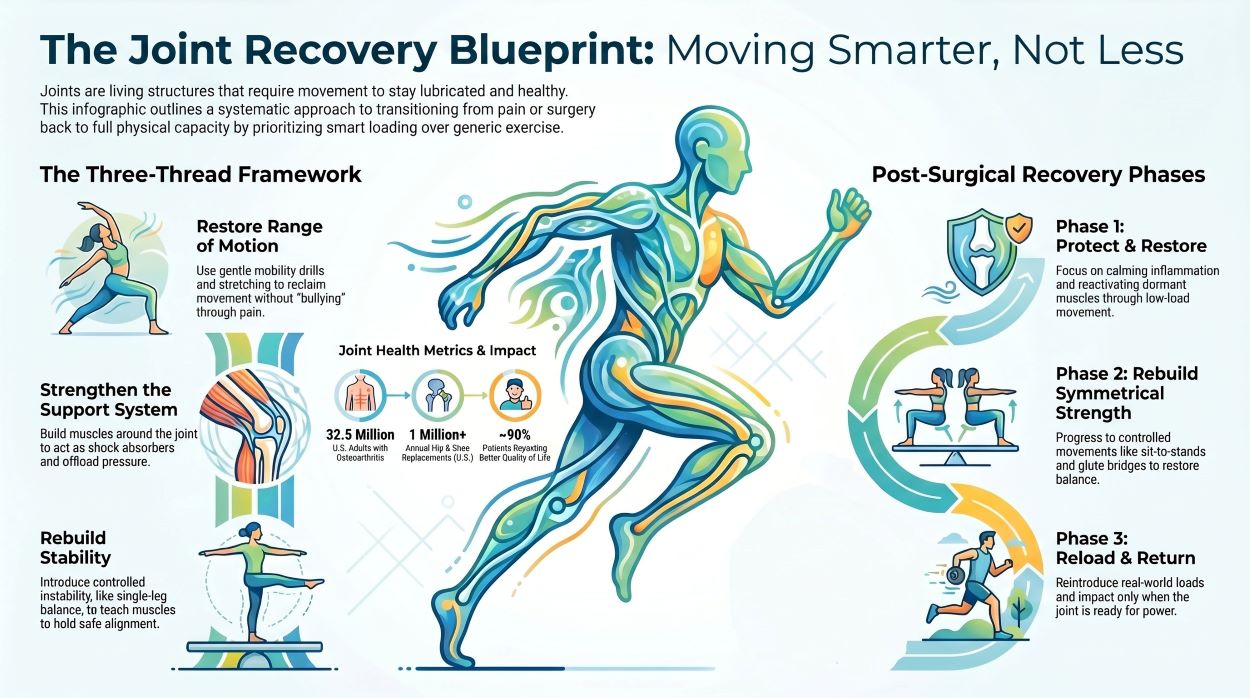
Whatever the diagnosis, our framework for a painful joint follows the same three threads, layered in the right order and progressed only as your body allows.
- Restore range of motion. Stiff, restricted joints force compensations elsewhere. We use gentle mobility drills, stretching, and trigger-point fascia release to free up the tissue around the joint and reclaim healthy movement, always respecting pain as a signal, never bullying through it.
- Strengthen the support system. Strong muscles offload the joint. For an arthritic or painful joint we strengthen everything around it while limiting heavy load and impact, bridges, band walks, controlled bodyweight work, and machine-based or seated variations are perfect early on. For ligament injuries we deliberately strengthen the opposing and stabilizing muscles (for example, hamstrings to protect the ACL).
- Rebuild stability. Stability is the body’s ability to resist unwanted motion. We rebuild it by introducing controlled instability, single-leg balance, stability-ball holds, anti-rotation presses, which teaches opposing muscles to co-activate and hold the joint in safe alignment.
Progress is governed by the same training principles we apply to every client: individualization, progressive overload, and the FITT variables (frequency, intensity, time, and type). We watch real-time cues to decide when to push and when to back off, how quickly you can move a weight, whether a muscle is shaking, whether you can still hold a conversation. We progress to get better; we regress to prevent injury. Both are wins.
We also distinguish between active range of motion (how far you can move a joint on your own) and passive range of motion (how far it goes with help). Reclaiming passive range matters, but it’s your active range that lets you put on your shoes, climb stairs, and pick up your kids, so functional, owned movement is always the end goal.
Exercising After Joint Surgery: Bridging the Gap
Joint surgery, a replacement, a ligament reconstruction, a labral or meniscus repair, is often just the beginning of the journey. Formal physical therapy gets you out of the danger zone: medically cleared, pain reduced, and mobile enough for basic tasks. But medical clearance does not guarantee physical capacity. Many people finish PT still lacking symmetrical strength, integrated stability, real-world load tolerance, and confidence in the joint. Closing that gap is precisely what intelligent post-rehabilitation training is for.
We think about the return to exercise in broad, overlapping phases, never rushed, always cleared with your surgeon and therapist:
| Phase | Primary Focus | Example Work |
|---|---|---|
| Protect & restore | Calm inflammation, regain pain-free range of motion, reactivate dormant muscles | Gentle mobility drills, isometrics, supported and low-load movement |
| Rebuild | Restore symmetrical strength and joint stability under control | Sit-to-stand, glute bridges, band walks, single-leg balance, stability holds |
| Reload & return | Reintroduce real-world load, then power and impact only when ready | Goblet/loaded squats, hinges, carries, and low-impact plyometrics |
The throughline is controlled, progressive, purposeful loading, not high loads for their own sake. We start low-impact, keep movements controlled, and advance one variable at a time. For any case beyond our scope, or any red-flag symptom, we refer out and lean on your medical team. Trust is built by recognizing when not to push.
Common Mistakes to Avoid
- Pushing through sharp pain. Pain during movement is information, not weakness. A dull, manageable working sensation is fine; sharp, pinching, or escalating pain is a signal to stop and reassess.
- Choosing total rest. Synovial joints benefit from movement. Prolonged rest stiffens the joint and weakens its support, making the eventual return harder.
- Loading too heavy, too soon. Especially after surgery, jumping back to old weights or high-impact activity is the fastest route to a setback that can cost weeks.
- Ignoring the surrounding muscles. Chasing the sore spot while neglecting the hips, core, or shoulder that should be sharing the load lets compensations persist.
- Skipping the warm-up and cool-down. A proper warm-up raises tissue temperature and primes the joint; rushing in cold raises injury risk on an already vulnerable joint.
- Following a generic plan. Cookie-cutter programs aren’t designed for your diagnosis, your stage of recovery, or your goals, and that mismatch is where most re-injuries start.
At Redefine Fitness, our specialists design progressive, individualized programs for clients living with joint pain and recovering from joint surgery, meeting you where you are and advancing only as your body is ready, in coordination with your medical team.
How Redefine Fitness Trainers Can Help
Managing joint pain through exercise is a science, and it deserves a guide who understands both the body and your individual situation. Our trainers work with clients living with arthritis, tendon and ligament injuries, and post-surgical joints, building evidence-informed programs that respect each person’s stage of healing.
- A thorough initial assessment of your movement, pain patterns, strength, and goals, including how surrounding joints are sharing the load.
- Progressive programs that begin with restoring range of motion and controlled, low-impact strength, then advance at a pace your joint can handle.
- Targeted strength, stability, and soft-tissue work chosen for your specific condition rather than a generic template.
- Ongoing monitoring and honest adjustment, we progress when you’re ready and regress the moment something doesn’t feel right.
- Coordination with your physician and physical therapist so your training reinforces, rather than conflicts with, your broader recovery.
You deserve a fitness experience that sees the full picture of your health, not a generic plan handed over without context. Our team is here to be that partner.
Frequently Asked Questions
Working through this yourself? Read the after physical therapy guide: closing the discharge gap step by step.
Should I exercise if my joints already hurt?
In most cases, yes, but smartly. Painful joints usually benefit from controlled movement and strengthening of the surrounding muscles, not complete rest. The key is staying within a pain-tolerable range and avoiding the loads or impacts that aggravate the joint. If you’re unsure, get assessed by a professional and clear it with your doctor first.
How soon can I start exercising after joint surgery?
That timeline is set by your surgeon and physical therapist, and it varies widely by procedure. Once you’re medically cleared, structured training can help close the gap between basic recovery and full, confident function. Begin gently, progress gradually, and keep your care team in the loop.
What’s the difference between physical therapy and post-rehabilitation training?
Physical therapy restores baseline function and gets you safely out of the injury phase. Post-rehabilitation training picks up where PT leaves off, rebuilding symmetrical strength, stability, load tolerance, and real-world capacity so you can return to the activities you love without re-injury.
Is strength training safe for arthritic joints?
For most people it’s not only safe but beneficial. Stronger muscles act as shock absorbers and take pressure off the joint. The approach is to strengthen while limiting excessive load and impact, using controlled tempos, supported positions, and gradual progression rather than heavy, jarring lifts.
What types of exercise are easiest on the joints?
Low-impact options like swimming, cycling, controlled resistance work, and bodyweight movements within a comfortable range tend to be joint-friendly. The best choice depends on which joint is involved and your stage of recovery, which is why an individualized plan beats a one-size-fits-all routine.
This article is for educational purposes only and does not constitute medical advice. Redefine Fitness coaches are fitness professionals, not licensed medical providers or physical therapists unless explicitly stated. Always consult your physician, surgeon, or physical therapist before beginning, changing, or resuming any exercise program, particularly with a painful joint or after surgery.
Sources
- 2019 ACR/Arthritis Foundation Guideline for the Management of Osteoarthritis of the Hand, Hip, and Knee
- Physical Activity Guidelines for Americans, 2nd edition — U.S. Department of Health and Human Services
Educational content from the Redefine Fitness specialist team. Not medical advice, and not a substitute for diagnosis or treatment by your physician.