More people on Long Island than ever are losing weight with the help of a medication their doctor prescribed. The scale is moving, and that is worth celebrating. But there is a quieter question that almost no weight loss plan answers: when the weight comes off, how much of it is fat, and how much of it is muscle?
This is a fitness education guide, not medical advice. Your medication and your medical care belong with your doctor. What follows is the strength and movement side of the equation, written for people who are already on a weight loss plan and want to keep the muscle and function they will rely on for the rest of their lives. The principles below are the same ones our Fitness Specialists are trained on through the education curriculum behind our New York State approved apprenticeship program.
Rapid weight loss is not automatically fat loss
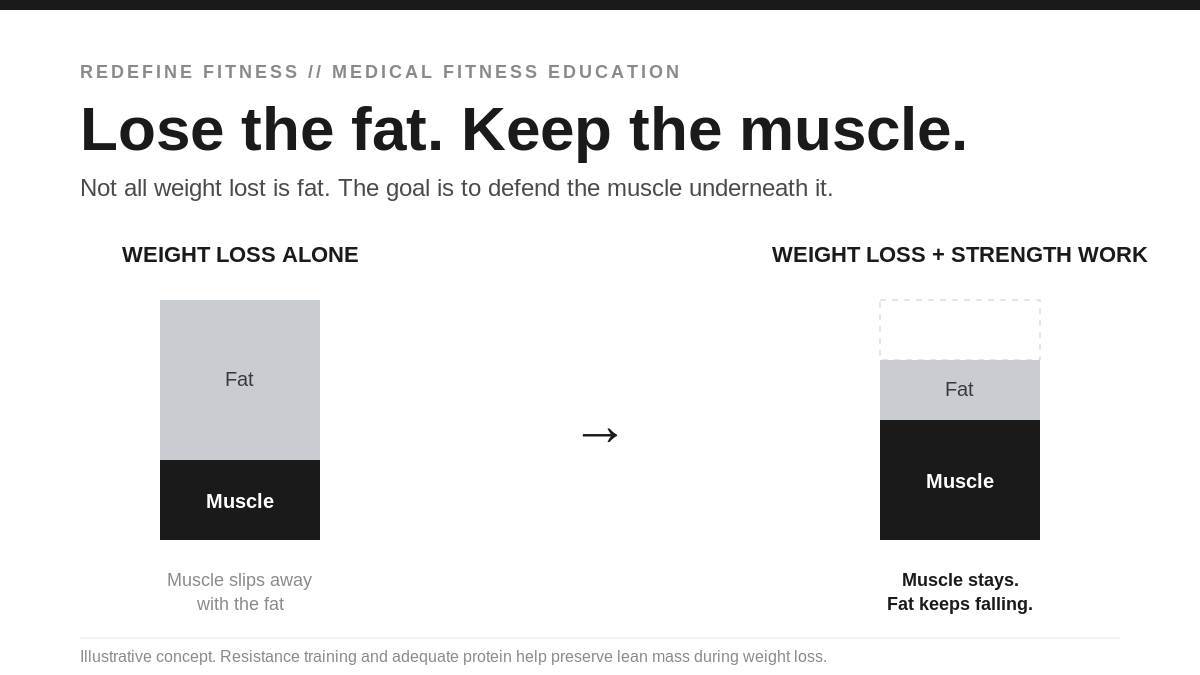
Your body does not read a label that says burn fat only. When you take in far less energy than you spend, and especially when appetite drops and protein falls with it, the body will pull from both fat and lean tissue to make up the difference. Research on rapid weight loss consistently shows that a meaningful share of the weight lost can come from lean mass when resistance training and adequate protein are missing from the plan.
That is the part that shows up later. The fat you lose is the goal. The muscle you lose is a cost, and it is a cost that is slow and difficult to pay back. Lose it quietly now and the bill arrives as less strength, a slower metabolism, weaker bones, poorer balance, and a higher chance of regaining the fat once the medication or the diet changes. Losing weight is the goal. Losing your foundation is not.
Why muscle is the asset you protect
Think of muscle as the engine that keeps you independent. It is what lets you carry groceries, climb stairs, get up off the floor, and stay steady on your feet as you age. It is also metabolically active tissue, which means the more of it you keep, the more your body uses at rest. And it is the single biggest lever you have over the hardest phase of any weight loss journey, which is not losing the weight but keeping it off. Protect your muscle now and you protect your strength, your function, and your results for years rather than months.
The principle that explains everything: use it or lose it
In our curriculum, one of the first training principles we teach is reversibility. Stated plainly: progress begins to reverse if it is not purposefully maintained. Your body is relentlessly efficient. It keeps tissue that it is asked to use and it sheds tissue that it is not, because muscle is expensive to carry. During weight loss this principle stops being theory and becomes the whole game. If you are eating less and giving your muscles no reason to stay, your body reads that muscle as a luxury it can no longer afford. The way you keep it is simple in concept: you keep using it, deliberately and consistently.
SAID: your body keeps what you make it work for
The second principle is specificity, often called SAID, which stands for specific adaptations to imposed demands. The body makes specific adaptations to the specific demands you place on it. Walking more is good for your heart and your step count, but it does not send a strong signal to keep upper body and total body muscle. The demand that tells your body to hold on to muscle is resistance training: challenging your muscles against meaningful load. That is the specific stress that produces the specific adaptation you want here, which is muscle retention. This is why we do not treat cardio and strength work as interchangeable. They ask the body for different things, and only one of them defends your muscle while you are in a deficit.
Recovery is where the work pays off
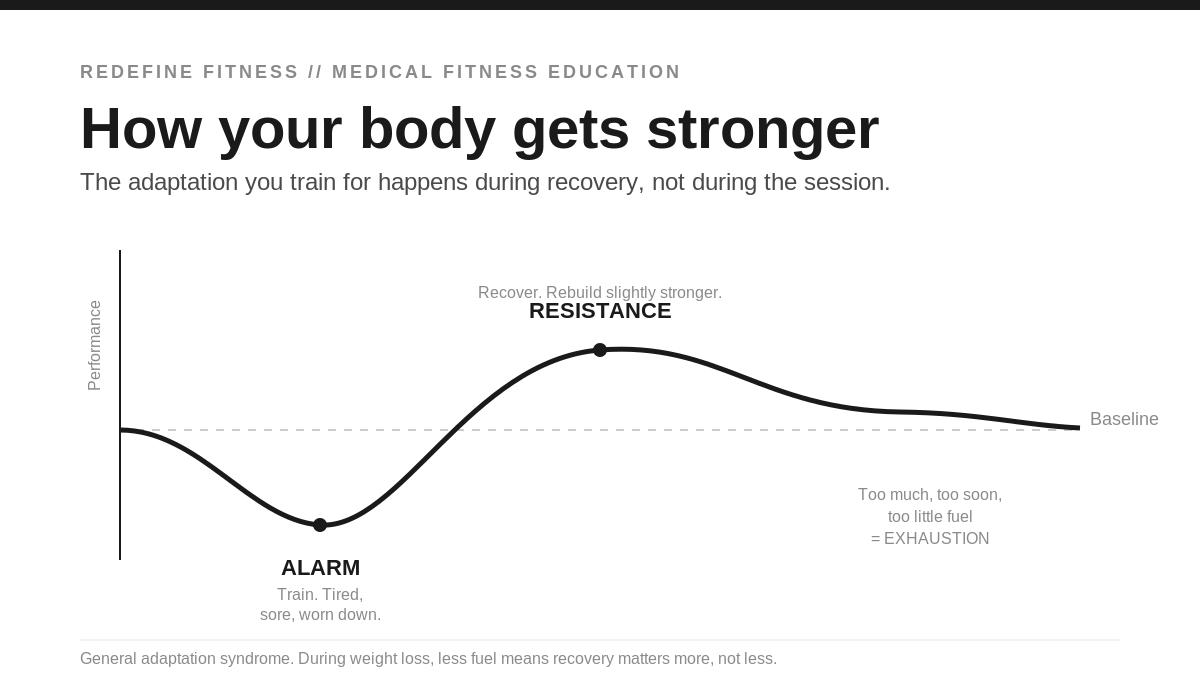
A third principle from the curriculum is general adaptation syndrome, the model for how the body responds to stress over time. It moves through three phases. In the alarm phase you impose a demand and performance dips: you are tired, sore, and worn down. In the resistance phase the body adapts and rebuilds slightly stronger than before, a process often called supercompensation. Push too hard with too little recovery and you reach the exhaustion phase, where the body can no longer adapt and progress slips backward.
This matters more, not less, when you are losing weight. A body that is eating less has less fuel for recovery, which means the line into the exhaustion phase sits closer than it would otherwise. The answer is not to train harder and more often. It is to train with enough quality stimulus to defend your muscle, then give the body the food, sleep, and rest it needs to actually adapt. More is not better here. Better is better.
Progressive overload: why a tracked plan beats just moving more
Holding muscle is the floor. If you want to protect it through months of weight loss, the stimulus has to keep pace with you. That is progressive overload: the demand has to gradually increase over time for adaptation to continue. In practice we manage this through what the curriculum calls the FITT levers: frequency, intensity, time, and type. You can progress by training a touch more often, adding load, adjusting the volume or tempo, or changing the movement. The point is that it is tracked and intentional. A program that never changes quietly becomes maintenance at best, and during aggressive weight loss, standing still often means sliding back. This is the difference between following a generic plan and following a program that is adjusted to you week over week.
What a muscle protecting week actually looks like
You do not need to live in a gym and you do not need to train like an athlete. A focused, well built program is enough. In practice it looks like this:
- Two to three resistance sessions per week, spaced out so recovery actually happens.
- Compound movements first. We program the big multi joint patterns, a push, a pull, a hinge, a squat pattern, and a carry, before smaller isolation work. Leading with compounds trains the most muscle for the time spent and avoids pre exhausting the smaller muscles that stabilize the big lifts, which lowers injury risk.
- Load and progression that are tracked, so the stimulus keeps pace with your strength instead of stalling.
- Technique held to a standard, with every movement scaled to what your body can safely handle today.
- Adjustments for the energy, appetite, and recovery shifts that come with being on a weight loss plan.
None of this is exotic. The skill is in the details: the right starting load, the right progression speed, and the right regressions for your body. The correct first lift for someone managing knee pain is different from the correct first lift for a desk worker with no injury history. That judgment is the part that is difficult to get from a printed sheet or a video, and it is exactly where private, hands on guidance earns its place.
The two levers outside the gym: protein and recovery
Training is the signal. Two things let your body act on it. The first is protein. When food intake drops, protein is usually the first thing to fall, which is exactly the wrong direction, because protein is the raw material your body uses to hold on to muscle while fat comes off. Your provider or a qualified nutrition professional can help you set a target that fits your plan. The second is recovery, especially sleep. The adaptation you are training for happens during rest, not during the session itself. Underrate either one and you blunt the work you did in the gym.
Why this has to be individual
The first principle in our curriculum is individuality: no two people respond to the same stimulus in the same way. Two people on the same medication, the same age, the same starting weight, will need different loads, different progressions, and different regressions. A program that ignores that is guessing. This is the core reason we are built the way we are. We are not a gym and we do not run group classes. Every session at Redefine is designed and delivered for one person by a credentialed Fitness Specialist who scales each movement to your body and adjusts as your weight loss progresses. It is personal training delivered to a private, one on one medical fitness standard, because protecting muscle through real weight loss is precisely the kind of goal that a one size fits all plan handles badly.
This works alongside your provider, not instead of them
To be clear: your medication, your bloodwork, and your medical decisions stay with your doctor. A structured fitness program does not replace any of that. What it does is take ownership of the strength and movement side, so the weight you lose is the weight you actually want to lose. We work with your plan, not around it, and we keep our lane.
Start with a conversation
If you are losing weight and want to make sure your strength comes with you, the next step is simple. We have two Long Island studios, in Mount Sinai at 271 Route 25A and in Stony Brook at 1113 North Country Road. Book your call and we will talk through your goals, your health history, and exactly how a private program would protect your muscle while you reach your target. If you want a related read first, our guide on strength training after 55 covers many of these same principles in a different context. The weight is coming off. Let us make sure your strength does not go with it.
Working through this yourself? Read the GLP-1 guide: protein targets and the lifting that keeps muscle on.
Common questions
Do you lose muscle on a GLP-1?
Rapid weight loss from any cause includes lean mass, not only fat. The proportion lost as lean tissue is influenced by protein intake and whether you are giving the body a reason to keep muscle. Resistance training is that reason. Your prescription and dosing are managed by your physician.
How much protein do you need on a GLP-1?
Appetite suppression makes adequate protein harder to hit, which is the practical problem. Working with a Registered Dietitian to set an intake target and a realistic way to reach it while eating less is usually more useful than a generic number.
How often should you lift while on a GLP-1?
Muscle strengthening on at least two days a week covering all major muscle groups is the baseline in federal activity guidance. During active weight loss, that is a floor rather than a target.
What happens to strength if you stop the medication?
That is a medical question for your prescriber. What is within our lane: muscle you built and kept during the weight loss stays with you, and it is far easier to maintain strength you already have than to rebuild it later.
Sources
- Physical Activity Guidelines for Americans, 2nd edition — U.S. Department of Health and Human Services
- Standards of Care in Diabetes 2026 — American Diabetes Association
Educational content from the Redefine Fitness specialist team. Not medical advice, and not a substitute for diagnosis or treatment by your physician.