Redefine Fitness | Educational Article • redefine-fitness.com
Exercise for Mental Health: Depression, Anxiety, PTSD, and Motivation
- Exercise is a proven mood-lifter. Large reviews of hundreds of studies show that regular physical activity meaningfully reduces symptoms of depression and anxiety — with benefits in the same range as therapy and medication for many people.
- It works on the brain and the body. Movement releases feel-good endorphins, lowers stress hormones, improves sleep, and breaks the cycle of negative thinking.
- PTSD evidence is promising. Exercise can help reduce PTSD symptoms, and it works best alongside professional trauma-focused care — not instead of it.
- Motivation is the real hurdle. Starting small, choosing something you enjoy, and having support or accountability matter more than intensity. Consistency is what makes the benefits last.
Movement Is Medicine for the Mind
At Redefine Fitness, our core belief is that fitness is medicine. We work in the space between the fitness world and the medical world, helping people improve their lives through movement and education. That mission goes far beyond muscles and weight loss — some of the most powerful effects of exercise happen in the mind.
If you live with depression, anxiety, or the aftermath of trauma, you already know how heavy daily life can feel. The encouraging news is that decades of research now point to physical activity as one of the most accessible, side-effect-free tools for feeling better. It is not a magic cure, and it is not a replacement for professional care. But used consistently, and tailored to you, movement can be a genuine part of feeling well again.
Sources: Singh et al., British Journal of Sports Medicine (2023); Choi et al., JAMA Psychiatry (2019); U.S. Department of Health & Human Services; Mayo Clinic.
How Exercise Changes the Brain and Body
You don’t need to understand the biology to feel the benefits, but it helps to know that the effects are real and physical — not just “thinking positive.” When you move, several things happen at once:
- It releases endorphins. These are natural brain chemicals that lift your mood and dull pain — the source of the classic “runner’s high.”
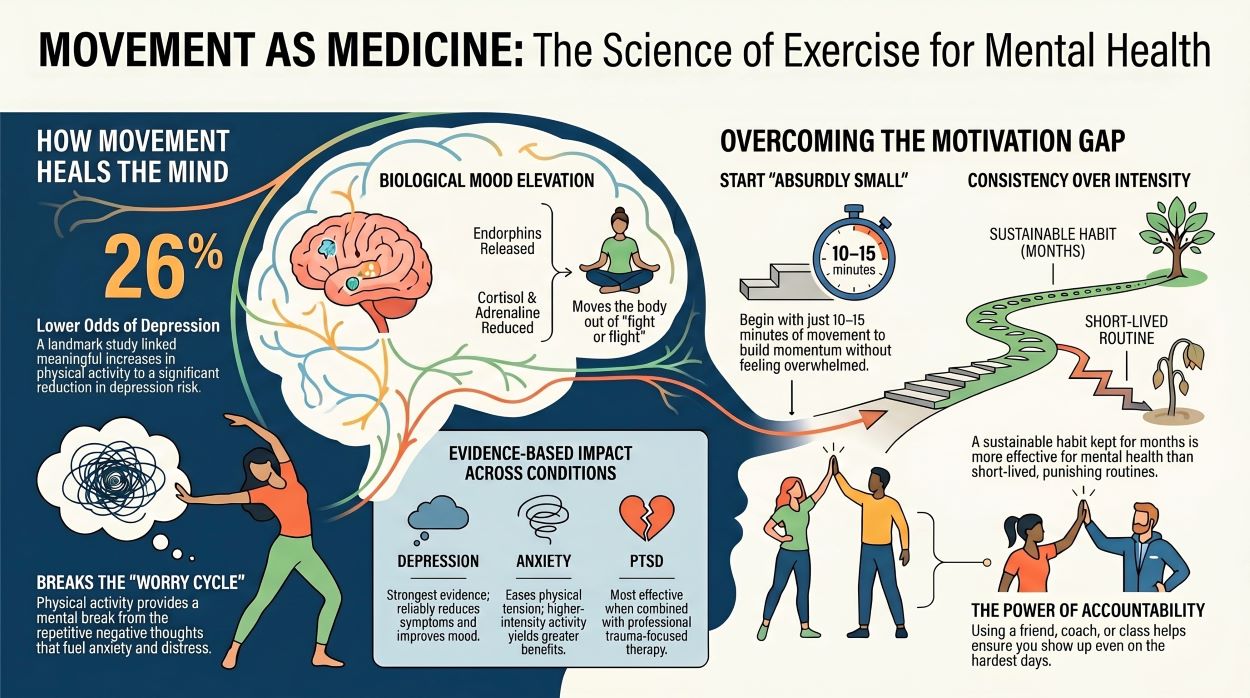
- It lowers stress hormones. Activity reduces levels of adrenaline and cortisol, the chemicals that keep your body stuck in “fight or flight.”
- It improves sleep. Better, more regular sleep is one of the fastest ways to steady your mood — and exercise is one of the best ways to get it.
- It breaks the worry cycle. Focusing on a movement, a walk, or a workout gives your mind a break from the loop of negative thoughts that feeds anxiety and depression.
- It builds confidence. Meeting small goals — showing up, finishing a session — creates a real sense of accomplishment that carries into the rest of your life.
Depression, Anxiety, and PTSD: What the Research Shows
One of the largest reviews ever conducted on this question pooled 97 research reviews covering more than a thousand trials and over 128,000 people. It found that physical activity produced medium-sized improvements in depression, anxiety, and general distress — effects that were comparable to, or in some cases slightly greater than, those seen with talk therapy and medication. Here’s how that breaks down by condition:
| Condition | What the evidence shows |
|---|---|
| Depression | The strongest and most consistent evidence. Regular exercise reliably reduces depressive symptoms, and one large genetic study found that a meaningful increase in activity was linked to roughly 26% lower odds of depression. |
| Anxiety | Solid evidence of medium-sized benefits. Movement eases physical tension and worry, and higher-intensity activity tends to produce greater improvements. |
| PTSD | Promising and growing evidence. Exercise — including mind-body forms like yoga — can reduce PTSD symptoms, and appears most effective when added to professional trauma-focused therapy rather than used alone. |
A few patterns hold across all three: any movement is better than none, more intense activity often helps more, and — importantly — the benefits last only as long as you keep going.
The Hardest Part: Finding the Motivation
Here is the cruel catch with mental health: the conditions that exercise helps most are the same ones that drain your motivation to move. When you’re depressed, getting off the couch can feel impossible. When you’re anxious, a busy gym can feel threatening. This is not a personal failing — it’s the nature of the illness. The solution is to make starting as easy as humanly possible.
- Start absurdly small. A 10-minute walk counts. Short bouts of activity throughout the day add up and genuinely help. The goal early on is simply to show up, not to crush a workout.
- Pick something you enjoy. Walking, dancing, lifting, swimming, yoga — the best exercise for your mental health is the one you’ll actually keep doing.
- Use accountability. Knowing someone is waiting for you — a friend, a class, or a trainer — is one of the most powerful motivators there is, especially on the days you’d rather not.
- Aim for consistency over intensity. A sustainable habit you keep for months beats an intense plan you abandon in two weeks. Progress in mental health is rarely a straight line, and that’s okay.
At Redefine Fitness, our specialists meet you exactly where you are — building supportive, enjoyable, sustainable routines that fit your life and your goals, in coordination with your care team.
Get Started → redefine-fitness.comHow Redefine Fitness Can Help
Exercising for your mental health is most effective when it’s personal — and that’s exactly how we train. The human side of coaching is half of our job, and it matters even more when someone is working through a hard season.
- A welcoming, judgment-free environment where we learn your name, your goals, and what you’re comfortable with.
- Individualized programs that start at your level and progress only as fast as you’re ready — because no two people respond to exercise the same way.
- Built-in accountability and encouragement to help you keep showing up on the hard days.
- A focus on building enjoyable, lifelong habits rather than short, punishing routines.
- Coordination with your doctor or therapist so your training supports your overall care.
Frequently Asked Questions
Can exercise replace my medication or therapy?
No. Exercise is a powerful complement to professional treatment, not a substitute for it. The research shows it works best as part of an overall plan. Never stop or change a prescribed treatment without talking to your doctor first.
How much exercise do I need to feel better?
For most adults, guidelines suggest about 150 minutes of moderate activity per week (or 75 minutes of vigorous activity). But you don’t have to hit that on day one — even 10 to 15 minutes at a time has real benefits, and starting small is often the smartest approach.
What type of exercise is best for mental health?
The best type is the one you’ll actually stick with. Aerobic activity like walking, jogging, and cycling has the most research behind it, but strength training and mind-body practices like yoga also help. Higher-intensity activity tends to produce slightly greater benefits, but consistency matters most.
I have no motivation to start. What do I do?
That’s one of the most common — and understandable — barriers, especially with depression. Shrink the goal until it feels easy (a five-minute walk), choose something you enjoy, and lean on accountability, whether that’s a friend or a coach. Showing up is the win; the rest builds from there.
Is exercise safe if I have PTSD or severe anxiety?
For most people, yes, and it can help — but the right setting and pacing matter. A calm environment, gentle progression, and options like mind-body movement can make it feel safer. Check with your healthcare provider, and consider working with a professional who can adapt the experience to you.
Sources & References
- Singh B, et al. (2023). Effectiveness of physical activity interventions for improving depression, anxiety and distress: an overview of systematic reviews. British Journal of Sports Medicine, 57(18), 1203–1209.
- Choi KW, et al. (2019). Assessment of Bidirectional Relationships Between Physical Activity and Depression Among Adults: A 2-Sample Mendelian Randomization Study. JAMA Psychiatry, 76(4), 399–408.
- Noetel M, et al. (2024). Effect of exercise for depression: systematic review and network meta-analysis of randomised controlled trials. BMJ, 384, e075847.
- Mayo Clinic. Depression and anxiety: Exercise eases symptoms.
- Harvard Health Publishing. More evidence that exercise can boost mood (2019); Exercising to relax.
- U.S. Department of Health & Human Services. Physical Activity Guidelines for Americans, 2nd edition.
- Systematic reviews and meta-analyses of randomized controlled trials on exercise and PTSD (2024–2025), including Rosenbaum S, et al. (2015).
This article is for educational purposes only and does not constitute medical or mental-health advice. Redefine Fitness coaches are fitness professionals, not licensed medical or mental-health providers unless explicitly stated. Always consult a qualified professional before starting an exercise program, and for the diagnosis or treatment of any mental-health condition.