Losing weight after 50 is not the same project it was at 30. The scale still moves, but what it measures changes. Without a deliberate plan, a meaningful share of the weight that comes off can be muscle, and muscle is the tissue that keeps you strong on stairs, steady on your feet, and independent for the decades ahead.
The goal after 50 is not a smaller number. It is a better body composition: less fat, as much muscle as possible kept, and strength that holds or improves. This guide covers what the research shows, why muscle goes missing during a diet, and the training and nutrition framework our Fitness Specialists and Registered Dietitian use to protect it.
Why the Scale Can Mislead You After 50
Body weight is the sum of fat mass and fat free mass, which includes muscle, bone, organs, and water. A bathroom scale cannot tell you which one changed. Two people can lose the same 15 pounds and end up in very different places: one leaner and stronger, the other lighter but weaker.
After 50, that difference matters more. Muscle mass and strength decline gradually with age, and a calorie deficit adds pressure in the same direction. When the body is short on energy and is not given a reason to keep muscle, it does not prioritize keeping it. That is the practical meaning of the training principle called reversibility: capacity that is not purposefully maintained begins to regress.
This is why “how to lose weight after 50” is really two questions. How do you create the fat loss, and how do you defend the muscle while you do it?
What the Research Shows
The evidence on this question is consistent, and it points in one direction.
A systematic review of 52 studies in middle aged and older adults with overweight or obesity compared diet alone with diet plus exercise. In 81% of the diet only groups, at least 15% of the weight lost came from fat free mass. When exercise was added, that figure dropped to 39% of groups (Weinheimer et al., 2010). In short, exercise changed what kind of weight came off.
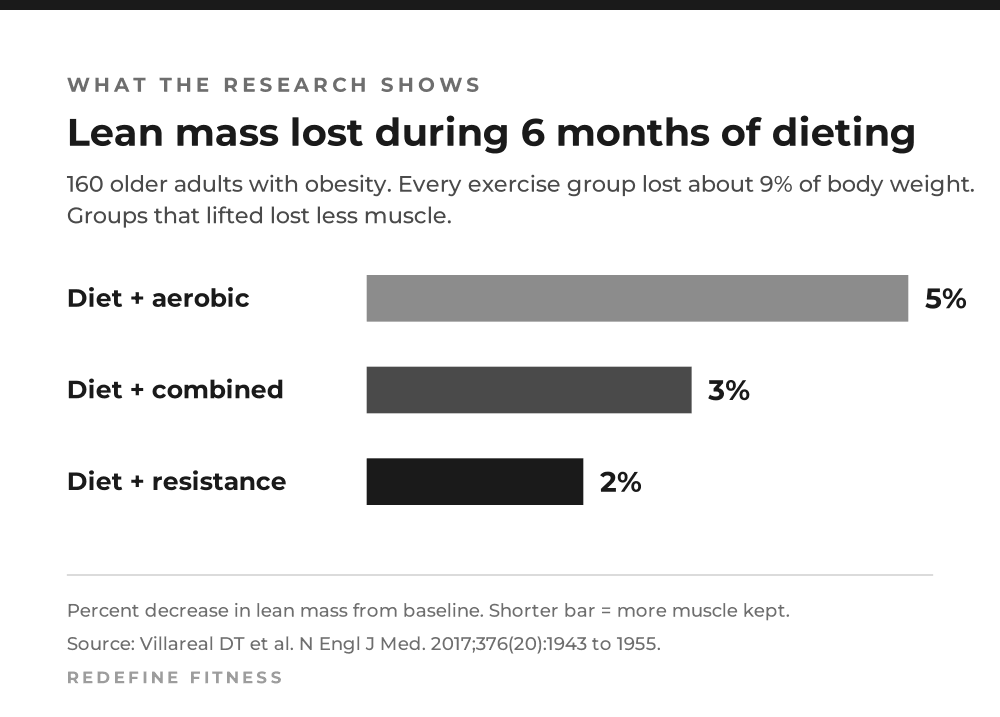
A randomized trial published in the New England Journal of Medicine went further. It assigned 160 older adults with obesity to a weight management program plus aerobic training, resistance training, or both, and compared them with a control group. Every exercise group lost about 9% of body weight over six months. But lean mass fell 5% in the aerobic only group, compared with 3% in the combined group and 2% in the resistance group. Strength rose 18% to 19% in the groups that lifted, versus 4% with aerobic work alone, and the combined group showed the largest improvement in physical performance (Villareal et al., 2017).
A 2017 review on preserving muscle during weight loss reached a compatible conclusion: both endurance and resistance exercise help preserve muscle mass during weight loss, and resistance exercise also improves muscle strength (Cava, Yeat and Mittendorfer, 2017).
The takeaway is simple. Cardio supports the process. Resistance training is what tells the body the muscle is still needed.
What About Belly Fat and Menopause?
Many women searching for how to lose belly fat during menopause are noticing a real shift. Hormonal changes around menopause are associated with fat being stored more centrally, and with an accelerated loss of muscle. There are two honest answers here.
First, you cannot choose where fat comes off. Crunches do not burn abdominal fat specifically. Central fat responds to the same thing all fat responds to: a sustained energy deficit over time, supported by training and protein.
Second, the muscle side of the equation matters even more during this stage. If you are in or past menopause, our guide to strength training through menopause covers how training adapts to this transition in more depth.
The Muscle First Framework
This is how we structure fat loss for adults over 50. The order is intentional.
1. Train for strength, at least two days a week
The U.S. Physical Activity Guidelines call for muscle strengthening activity at least two days each week for adults. For someone trying to lose fat without losing muscle, we consider that the floor, not the ceiling.
The session itself follows principles from the training curriculum our Fitness Specialists are taught:
- Compound before isolation. Multi joint movements like squats, hinges, pushes, and pulls come first, while you are fresh, because they load the most muscle at once. Smaller accessory work follows.
- Cover every movement pattern. A balanced week trains squatting, hinging, pushing, pulling, lunging, carrying, and rotation or anti rotation. Skipping patterns creates imbalances.
- Use a working range of effort. For most adults building or keeping muscle, sets of roughly 8 to 12 repetitions taken close to, but not past, good form are a practical starting point.
2. Progress the load on purpose
Progressive overload means the stimulus must increase over time for progress to continue. During a calorie deficit, many people quietly lift lighter because they feel tired. That is exactly when the muscle needs a clear signal to stay.
We use the FITT levers to progress: frequency, intensity, time, and type. Not every week needs more weight. It might mean an extra set, slower and more controlled repetitions, or a harder variation of the same pattern. You can read more in our explainer on progressive overload.
Fitness Specialists also read the body in real time. If the lifting speed slows sharply, the muscles start to shake, and breathing becomes a fight for every rep, the exercise is regressed. If you can hold a conversation and the reps move cleanly, it is time to progress. We regress to keep you safe and progress to keep you improving.
3. Make protein a priority
Protein is the raw material for muscle, and needs tend to rise with age. The PROT-AGE Study Group recommends that healthy adults over 65 average at least 1.0 to 1.2 grams of protein per kilogram of body weight per day, and 1.2 grams or more for those who exercise (Bauer et al., 2013). The same paper notes that people with severe kidney disease may need to limit protein, which is why protein targets should be set with your physician and a Registered Dietitian, not copied from the internet.
Practically, that usually means a meaningful protein source at every meal rather than a light breakfast and a large dinner.
4. Choose a moderate deficit
Aggressive, very low calorie approaches can make the scale move fast, but they make it harder to train well and harder to sustain. A moderate, steady deficit that you can hold through real life tends to protect training quality, and training quality is what protects muscle. This is general best practice rather than a single number that fits everyone, and it is exactly where a Registered Dietitian earns their place on the plan.
5. Use aerobic work as support
The same national guidelines recommend 150 to 300 minutes of moderate intensity aerobic activity per week for adults. Walking, cycling, and similar activity support heart health and energy expenditure. In the NEJM trial above, combining aerobic and resistance training produced the best overall improvement in physical function. Aerobic work belongs in the plan, layered around strength training rather than in place of it.
6. Respect recovery and individuality
Muscle adapts between sessions, not during them. The training model known as general adaptation syndrome describes how the body responds to a stressor, recovers, and then rebuilds slightly above where it started, a process called supercompensation. In a calorie deficit, recovery resources are tighter, so sleep and sensible scheduling matter more. See our guide to recovery and adaptation for the full picture.
And because of individuality, no two people respond to the same plan the same way. Joint history, medications, conditions, and schedule all shape what the right week looks like.
Where People Go Wrong
- Cardio only. It burns energy, but by itself it does little to signal that muscle should be kept.
- Judging progress by the scale alone. Strength, how clothes fit, and body composition measures tell a more complete story.
- Cutting too hard, too fast. The bigger the deficit, the harder it becomes to train with enough intensity.
- Light, comfortable weights forever. Without progression, the stimulus fades and so does the muscle.
- Starting over every January. Consistency beats intensity. If the holidays have you thinking about a reset, our look at what the research says about holiday weight gain puts the season in perspective.
If you are using a GLP-1 medication for weight management, the muscle question becomes even more important. Our page on GLP-1 medications and muscle loss covers that topic specifically.
How Redefine Fitness Approaches Weight Loss After 50
Redefine Fitness is a medical fitness company, not a gym. Every client trains privately, one on one, with a Fitness Specialist who builds the program from your health history. A Registered Dietitian is part of the plan, and a Nurse Practitioner Clinical Advisor stands behind our training standards.
We work alongside your physician and care team, never in place of them. If you have a heart condition, diabetes, kidney disease, osteoporosis, or joint replacements, your training and nutrition are built around that history from the first session.
We train clients at two Long Island studios: Mount Sinai at 271 Route 25A and Stony Brook at 1113 North Country Road. January spots are limited at each studio.
Common Questions
Is it harder to lose weight after 50?
Many people find it harder, partly because muscle mass tends to decline with age and daily activity often drops. Fat loss is still very achievable. The priority shifts toward protecting muscle with resistance training and adequate protein while a moderate calorie deficit does the work.
Should I do cardio or weights to lose weight after 50?
Both have a role, but strength training should anchor the plan. In a 2017 NEJM trial of older adults who were dieting, groups that included resistance training lost less lean mass and gained more strength than the aerobic only group. Combining both produced the best overall physical function.
How much protein do I need after 50 to keep muscle?
An expert group recommends at least 1.0 to 1.2 grams of protein per kilogram of body weight per day for healthy adults over 65, and 1.2 grams or more for those who exercise. People with kidney disease may need less, so confirm your target with your physician and a Registered Dietitian.
Can I lose belly fat specifically during menopause?
No exercise targets fat in one area. Abdominal fat comes down with overall fat loss from a sustained calorie deficit. Strength training helps you keep muscle while that happens, which matters more during and after menopause.
Start With a Plan Built Around You
If you want to lose weight after 50 without giving up the strength you have, the first step is a plan built on your health history, not a generic program. In a complimentary consultation, we will review your goals and history and show you what training and nutrition would look like for you.
Book Your Complimentary Consultation
Sources
- Weinheimer EM, et al. A systematic review of the separate and combined effects of energy restriction and exercise on fat-free mass in middle-aged and older adults: implications for sarcopenic obesity. Nutr Rev. 2010;68(7):375 to 388.
- Villareal DT, et al. Aerobic or Resistance Exercise, or Both, in Dieting Obese Older Adults. N Engl J Med. 2017;376(20):1943 to 1955.
- Cava E, Yeat NC, Mittendorfer B. Preserving Healthy Muscle during Weight Loss. Adv Nutr. 2017;8(3):511 to 519.
- Bauer J, et al. Evidence-based recommendations for optimal dietary protein intake in older people: a position paper from the PROT-AGE Study Group. J Am Med Dir Assoc. 2013;14(8):542 to 559.
- U.S. Department of Health and Human Services. Physical Activity Guidelines for Americans, 2nd edition: Top 10 Things to Know.
This article is for general education and is not medical advice. Redefine Fitness does not diagnose, treat, or prescribe. Talk with your physician before starting a new exercise or nutrition program, especially if you have a medical condition or take medication.