Most people who come to us after a knee replacement have already done the hard part. They had the surgery, they did the physical therapy, and they were discharged with a sheet of home exercises and the word “cleared.” Then they discovered that cleared is not the same as strong. The stairs still feel like work. Getting up from a low chair still takes a hand on the armrest.
This guide covers why the operated leg is rarely the only one that got weaker, and how a structured strength program is built once your surgeon and physical therapist have signed off. The surgery, the recovery, and the decision about when you are ready for more belong to your care team. Nothing here changes that. This is education about training, offered alongside your medical care rather than instead of it.
The gap between discharge and capacity
Physical therapy after a knee replacement has a specific job: restore range of motion, get you walking, and get you safe enough to manage daily life. It is scoped, it is time limited, and when the goals are met, it ends. That is exactly how it should work.
What it leaves behind is a gap. Being able to climb a flight of stairs is not the same as climbing them without thinking about it. The distance between “safe” and “capable” is a training problem, and training problems have training solutions. Physical therapy asks “can you do this safely?” Strength training asks “how much more can you do?”
What the knee is actually doing
It helps to understand the joint you are training. The knee is where the femur meets the tibia. The bottom of the femur is shaped like two rounded knuckles, the medial and lateral condyles, which sit on a flat surface at the top of the tibia called the tibial plateau. Because the knees carry the entire weight of the upper body and the thighs, the connective tissue between those surfaces is thick and strong. In front sits the patella, a floating bone held in place by the quadriceps tendon above and the patellar tendon below, riding in a groove on the femur every time the knee bends and straightens. The quadriceps extend the knee. The hamstrings flex it.
A knee replacement resurfaces the joint. What it does not do is rebuild the muscles that move it. The quadriceps, hamstrings, glutes, and calves are the trainable variable, and they are the reason two people with identical implants can have completely different function a year later.
The two principles that govern the comeback
Every training program obeys the same principles, and two of them matter more than the rest after a joint replacement.
Reversibility. Progress regresses if it is not purposefully maintained. Before surgery, most people spend months or years moving less because the knee hurt. After surgery, they spend weeks moving very little while the joint recovers. The body responds to reduced load by giving up strength, on both legs, not just the one that was operated on. The uninvolved leg has usually been compensating for a long time and is often tighter and more fatigued than anyone expects.
Individuality. No two people respond to the same stimulus in the same way. Your age, your strength before surgery, how the other knee feels, what your surgeon told you, and what you actually want to do with the new joint all change what the correct program is. A home exercise sheet cannot know any of that.
Underneath both sits SAID, specific adaptations to imposed demands. The body gets good at exactly what it is asked to do. Strength built on a seated machine is real, but it does not automatically become confidence on stairs. If stairs are the goal, the training has to eventually look like stairs.
How progression actually gets decided
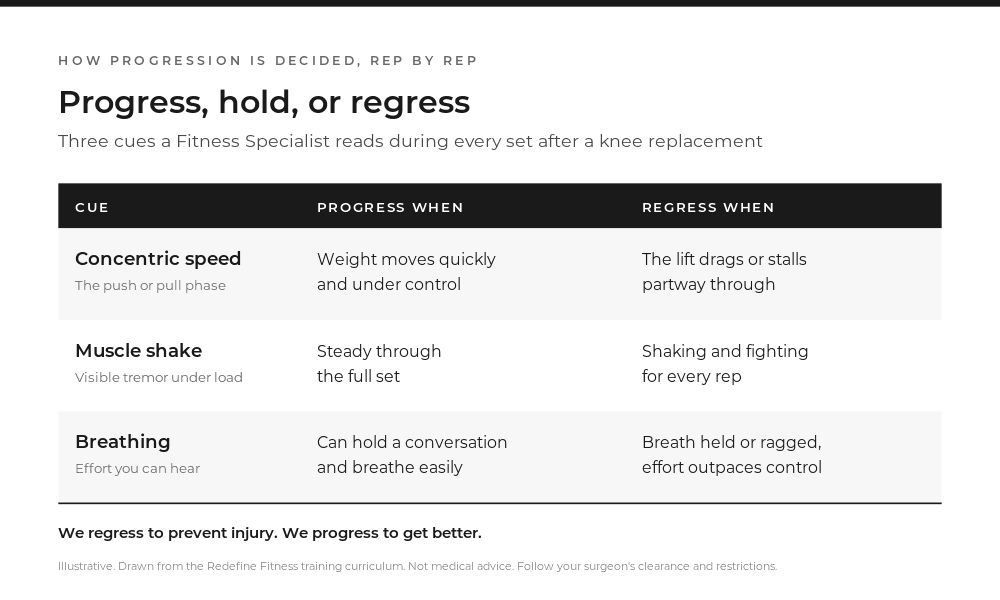
The most important skill in post-surgical training is not picking exercises. It is knowing when to add load and when to back off, and the decision is made rep by rep, not on a calendar. Three cues drive it.
The first is the speed of the concentric portion of the movement, the part where you push or pull the weight. If it moves quickly and under control, it is time to progress. If it is dragging, it is time to regress. The second is muscle shake. Shaking and fighting for every rep means the movement is too hard for today, whatever it was last week. The third is breathing. Someone who can hold a conversation through a set has room to progress.
The rule underneath all three is simple: we regress to prevent injury, we progress to get better. After a joint replacement, both directions matter equally. Under loading leaves capacity on the table that the joint was built to handle.
What a session looks like once you are cleared
A session has a shape, and the shape is not arbitrary.
Warm up. The RAMP protocol: raise, activate and mobilize, potentiate. A few minutes of light cardio to raise heart rate. Dynamic movement and soft tissue work to activate and mobilize the hips, quadriceps, hamstrings, and calves. Then one or two light sets of the day’s main lower body movement to potentiate. If you are going to load a knee, you still start with body weight.
Compound movements first. Compounds use multiple muscle groups at once and come first so nothing involved in them is pre-exhausted. After a knee replacement, two categories matter most: the lower push, meaning squat and lunge patterns like the sit to stand, the leg press, and the split squat, and the lower pull, meaning hinge patterns like the hip hinge and the hip thrust. The hinge is underrated here. It loads the glutes and hamstrings heavily while asking relatively little of the knee, which lets total strength climb even on days the knee needs a lighter touch.
Accessory work. Isolation movements target one muscle group and exist to improve the compounds. Knee extension for the quadriceps, knee flexion for the hamstrings, and calf work for the gastrocnemius and soleus.
Balance and proprioception. Balance work starts in stable environments with clear support options: weight shifts, split stance holds, marching patterns, and controlled single leg work with something to hold. The rule is to progress complexity before removing support. Standing on one leg on an unstable surface is a late stage skill, not a starting point.
The movement patterns worth building
Rather than thinking in muscles, think in the seven functional movement patterns: squat, hinge, lunge, push, pull, carry, and rotate. After a knee replacement, three of them carry the most weight.
The squat is getting out of a chair and up from the floor. The lunge is every stair and every curb. The carry is groceries, a grandchild, and a suitcase, and it trains the entire body to stay stable while the legs do their job. Progress inside those three and the new knee becomes something you stop thinking about, which is the entire point of having it.
Progression inside a pattern uses the FITT levers: frequency, intensity, time, and type. A sit to stand progresses by lowering the seat, adding a weight to the chest, slowing the descent, or moving to a split stance. It needs to keep asking a little more than last time. That is progressive overload, and it is the only way adaptation continues.
Structuring the week
Two rules govern the week. Train every muscle group at least twice, and allow a minimum of 48 hours of recovery for a muscle group between sessions that target it. Two sessions a week is typically full body. Consistency at two well built sessions beats four inconsistent ones.
The reason recovery is non negotiable comes from general adaptation syndrome. A training session is the alarm phase, where performance temporarily drops. The resistance phase is where the body recovers and rebuilds slightly above where it started, which is called supercompensation. The exhaustion phase is what happens when the next stress arrives before adaptation finishes: more soreness, less strength, and more risk. After a joint replacement, the joint itself is an extra signal. Swelling or stiffness that is worse the day after a session and lingers usually means the dose was too high for that day, which is why load is decided rep by rep rather than by a printed program.
When this is not a fitness question
Some things are outside our lane, and we will tell you so directly.
New or increasing swelling, warmth, or redness around the joint, calf pain or tenderness, fever, a sudden loss of range of motion, a feeling of instability or giving way, and pain that is sharp rather than muscular all belong with your surgeon first. So does the question of when you are cleared for loading at all, and whether there are movements your surgeon wants avoided. We ask for that information before the first session, and we follow it.
Training is not a substitute for surgical follow up or physical therapy, and we do not present it as one. It works best in a lane next to your medical care, not on top of it.
How we approach this at Redefine Fitness
Redefine Fitness is a medical fitness company, not a gym. Every session is private and one on one with a Fitness Specialist. No classes, no semi private sessions, no online programming. Our Fitness Specialists are trained through a New York State approved apprenticeship curriculum, which is the same curriculum the anatomy and training principles in this article are drawn from.
That structure exists because of the individuality principle. A printed program cannot see the concentric speed slow down on rep six, notice the shake, or hear the breathing change. A Fitness Specialist watching you move in real time can. The thinking is handled for you. You execute the system.
We operate two Long Island studios: Mount Sinai at 271 Route 25A and Stony Brook at 1113 North Country Road. If you are managing arthritis in the other knee or a hip, our guide to exercise for knee and hip arthritis covers that starting point. If you are over 55, our guide to strength training after 55 applies the same principles to a different baseline, and you can see the full list of what we do on our services page.
Where to start
If you have been discharged from physical therapy and the knee still does not feel like yours, the next step is not a harder home workout. It is a plan built around your surgery, your clearance, your other leg, and what you actually want the new joint to do.
Book Your Call. We will talk through your surgical history, what your care team has cleared, and what a structured program would look like for you. No pressure, no obligation.