Balance Isn’t Luck. It’s Trainable.
Falling is not an inevitable part of getting older, it’s the result of specific abilities quietly fading. Every one of them can be trained back. What erodes balance, and the work that rebuilds it. Built from how we coach it every day.
100+ conditions studied
1-on-1, never more than 3-5 in the studio
Everything tracked (InBody / DEXA)
A 2-minute balance self-check (do it near a counter)
Balance is measurable. Try these with a countertop within arm’s reach for safety:
| The test | A strong result | What it reflects |
|---|---|---|
| Stand on one leg, eyes open | Hold it steady, no grabbing | Single-leg control, the everyday balance you use on stairs and curbs |
| Heel-to-toe stand (one foot directly in front of the other) | Hold it without stepping out | Narrow-base stability |
| Stand from a chair without hands, 5 times | Smooth and controlled | Leg strength & power, you can’t balance on legs that can’t hold you |
| Turn 360° in place | Few steps, no unsteadiness | Dynamic balance while moving |
Wobble or reach for support on any of these? That’s not fragility to accept, it’s a specific, trainable ability with your name on it.
Why we fall, and why it’s not random
Balance isn’t one thing. It’s several systems working together, and falls happen when they weaken:
- Strength, legs that can actually hold and catch you.
- Power / reaction speed, the ability to fire fast when you stumble. This fades faster than strength and matters enormously.
- Reactive balance, the automatic step or grab that saves you when you trip. It can be trained directly.
- Proprioception, your body’s sense of where it is in space.
The good news is that every one of these responds to the right training, which is why balance is one of the most rewarding things to work on.
What the research actually says: a large Cochrane review found that exercise reduces the rate of falls in older adults by roughly a quarter, and that the most effective programs are the ones that genuinely challenge balance and include strength work. Notably, walking programs alone did not show the same benefit, and for some, extra walking without balance training just adds exposure. The active ingredient is challenge, not steps.
The four systems we train, in order
| System | What it does | How we build it |
|---|---|---|
| 1. Strength base | Legs strong enough to hold you | Sit-to-stands, step-ups, hinges |
| 2. Static → dynamic balance | Stability standing, then moving | Single-leg holds → narrow-base → walking drills |
| 3. Reactive balance | The save when you actually trip | Controlled nudges, quick stepping, catch drills |
| 4. Power & stepping speed | Firing fast enough to matter | Fast stand-ups, quick step-outs |
Your working set, from steady to reactive
- Sit-to-stands. You can’t balance on legs that can’t stand you up. Build the base first. 3 sets of 8-10.
- Single-leg holds, progressed. Start with support, then fingertips, then hands-free, then eyes-closed near a counter. 3 × 20-30 seconds each side.
- Tandem and narrow-base walking. Heel-to-toe along a line, then head turns while you walk. Trains balance in motion. 3-4 passes.
- Step-ups and lateral steps. Strength and control in every direction you actually move. 2-3 sets of 8 each way.
- Quick stepping. Step out fast to a target and recover, this rehearses the exact save that stops a stumble becoming a fall. 2-3 sets of 5 each direction.
- Fast stand-ups. Up fast, down slow. Trains the power that fades first. 3 sets of 5.
Balance is a skill, and skills need progressive challenge, done safely, at the edge of your ability, with a spotter early on. That last part is why this is worth doing with someone.
Do this today, your first 10 minutes (near a counter)
- Single-leg holds, 3 × 20 seconds each side. Fingertips down only if you need them.
- Sit-to-stands, 2 × 8. No hands if you can.
- Heel-to-toe walk, 3 passes. Slow, controlled, eyes forward.
Ten minutes. Do it a few times this week and you’ll already feel steadier, balance responds fast.
How you’ll know it’s working, track these
- Single-leg hold: seconds before you reach for support. Trending up = safer.
- Chair stands: clean reps in 30 seconds, leg power returning.
- Confidence: stairs, curbs, and turning in the kitchen without thinking about it.
- Near-misses: fewer stumbles that almost became something.
When you train with us we log these in-app and reassess on a set cadence, progressing the challenge as you improve. We don’t guess, we measure.
The cycle worth breaking
After a stumble or a fall, it’s natural to do less, but doing less makes you weaker, and weaker makes the next fall more likely. Fear of falling quietly restricts activity, and that restriction predicts future falls. The way out isn’t to move less and hope; it’s to rebuild the strength and balance that make you genuinely steadier, and let real capability replace the fear.
See your doctor first if…
Talk to your physician before starting if you have dizziness or vertigo, fainting spells, a recent fall with injury, new numbness or weakness, or if you take medications that affect balance or blood pressure. Some balance problems have a medical cause that training alone won’t address, and we’d rather you get that checked than push through it.
What a first month looks like with us
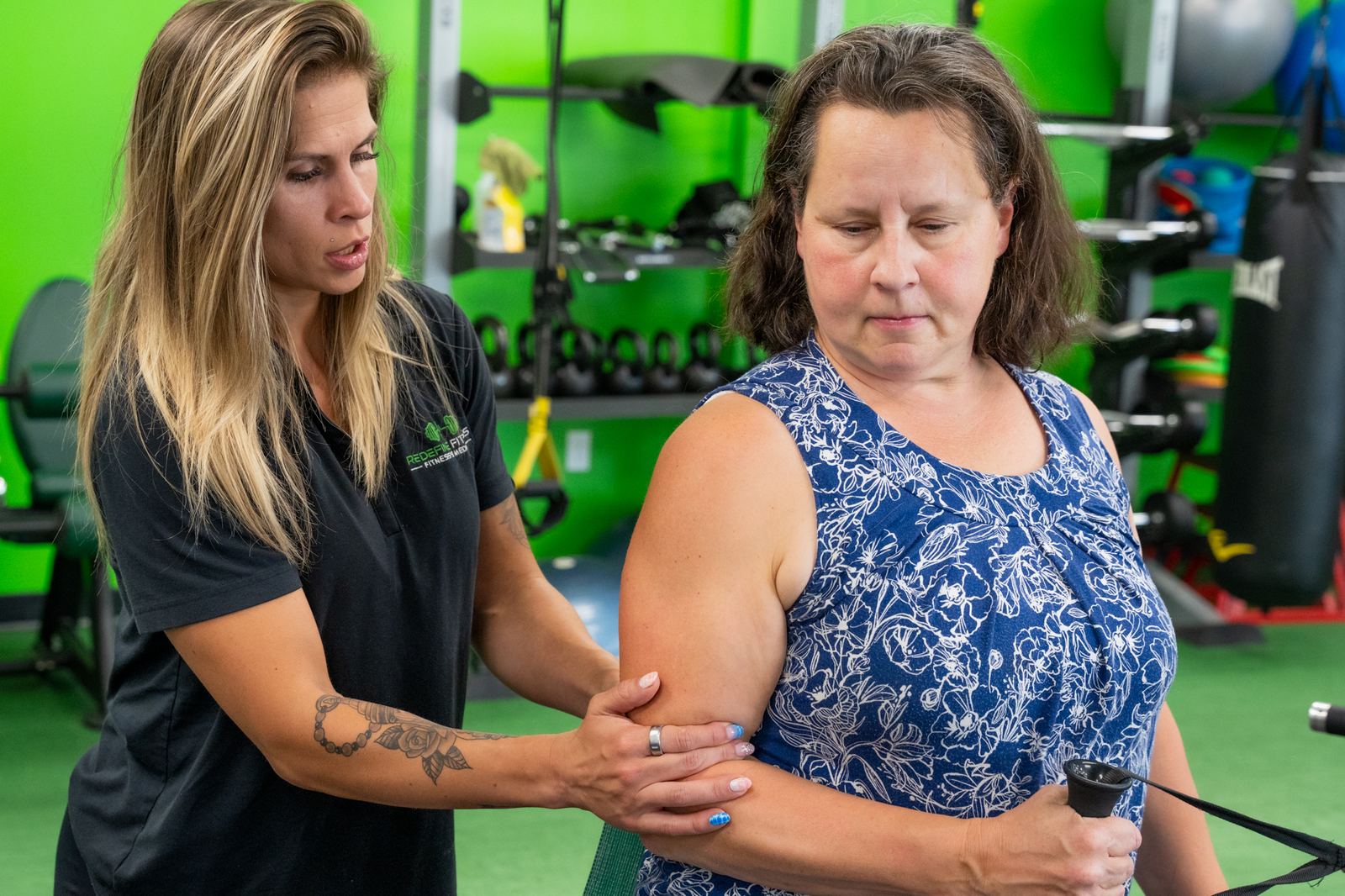
Every session is 1-on-1 with a Fitness Specialist. Weeks 1-2, establish your leg-strength base and static balance, screen where you’re least steady. Weeks 3-4, progress to dynamic and reactive work, add stepping speed and power, and layer in real-world challenges. Built around your history, adjusted every session, always at the edge of your ability but never past safety.
What the evidence shows
A Cochrane systematic review of over 80 trials found exercise reduces the rate of falls in community-dwelling older adults by roughly a quarter, with balance and functional training the most effective category and combined balance-plus-strength programs strongest of all (Sherrington et al., Cochrane Database Syst Rev, 2019). Training the automatic “save” directly, perturbation-based balance training, has been shown to reduce falls (Mansfield et al., Phys Ther, 2015). And fear-driven activity restriction predicts future falls, underscoring why rebuilding real capability matters (Delbaere et al., Age and Ageing, 2004). The evidence also points to dose: meaningful, ongoing balance challenge, on the order of a few hours a week, sustained, is what moves the needle. Balance is not a personality trait. It’s trained.
Common questions
Isn’t some loss of balance just part of aging?
Some change is normal, but most of what people accept as “just aging” is trainable, strength, reaction speed, and reactive balance all respond to the right work at any age.
I’ve already fallen. Is it safe to train balance?
Yes, and it’s exactly why it’s done one-on-one, at the edge of your ability with a spotter, and progressed carefully. We’d also want to know the cause of the fall so anything medical gets checked first.
How fast will I notice a difference?
Balance often improves quickly, many people feel steadier within a couple of weeks of consistent, progressive work. Holding those gains means keeping it up.
Every session at Redefine is one-on-one with a Fitness Specialist who finds where you’re least steady and rebuilds it, safely, progressively, measured every step. Two Long Island locations, everything tracked.
General fitness education, not medical advice. We build strength and capability; we don’t diagnose or treat. We always recommend checking with your doctor.
This is what we build programs around every day.
Want the reasoning behind this? Read the long form article: Rebuilding Mobility: Balance, Walking and Functional Strength.