
Yes, there are specific exercises recommended for post-rehabilitation training, but they are not random workouts or cookie-cutter strength routines. In post-rehabilitation training, every exercise serves a purpose: to rebuild stability, restore strength, correct movement patterns, and progressively prepare your body for the activities of daily life and beyond.
At Redefine Fitness in Mount Sinai and Stony Brook, NY, we design post-rehabilitation exercise programs that bridge the gap between recovering from injury and truly thriving in everyday movement and athletic tasks.
What Is Post-Rehabilitation Training?
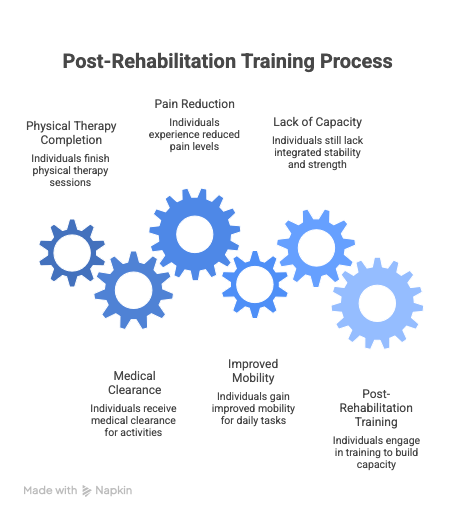
When someone completes physical therapy, they are often:
- Cleared medically
- Pain-reduced
- Mobile enough to perform basic functions
However, medical clearance doesn’t guarantee physical capacity. Many individuals still lack:
- Integrated stability
- Symmetrical strength
- Confidence in movement
- The ability to tolerate real-world loads
That’s where post-rehabilitation training truly becomes necessary, it goes beyond recovery to build capacity.
Why Specific Exercises Matter
Generic workouts are not appropriate immediately after rehabilitation. The wrong exercise or the wrong intensity can:
- Reinforce compensatory movement patterns
- Lead to stiffness in inappropriate ranges
- Cause discomfort or re-injury
- Slow long-term progress
Thoughtful selection avoids these pitfalls and prepares your body for safe progression.
Foundational Movement Patterns for Post-Rehabilitation
Movement is best trained through integrated, functional patterns rather than isolated muscles alone. These primary patterns form the backbone of most exercise progressions:
- Squat, trains hip, knee, and ankle integration
- Hinge, teaches safe posterior chain strength
- Lunge, restores unilateral strength and balance
- Push / Pull, builds upper body stability and strength
- Carry, enhances bracing under load
- Rotation, develops core control and functional integration
Stability Exercises That Build a Strong Foundation
Core Stability
Core stability isn’t about abdominal aesthetics, it’s about training the trunk to resist unwanted movement and protect the spine.
Common core stability drills include:
- Dead bugs
- Pallof presses
- Side planks
- Farmer’s carries
These drills teach coordinated stabilization under load, which is critical for safe lifting and functional movement.
Joint Stability Drills
In addition to core stability, joint-specific drills help the nervous system learn to control vulnerable areas like ankles, knees, hips, and shoulders.
Examples include:
- Single-leg balance reaches
- Split squat holds
- Bottoms-up kettlebell carries
- Stability ball wall holds
These drills build co-activation of muscle groups responsible for joint control.
Strength Progressions for Functional Capacity
Once stability is established, strength can be introduced and progressed.
Strength comes not from high loads alone, but from controlled, progressive, and purposeful loading.
Lower Body Strength: Squat and Hinge Progressions
| Pattern | Early Stage | Later Stage |
|---|---|---|
| Squat | Sit-to-stand | Goblet or barbell squat |
| Hinge | PVC hip hinge | Romanian deadlift or trap bar |
Squat progressions restore hip and knee strength with proper alignment and control.
Hinge progressions activate the glutes, hamstrings, and posterior chain, vital for lifting and everyday function.
Lunges for Unilateral Strength
- Reverse lunges
- Split squats
- Walking lunges
Upper Body Strength and Post-Rehab Exercise Selection
Horizontal Push and Pull
Incline push-ups help rebuild pressing mechanics with less stress.
Cable or TRX rows reinforce balanced pulling and improved posture.
Vertical Push and Pull (When Appropriate)
- Dumbbell overhead presses
- Lat pulldowns or assisted pull patterns
Mobility Work That Enhances Movement Quality
- Dynamic hip flexor and hamstring mobilizations
- Thoracic spine extensions for overhead movement quality
- Ankle mobility drills to support squat mechanics
- Chest and lat mobility to assist upper body movement
Carry Patterns: Training Real-World Load
- Farmer’s carry
- Suitcase carry
- Overhead carry (advanced)
Low-Impact Plyometrics (When Ready)
- Box step-offs
- Medicine ball throws
- Light jump squats
Next Step: Get Started with Redefine Fitness
Learn more or schedule an assessment today.
👉 Get Started
FAQ’s
What types of exercises are typically included in post-rehabilitation training programs?
Post-rehabilitation training programs include exercises specifically chosen to restore stability, rebuild strength, correct movement patterns, and safely reintroduce load.
Which exercises are most appropriate immediately after completing physical therapy?
Immediately after physical therapy, exercises should emphasize control and stability before heavy strength work.
How does a structured post-rehabilitation program differ from a standard workout routine?
A structured post-rehabilitation program prioritizes movement quality, joint control, and progressive overload based on individual needs.
If you’re ready to transition from recovery to resilient strength: