
PT Got You Out of Pain. Now Get Strong Again.
Discharge means you’re no longer a patient. It rarely means you’re back to full strength. That space, out of pain but not yet resilient, is exactly where we work. Built from how we coach it every day.
100+ conditions studied
1-on-1, never more than 3-5 in the studio
Everything tracked (InBody / DEXA)
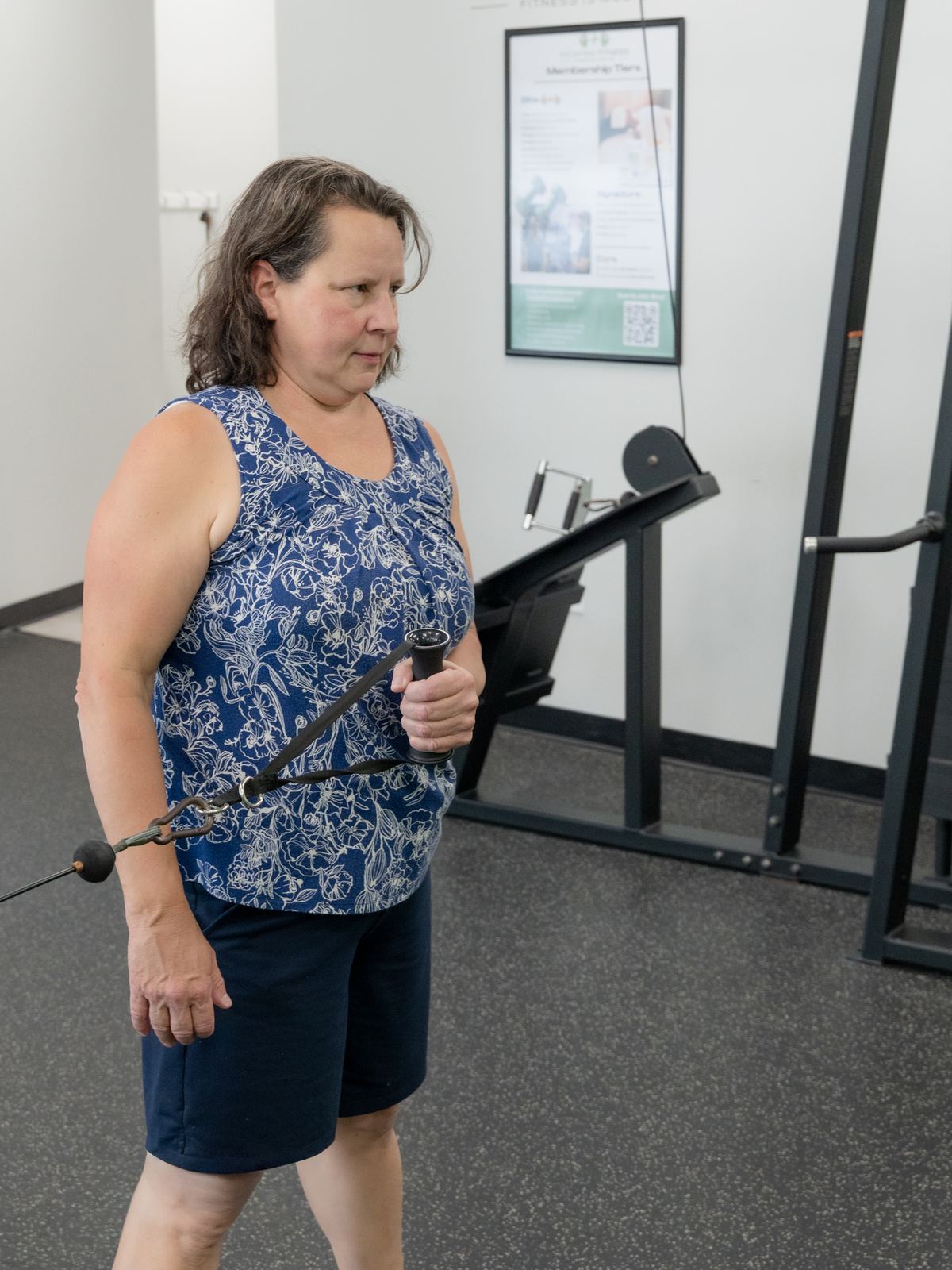
Are you stuck in the discharge gap? A quick read
Physical therapy did its job: it calmed things down and got you moving. But “no longer in pain” and “as strong and capable as before” are two very different finish lines. Check yourself:
| Sign you’re in the gap | What it really means |
|---|---|
| You still favor the side or trust it less | Strength and confidence haven’t caught up to comfort |
| You avoid certain movements “just in case” | Fear is quietly keeping you deconditioned |
| The injured side feels noticeably weaker | A real strength gap the eye can’t see but a test can |
| You were told “you’re good to go” but don’t feel it | You were discharged at baseline, not at your ceiling |
| You’ve stopped progressing and quietly plateaued | Capacity you don’t rebuild, you slowly lose |
Two or more of these is the discharge gap. It is not a setback, it’s the normal place PT hands off, and the exact work most people never finish on their own.
Why “out of pain” isn’t the finish line
Pain usually settles well before strength returns. The clearest example comes from knee-surgery research: people are often cleared to return to activity while the operated leg is still measurably weaker than the other one. That lingering gap matters, and closing it is what actually lowers the odds of getting hurt again.
The number that reframes everything: in a well-known study of athletes returning after knee reconstruction, those who met objective strength and function criteria before returning had a dramatically lower re-injury rate than those who returned on feel alone, the difference was on the order of an 84% reduction in re-injury for those who met the criteria (Grindem et al., 2016). The lesson isn’t only for athletes: getting strong enough is what protects you, not just getting comfortable.
The four jobs that close the gap
| Job | Why it matters |
|---|---|
| 1. Close the side-to-side strength gap | The injured side has to catch up to the other one, on purpose |
| 2. Rebuild capacity beyond pain-free | Tissue that’s merely “okay” isn’t the same as tissue that’s robust |
| 3. Restore confidence through graded exposure | You beat the fear by meeting the movement in controlled doses, not avoiding it |
| 4. Make it stick | Strength you stop training, you lose, maintenance isn’t optional |
Your working set, from cleared to capable
- Load the injured pattern, symmetrically. Whatever the area, knee, shoulder, back, train both sides and deliberately push the weaker one to catch up. Progressive, controlled, 2-3 sets.
- Single-limb work. Split squats, step-ups, single-arm presses and rows expose the side that’s been hiding behind the strong one. This is where gaps close. 2-3 sets of 8-10 each side.
- Graded exposure to what you avoid. The movement you’re nervous about, reintroduced in a controlled, scaled version and progressed as confidence returns.
- Build capacity above baseline. Once symptom-free, keep progressing load and volume so the tissue is stronger than it was before the injury, not just back to it.
- A full-body strength base. The rest of you got weaker while you protected one area. Rebuild the whole system.
We are not physical therapy and we don’t replace it. PT restores. We rebuild capacity on top of what PT restored, that’s a different job, and it’s ours.
Do this today, find your gap
A simple honesty check, both sides:
- Single-leg sit-to-stand (or single-arm task), each side. Count clean reps. Notice the difference between sides, that difference is your gap.
- Balance on the injured side, 30 seconds. Compare to the other side.
- The movement you avoid, scaled way down, 5 slow reps. Prove to your nervous system it’s allowed.
You just measured the exact thing to close. That’s the whole plan in miniature.
How you’ll know it’s working, track these
Don’t guess, measure, and always compare sides:
- Side-to-side gap: reps or load the injured side can match versus the other. Closing = winning.
- Load: weight on your key lifts trending up over weeks.
- Avoidance: movements you’ve added back that you used to dodge.
- Confidence: do you trust the side under real-life demand yet?
When you train with us this is exactly what we log in-app and reassess on a set cadence. We don’t guess, we measure, and symmetry is the number we watch hardest.
When to go back to your PT or doctor first
This work starts after medical discharge. Check with your PT or physician first if you have sharp or worsening pain, new swelling, a joint that gives way or locks, numbness or tingling, or if you were given specific restrictions you haven’t been cleared past. We build on top of a clean handoff, we don’t work around an unfinished one.
What a first month looks like with us
Every session is 1-on-1 with a Fitness Specialist. Weeks 1-2, measure the side-to-side gap honestly, reintroduce the movements you’ve been avoiding at a scaled load, rebuild a base. Weeks 3-4, drive the weaker side to catch up, progress load past your old baseline, restore confidence under real demand. Built around your injury history and your doctor’s guidance, adjusted every session. The goal isn’t back to normal, it’s better-built than before.
What the evidence shows
Meeting objective strength and function criteria before returning to activity was associated with a large reduction in re-injury after knee reconstruction (Grindem et al., Br J Sports Med, 2016). Fear of re-injury drives avoidance, and avoidance drives deconditioning, the fear-avoidance model is well established in the pain literature (Vlaeyen & Linton, Pain, 2000). Strength is retained for only a short window once you stop training and then progressively declines, which is why maintenance matters (Mujika & Padilla, Sports Med, 2000). And progressive overload, gradually increasing load as you adapt, is the foundational principle for rebuilding capacity (ACSM Position Stand, Med Sci Sports Exerc, 2009). The throughline: comfort is the start line, capacity is the finish line.
Common questions
Are you replacing my physical therapy?
No. PT is medical care and this isn’t. We pick up after you’ve been discharged, to rebuild strength and capacity on top of what PT restored. If anything suggests you need more medical care, we send you back.
My PT gave me a home sheet. Isn’t that enough?
A home sheet maintains the minimum. Closing a real strength gap and rebuilding capacity takes progressive loading, measured and adjusted, which is hard to do alone and easy to do with a Fitness Specialist watching the numbers.
It’s been months since PT. Is it too late?
No. The gap doesn’t close on its own, but it responds to training whenever you start. Later just means there’s a bit more to rebuild.
Every session at Redefine is one-on-one with a Fitness Specialist who measures the gap, closes it, and rebuilds you stronger than before, in step with your medical team. Two Long Island locations, everything tracked.
General fitness education, not medical advice. We build strength and capability; we don’t diagnose or treat, and we don’t replace physical therapy. We always recommend checking with your doctor.
This is what we build programs around every day.
Want the reasoning behind this? Read the long form article: Exercising With Joint Pain and After Joint Surgery.