
Your Muscle Is Where Blood Sugar Goes.
The single biggest place your body stores and burns glucose is skeletal muscle. Build more of it, and use it, and you change how your body handles sugar, even when insulin isn’t cooperating. Built from how we coach it every day.
100+ conditions studied
1-on-1, never more than 3-5 in the studio
Everything tracked (InBody / DEXA)
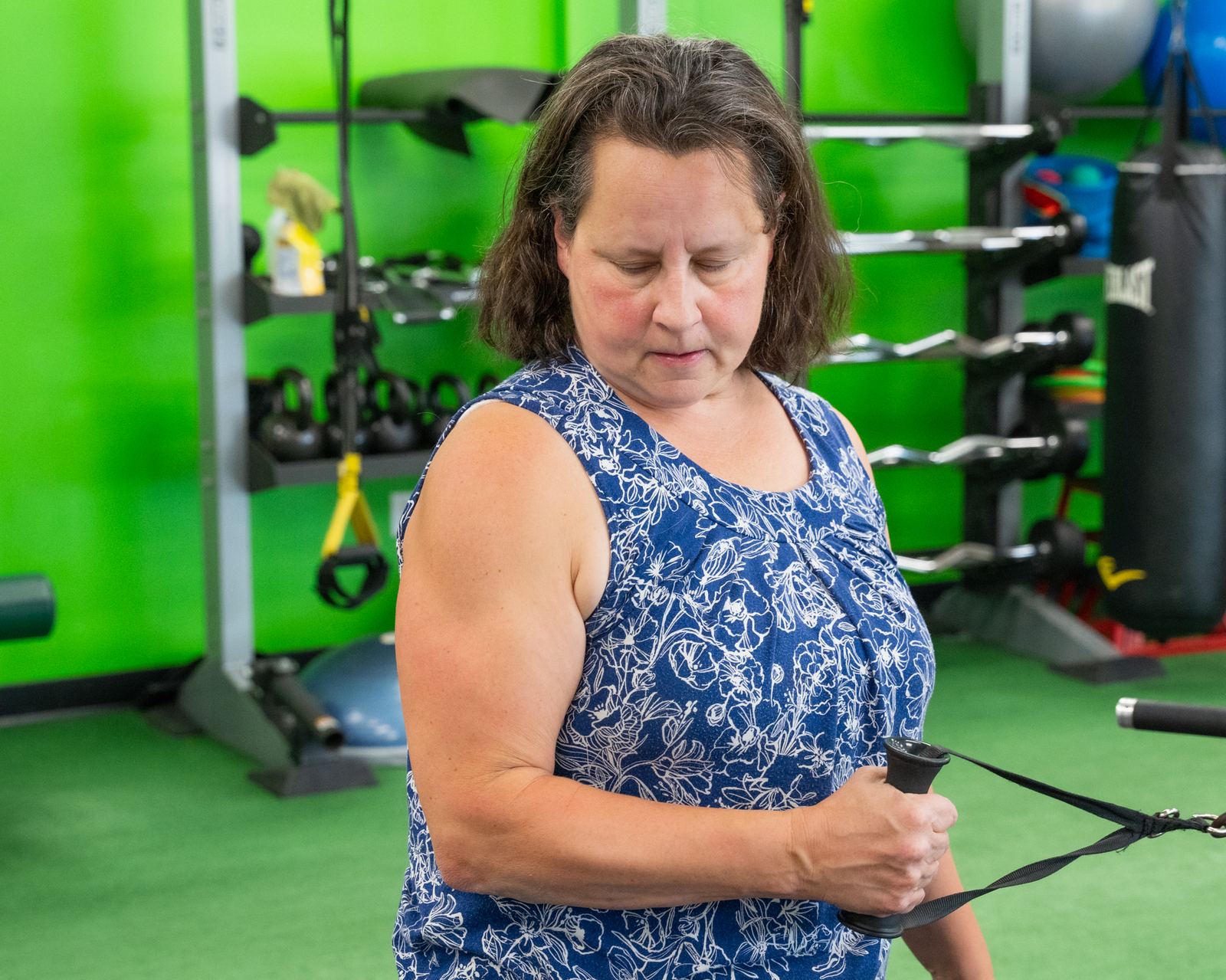
The mechanism, in one picture
After you eat, the sugar in your blood has to go somewhere. The overwhelming majority of it is taken up by your muscles. That makes muscle the body’s main glucose “tank”, and the size and activity of that tank is something you have direct control over:
| What’s true | Why it matters to you |
|---|---|
| Muscle takes up the large majority of the glucose from a meal | More muscle = a bigger tank to park blood sugar in |
| Muscle contraction pulls glucose in without needing insulin | Exercise lowers blood sugar even when insulin resistance is in the way |
| Higher muscle mass tracks with better insulin sensitivity | Strength training works on the root, not just the symptom |
Why muscle moves the needle when other things stall
Here’s the part most people never hear: when you contract a muscle, it opens a separate door for glucose to enter, one that doesn’t depend on insulin. That’s why a hard set or a brisk walk can lower blood sugar even in a body that has become resistant to insulin. You’re not fighting the broken lever; you’re using a different one entirely.
The strategic takeaway: cardio burns some sugar today. Building muscle gives you a permanently bigger place to put it, and a body that handles glucose better around the clock, not just during the workout. That’s why strength training belongs at the center of this, not on the side.
The four levers, in priority order
| Lever | What it does |
|---|---|
| 1. Build muscle | Enlarges the glucose tank and improves insulin sensitivity at the root |
| 2. Contract it often | Insulin-independent glucose uptake, works even with resistance |
| 3. Break up sitting | Short, frequent movement blunts the spikes after meals |
| 4. Stay consistent | Blood-sugar control is a daily habit, not a heroic session |
Your working set, build the tank, use the tank
- Big compound lifts. Squats, hinges, presses, rows, the movements that recruit the most muscle build the most tank. 2-3 sessions a week, 2-3 sets of 8-12.
- Full-body, not favorites. The more total muscle you train, the more glucose real estate you create. Legs and back are the biggest wins.
- Progressive load. Muscle only grows when you keep asking a little more of it over time, the load has to climb.
- Post-meal movement. A 10-15 minute walk after your biggest meals uses muscle contraction to blunt the spike, when it counts most.
- “Exercise snacks.” A few sets of sit-to-stands or a short walk every time you’ve been sitting an hour, small doses, repeated, add up.
The winning pattern is boring on purpose: build muscle two or three times a week, and interrupt sitting with movement most days. Consistency beats intensity here.
Do this today, two easy wins
- After your next big meal, walk 10-15 minutes. Easy pace. Notice you feel less sluggish, that’s muscle pulling sugar out of your blood.
- Every hour you sit today, do 10 sit-to-stands. Ten seconds of work, repeated. Your muscles open the insulin-independent door each time.
Nothing dramatic, but you just used the exact mechanism the research is built on.
How you’ll know it’s working, track these
Some of these you track with your doctor; others you feel:
- Your numbers (with your physician): fasting glucose and HbA1c on your doctor’s schedule, the long-game scoreboard.
- Strength: load on your main lifts climbing = the tank getting bigger.
- Energy: steadier energy and fewer post-meal crashes.
- Muscle: what we can measure directly on InBody over time.
When you train with us we log the strength and body-composition markers in-app and reassess on a set cadence, and we build in step with whatever your doctor is tracking on labs. We don’t guess, we measure.
Important if you take glucose-lowering medication
Exercise lowers blood sugar, which is the point, but if you take insulin or medications that can cause low blood sugar (such as sulfonylureas), training can push your glucose lower than expected. Talk to your physician about monitoring and any adjustments before you ramp up, and keep a fast-acting carbohydrate on hand. This is exactly the kind of thing we coordinate around, not guess at.
What a first month looks like with us
Every session is 1-on-1 with a Fitness Specialist. Weeks 1-2, establish clean technique on the big lifts, set a sustainable starting load, build the post-meal-movement habit. Weeks 3-4, progress load to grow muscle, add full-body volume, dial in the daily movement pattern. Built around your health history and your doctor’s guidance, adjusted every session. The goal is a body that handles sugar better because it’s stronger.
What the evidence shows
Skeletal muscle is the primary site of glucose disposal, it takes up the large majority of a glucose load (DeFronzo & Tripathy, Diabetes Care, 2009). Muscle contraction stimulates glucose uptake through an insulin-independent pathway that remains functional even in insulin-resistant muscle (O’Neill, Diabetes Metab J, 2013). Structured exercise, including resistance training, is associated with meaningful reductions in HbA1c in type 2 diabetes (Umpierre et al., JAMA, 2011). Breaking up prolonged sitting with brief activity lowers post-meal glucose and insulin responses (Dunstan et al., Diabetes Care, 2012). And higher relative muscle mass is associated with better insulin sensitivity and lower odds of prediabetes (Srikanthan & Karlamangla, J Clin Endocrinol Metab, 2011). The physiology is consistent: build muscle, use it often, and your body handles glucose better.
Common questions
Can strength training reverse or cure my diabetes?
We don’t make medical claims, and your condition is managed with your physician. What the evidence supports is that building and using muscle improves how your body handles glucose, a powerful lever that works alongside your medical care, not instead of it.
Is cardio or strength training better for blood sugar?
Both help, and they’re not either/or. Cardio burns glucose in the moment; strength training builds a bigger place to store it and improves insulin sensitivity around the clock. That’s why we anchor the plan in strength and add movement on top.
Does this help with PCOS or insulin resistance too?
The core mechanism, muscle as a glucose sink and insulin-independent uptake, applies to insulin resistance broadly. Evidence specific to resistance training for PCOS is still emerging, so we lean on the well-established fundamentals and coordinate with your physician.
Want the food side handled for you? Redefine’s RD-Led Nutrition coaching is built one-on-one by a Registered Dietitian around your health history, goals, and training.
Every session at Redefine is one-on-one with a Fitness Specialist who builds the muscle and the habits that change how your body handles sugar, in step with your medical team. Two Long Island locations, everything tracked.
General fitness education, not medical advice. We build strength and capability; we don’t diagnose or treat. We always recommend checking with your doctor, especially regarding any medication.
This is what we build programs around every day.
Want the reasoning behind this? Read the long form article: Strength Training and Blood Sugar.