After 50, Muscle Is the Organ of Longevity.
Your body stops volunteering strength, it only keeps what you ask for. What actually changes after 50, what to train, what to stop wasting time on, and how to start this week. Built from how we coach it every day.
100+ conditions studied
1-on-1, never more than 3-5 in the studio
Everything tracked (InBody / DEXA)
First, a 60-second read on where you actually are
Age on a birth certificate tells you almost nothing. Function tells you everything. Run yourself through these, they are the same everyday markers a Fitness Specialist watches:
| The test | What a strong result looks like | What it tells you |
|---|---|---|
| Stand from a chair without using your hands, 5 times | Smooth, no push-off, no wobble | Leg strength & power, the #1 predictor of staying independent |
| Balance on one leg, eyes open | Hold it, steady, without grabbing something | Balance and ankle control, your fall insurance |
| Carry something heavy from the car in one trip | You’d rather carry it than make two trips | Grip and whole-body strength, grip tracks with longevity |
| Climb a flight of stairs and talk at the top | Not gasping, legs not burning | Leg endurance and capacity |
Struggle with any of them and that is not “getting old.” That is a trained capacity you have lost and can get back. None of these require you to already be fit, they show you the target.
What actually changes after 50, and why “just do cardio” fails you
Three things shift, and none of them are fixed by walking more:
- You lose muscle on autopilot. Adults lose roughly 3-8% of their muscle per decade after 30, and it accelerates after 60. Nobody schedules this, it just happens in the background unless you actively pull against it.
- You lose power faster than strength. Power, the ability to produce force quickly, fades faster than raw strength. Power is what catches you when you trip and what gets you out of a low chair. Slow walking never trains it.
- Recovery gets more honest. You can still train hard, you just can’t train sloppy. Junk volume and ego lifting cost more than they return. Precision beats punishment.
The reframe that changes everything: muscle is not about looking a certain way. It is metabolic armor and your insurance policy against frailty. Large population research associates greater muscular strength with substantially lower all-cause mortality, strength is one of the clearest signals of how well you are aging. You are not “too old to lift.” You are at the exact age where lifting matters most.
The four things that actually matter (skip the rest)
| Priority | Why it wins | What it looks like |
|---|---|---|
| 1. Progressive strength | Directly rebuilds the muscle age takes | Squat, hinge, push, pull, carry, loaded a little heavier over time |
| 2. Power / speed work | The thing that fails first and protects you most | Standing up fast, quick step-ups, throwing a light ball |
| 3. Protein, leaning high | You need more to build muscle at this age, not less | Protein at every meal, anchored around your training |
| 4. Balance | One bad fall can undo years of progress | Single-leg work, uneven surfaces, reaching under control |
The movements that carry you, your working set
You do not need a machine for every muscle. You need a handful of patterns loaded well. These are the workhorses:
- Sit-to-stand (the squat you already do). Stand from a chair, sit back down under control, no hands. Add a slight pause at the bottom. 3 sets of 8-10. Progress by lowering the seat or holding a weight to your chest.
- Hip hinge to a target. Push your hips back to tap a chair behind you, flat back, then drive up. This is how you protect your back for the rest of your life. 3 sets of 8-10.
- Loaded carries. Pick up something heavy in each hand and walk tall and slow. The single most transferable exercise there is, grip, core, posture, everything. 3-4 walks of 20-40 steps.
- Step-ups. Step onto a stair or low box, stand all the way tall, control the way down. 2-3 sets of 8 each leg.
- A push and a pull. Wall or incline push-ups, and a rowing motion with a band. Keeps the upper body and posture in the game. 2-3 sets of 8-12.
- One power move. Stand up from the chair fast on the way up, slow on the way down. Speed on the concentric is the whole point. 3 sets of 5, crisp.
Two to three sessions a week covering these beats seven days of the same walk. Load progresses as you do, that is the part most people never get right on their own.
Do this today, your first 10 minutes
No plan needed. Prove to yourself the body still responds:
- Sit-to-stands, 2 × 8. No hands if you can, slow down, then up.
- Chair hip-hinges, 2 × 8. Hips back to tap the seat, flat back.
- One-leg balance, 3 × 20 seconds each side. Fingertips on a counter if needed.
That is it. The goal today is not to be sore, it is to feel that strength is a switch you can still turn on.
Protein, the lever most people over 50 under-use
Older muscle is harder to build, which means you need more protein to trigger it, not less. Research on protein for older adults points toward the higher end, roughly 1.2 to 2.0 grams per kilogram of bodyweight per day, spread so that each meal carries a solid dose of protein (around 25-30 grams) rather than loading it all at dinner. Anchor a protein-forward meal around your training days. This is education, not a prescription, but it is the single change that most often makes strength work actually stick.
How you’ll know it’s working, track these
Don’t guess, measure. Recheck every 2-3 weeks:
- Chair stands: how many clean reps in 30 seconds. Trending up = power returning.
- One-leg balance: seconds held before you reach for support.
- Carry: how far, or how heavy, before your grip quits.
- Stairs: can you now talk at the top?
When those move, everything downstream, energy, confidence, how you feel getting off the floor, moves with them. When you train with us this is exactly what we log in-app and reassess on a set cadence. We don’t guess, we measure.
Before you load heavy, a few checks
Talk to your physician first if you have uncontrolled blood pressure, chest pressure or shortness of breath on exertion, recent surgery, sudden unexplained weakness, or a joint that is hot and swollen. Strength work is remarkably safe when it is built to you, but it should start from an honest picture of your health history, not a guess.
What a first month looks like with us
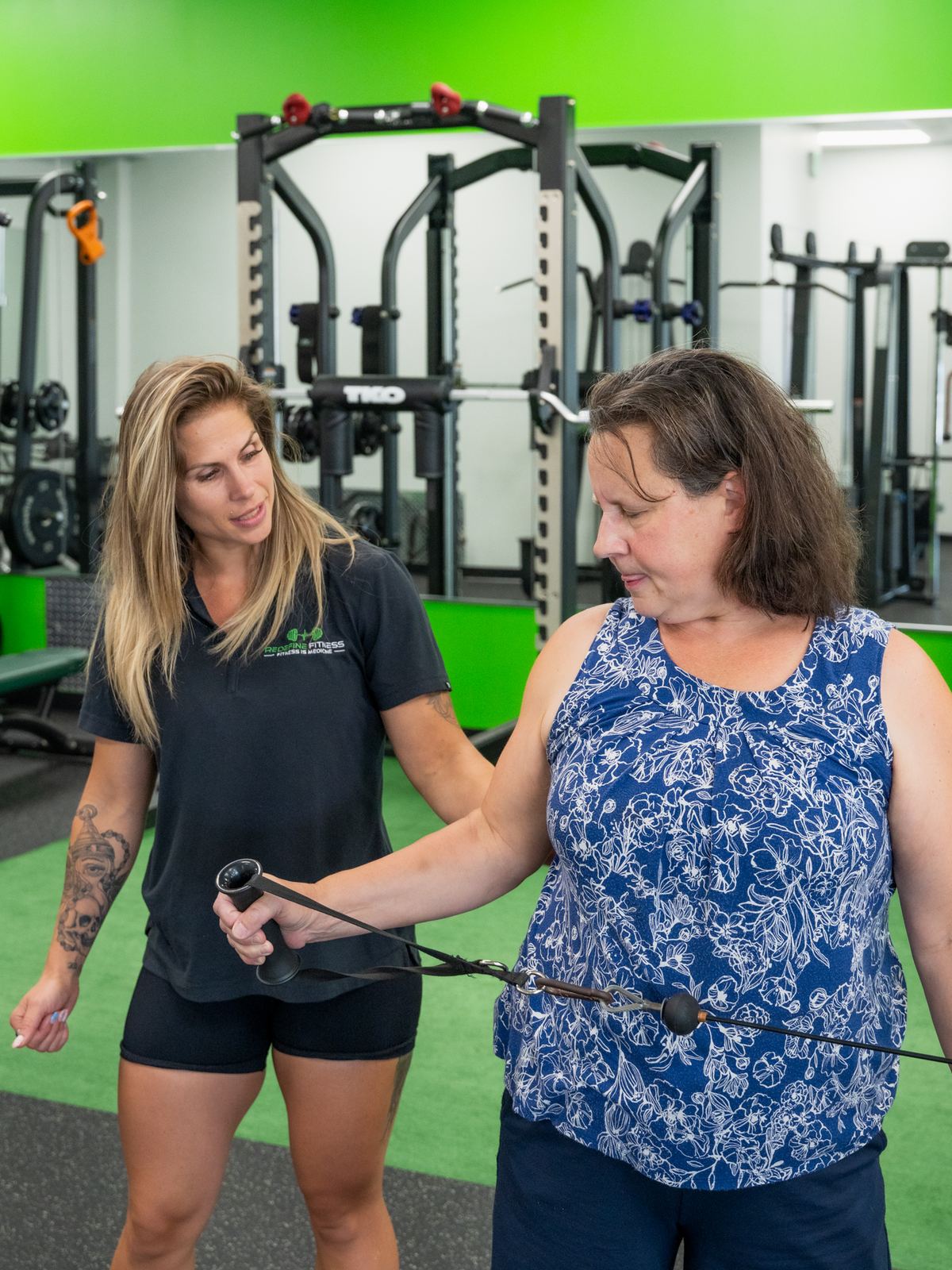
Every session is 1-on-1 with a Fitness Specialist. A typical first four weeks: Weeks 1-2, establish your baseline on the movements above, groove clean technique, find the right starting load. Weeks 3-4, add load, introduce power and balance progressions as your control improves. The plan is built around your goals and health history and adjusted every single session by how you respond. Nothing generic, nothing you have to figure out alone.
What the evidence shows
Muscle mass declines measurably with age, on the order of 3-8% per decade after 30, accelerating later (Volpi et al., Curr Opin Clin Nutr Metab Care, 2004). A meta-analysis of roughly two million adults associated higher muscular strength with markedly lower all-cause mortality (García-Hermoso et al., Arch Phys Med Rehabil, 2018). For older adults, power training tends to improve everyday physical function at least as well as, and modestly better than, traditional slow strength work (Balachandran et al., JAMA Netw Open, 2022). And higher protein intake supports muscle in older adults, with expert groups recommending the upper end of the range (Bauer et al., PROT-AGE, JAMDA, 2013). The pattern is consistent: strength, power, and protein, trained deliberately, are how you age on your terms.
Common questions
Is it too late to start lifting at my age?
No. Muscle and strength respond to training well into later decades, the research on adults in their 60s, 70s and beyond is clear that the body still adapts. The best time was earlier; the second best time is now.
I have some aches and old injuries. Can I still do this?
Yes, and that is exactly why it is built one-on-one and around your health history. We work with the body you have, not an idealized one.
Do I need to lift heavy to get the benefit?
You need to lift challenging for you and progress it over time. What is challenging is personal, the skill is loading it correctly, which is what a Fitness Specialist manages session to session.
Every session at Redefine is one-on-one with a Fitness Specialist who builds around your body, your history, and your goals, and adjusts it every time. Two Long Island locations, everything tracked.
General fitness education, not medical advice. We build strength and capability; we don’t diagnose or treat. We always recommend checking with your doctor.
This is what we build programs around every day.
Want the reasoning behind this? Read the long form article: Strength Training After 55.