A stroke changes the relationship between the brain and the body. The signal that used to travel instantly from motor cortex to muscle now arrives late, incomplete, or not at all on one side. For survivors, the months and years after a stroke are defined by a single question: how much strength, balance, and independence can be rebuilt, and how do you rebuild it safely.
Exercise is one of the most well documented tools for that process, but the exercise itself has to be programmed correctly. Generic workouts, group fitness classes, or a treadmill routine copied from a gym app do not account for the asymmetry, delayed motor recruitment, and balance deficits that come with stroke. At Redefine Fitness, our Fitness Specialists are trained through a New York State approved apprenticeship curriculum built around the nervous system, not just the muscle, as the target of every session. This article walks through the training science behind that approach and what it looks like in practice, always in coordination with, never in place of, your physical therapist, neurologist, or physician.
Fitness Training Is Not a Substitute for Clinical Rehabilitation
It is worth being direct about this before anything else. Physical therapy and occupational therapy are clinical disciplines delivered by licensed professionals who assess impairment, set functional goals, and treat the effects of stroke directly. Personal training is not that. What a medical fitness program offers is the next layer: a structured, progressive strength and conditioning plan that picks up where clinical rehabilitation leaves off, or runs alongside it, to help a client continue building capacity once they have been cleared for independent or supervised exercise.
Anyone in the early stages of stroke recovery, or with unresolved medical clearance questions, should be working with their care team first. What follows applies once a physician or therapist has given the green light for structured exercise.
The Training Principles Behind Every Session
Our internal training curriculum is built around five foundational principles that apply to every client we program for, including those recovering from neurological events. Understanding them explains why a generic program falls short.
Individuality means no two people respond to the same stimulus the same way. Two clients with a similar stroke history can have completely different presentations depending on which hemisphere was affected, how much time has passed, and their baseline fitness before the event. A program built for one is not automatically appropriate for another.
Specificity, sometimes called the SAID principle (specific adaptations to imposed demands), means the body adapts to exactly the stress it is given. If the goal is standing balance, the training has to include standing balance work under progressively harder conditions. Treadmill walking alone does not automatically transfer to getting up from a chair safely.
Progressive overload means the demand placed on the body has to increase over time for adaptation to continue. For a stroke survivor this might mean less weight and more emphasis on range, tempo, and control early on, with load, complexity, or reduced support added gradually.
Diminishing returns means progress is fastest early and slows as a client approaches their physical ceiling. This matters for expectation setting. Rapid early gains in balance or gait quality are common and encouraging, but the rate of improvement will naturally taper, and that is normal, not a plateau to panic over.
Reversibility means progress that is not maintained will regress. Consistency matters more than intensity for this population. A client training with control twice a week, every week, will outperform a client who trains hard sporadically. The same principle shows up in how we program for other populations working against decline, including our approach to strength training after 55.
Pacing Recovery: General Adaptation Syndrome
Every body, healthy or recovering, moves through the same three phase cycle when exposed to a training stress: alarm, resistance, and exhaustion. In the alarm phase, the body registers the demand and dips below baseline, showing up as fatigue or soreness. In the resistance phase, the body adapts and rises above where it started. If training continues without adequate recovery, the body enters the exhaustion phase, where performance and progress both decline.
For a client with a compromised nervous system, that exhaustion phase is reached faster and is riskier than it is for a general population client. Overworking a nervous system that is already working hard just to send clean signals can set balance and coordination back, not forward. Our Fitness Specialists build in more recovery, watch fatigue cues more closely, and aim for the state training science calls supercompensation, adapting to just above the previous baseline, rather than chasing intensity for its own sake.
Rebuilding the Fundamental Movement Patterns
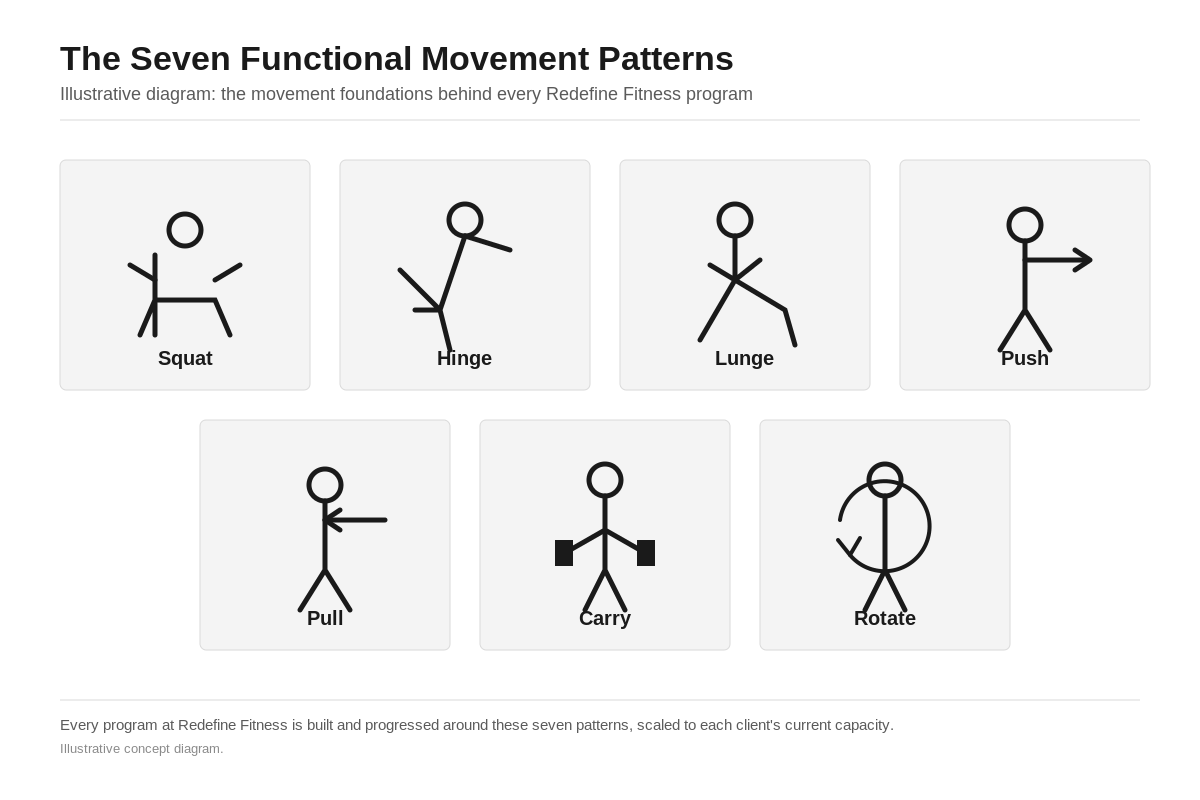
Our programming is organized around seven functional movement patterns: squat, hinge, lunge, push, pull, carry, and rotate. Every one of these underlies a real world task, and every one of them can be scaled to a client’s current capacity and progressed as capacity improves.
For a stroke survivor, the squat pattern often starts as an assisted sit to stand from a raised surface, the single most requested functional goal we hear from clients and families. The hinge pattern might begin with a supported, guided motion using a light dowel to teach the hip movement before any load is added. The carry pattern, walking while holding a weight in one or both hands, is one of the most effective ways to layer gait training, grip, core stability, and cardiovascular demand into a single exercise.
The point is progression, not the exercise itself. Every pattern has a regression that makes it accessible on day one and a progression that keeps challenging the client for years. The work is finding where a client sits on that spectrum today and moving them one deliberate step at a time.
Balance, Proprioception, and Reaction Time
Balance deficits are one of the most common and most disruptive effects of stroke, and they are trainable. Our approach breaks balance work into distinct categories rather than viewing it as one generic skill.
Proprioception work uses slow, controlled movements that build awareness of joint position and pressure through the feet, such as tempo lunges and step through patterns performed with full attention on where the body is in space. Reaction time work introduces intentional, externally cued responses, like reaching for a ball on a verbal cue or stepping in response to a call out, which trains the nervous system to fire faster without asking a client to move recklessly. Both categories start in a stable, supported environment with clear options to hold on, and complexity is added before support is removed, never the other way around.
This sequencing matters. Falls during stroke recovery tend to happen during transitions: standing up, turning, stopping short, or stepping through a narrow space. Training those specific transitional moments in a controlled setting, with a Fitness Specialist spotting every rep, is what separates a program built for this population from a generic balance class.
What a Session Actually Looks Like
Every session follows the same basic architecture our curriculum teaches for any client, adapted in intensity and complexity for a neurological population.
The session opens with a RAMP warm up: raise the heart rate with a few minutes of light movement, activate and mobilize the muscles and joints that will be used, and potentiate with one or two light sets of the day’s primary movement pattern. Compound, multi joint movements come next, chosen to match the client’s current functional goals, whether that is standing tolerance, gait mechanics, or upper body pushing and pulling strength. Isolation and accessory work follows, targeting whichever specific muscle group needs extra attention to support the compound movement, often the weaker or more affected side. The session closes with a controlled cool down to bring heart rate and effort back down gradually.
All of this happens one on one, in a private setting, with a Fitness Specialist who is not managing four other clients at the same time. That is the structural difference between a medical fitness studio and a gym: the thinking, the sequencing, and the spotting are handled, and the client’s only job is to show up and execute.
Why the Setting Matters
Redefine Fitness operates as a medical fitness company, not a gym and not a group fitness studio. Every session at our Mount Sinai and Stony Brook, New York studios is private and one on one, delivered at what we call a done with you standard, meaning the client is never handed a printed program and left to interpret it alone. A stroke survivor working through balance deficits and one sided weakness needs a Fitness Specialist watching every rep, not a class instructor cueing a room of twelve people at once.
Our Fitness Specialists are trained through a New York State approved apprenticeship curriculum built around the exact training science covered in this article: individuality, specificity, progressive overload, and structured, evidence informed balance progressions. That curriculum is also why we can coordinate meaningfully with a client’s physical therapist or physician, using shared vocabulary and shared goals rather than working in a silo.
Where to Start
If you or someone you love is navigating life after a stroke and has been cleared for structured exercise, the first step is a conversation, not a program. Every client starts with an assessment so we understand exactly where strength, balance, and mobility stand today, and we build forward from there in coordination with your existing care team.
Redefine Fitness serves the Mount Sinai and Stony Brook communities with private, one on one medical fitness training. Learn more about our medical fitness training services, then book your call to talk through what a program built around your specific recovery could look like.