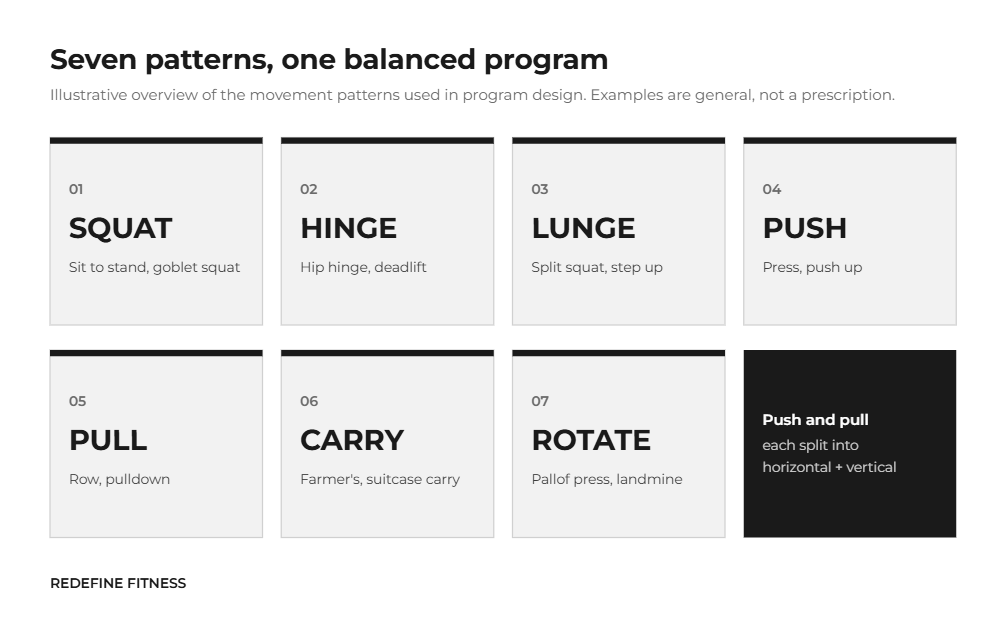
Most people describe a workout by the muscles it targets: chest day, leg day, arms. A well built program is organized differently. It starts with movement patterns, the handful of basic ways the human body squats, hinges, steps, pushes, pulls, carries, and rotates. Cover all seven in proportion to a person’s goals, history, and current capacity, and you have a program that supports real life, not just a mirror.
This is the framework our Fitness Specialists use when they build a plan at Redefine Fitness, and it comes straight from the training curriculum behind our NY State approved apprenticeship program. Here is what the seven patterns are, why they matter, and how the same pattern can look completely different for two different people.
Why patterns beat body parts
Daily life does not ask your biceps to work alone. Standing up from a chair, lifting a bag of groceries off the floor, climbing stairs, reaching a high shelf, carrying a suitcase through an airport, and turning to look behind you are all multi joint tasks. They share a few recurring shapes. Train those shapes and you train the tasks.
The exercise science concept underneath this is specificity, often summarized as the SAID principle: Specific Adaptations to Imposed Demands. The body adapts to what it is repeatedly asked to do. A body asked to sit all day gets very good at sitting all day. A body asked to squat, hinge, and carry gets better at squatting, hinging, and carrying. The curriculum we teach makes a practical point of it: the broader a person’s goals, the broader their training should be. As someone becomes more advanced, or has specific limitations to work around, training becomes more targeted.
The seven patterns
1. Squat
Lowering and raising your body with the hips and knees bending together. The everyday version is sitting down and standing up. In the gym it ranges from a sit to stand from a box, to a goblet squat holding a single dumbbell, to a barbell back squat. The pattern is the same. The load, depth, and support change.
2. Hinge
Bending at the hip while the spine stays long and neutral. This is how you pick something up off the floor without rounding your back. Common training versions are the Romanian deadlift (RDL), the trap bar deadlift, and the conventional deadlift. A simple dowel or PVC pipe held along the spine is a classic way to teach the three points of contact: back of the head, upper back, and tailbone. The hinge works the glutes and hamstrings, the muscles that most people underuse after years of sitting.
3. Lunge
Single leg, split stance work: split squats, step ups, walking lunges. Real life is rarely symmetrical. Every step you take is a brief single leg moment, so this pattern matters for balance, stability, and for spotting differences between the left and right sides.
4. Push, horizontal and vertical
Pressing away from your body (a push up, a bench press) is horizontal. Pressing overhead (a dumbbell overhead press) is vertical. They load the chest, shoulders, and triceps differently, and shoulders in particular tend to be happier when both are trained thoughtfully and within a comfortable range.
5. Pull, horizontal and vertical
Rows are horizontal pulls. Pulldowns and pull ups are vertical pulls. Pulling work builds the upper back and lats, which counterbalance all the pushing and desk posture most adults accumulate. A strong, well balanced push to pull ratio is one of the simplest ways to keep a program shoulder friendly.
6. Carry
Walking while holding load: farmer’s carries (a weight in each hand), suitcase carries (one side only), and pinch carries for grip. Carries train grip, trunk stability, posture, and walking mechanics all at once. They are also underrated for everyday readiness, since most of what we lift in life, we also have to move somewhere.
7. Rotate
Producing or resisting rotation through the trunk: Pallof presses, landmine rotations, and similar work. Twisting is part of golf, gardening, getting into a car, and playing with kids. Training the trunk to control rotation is a core of its own, separate from crunches.
Some frameworks count nine patterns, but these seven cover the large majority of what a general program needs.
Same pattern, very different progressions
Here is where the framework earns its keep. The pattern stays constant. The version depends on the person. Our curriculum lays out four example clients to make this concrete: a powerlifter who needs to progress strength, an athlete who needs to progress explosiveness, an older adult who needs to progress stability, and a general population client who needs to progress mobility. Take the squat:
- An older adult might progress from an assisted sit to stand to a goblet squat, building stability and confidence.
- A general population client might progress from a sit to stand to a barbell back squat, with mobility as the focus.
- A powerlifter might progress from a goblet squat to a barbell back squat, with strength as the focus.
- An athlete might progress toward box jumps or jump squats, with explosiveness as the focus.
Same pattern, four different paths. These are hypothetical examples to show the logic. There are nearly endless progressions and regressions for each pattern, and no definitive lines between them.
How a pattern gets harder (or easier)
Moving along a progression is not guesswork. The standard tool is progressive overload, gradually increasing the demand so the body keeps adapting (we cover it in detail in progressive overload explained). The FITT principle gives four levers for doing it: frequency, intensity, time, and type. Changing the type of exercise, for example from a sit to stand to a goblet squat, is a progression just like adding load.
Specialists also read cues in real time. Three of the most useful:
- Concentric speed. The concentric phase is the lifting or shortening part of the rep. If the weight moves up quickly and under control, it may be time to progress. If the concentric phase is slow and grinding, it may be time to regress.
- Muscle shake. If someone is shaking and fighting for every rep, the load or version may be too hard for today.
- Breathing. If someone can hold a conversation and is breathing easily mid set, there is probably room to progress.
None of these is a rule on its own. Together they let a specialist adjust within a single session, which is much of the value of private one on one training.
Where patterns fit inside a session
A session built on patterns tends to follow a predictable shape. It opens with a warm up (see the RAMP warm up explained): raise heart rate, activate and mobilize the joints and muscles about to be used, and potentiate with one or two light sets of the first main lift. Then come the compound movements, the multi joint patterns above, while the person is fresh. Smaller isolation or accessory exercises come after, chosen to support the big patterns. If grip fails first on deadlifts, for example, a forearm exercise earns a spot. Compound first is a rule of thumb, not a law. A conditioning day or a recovery focused day may be organized differently.
Training is also only half the equation. Adaptation happens during recovery, which we cover in recovery and supercompensation. And reversibility cuts both ways: patterns you stop practicing will fade, which is exactly why consistent exposure matters.
Using this on your own: a simple self check
You do not need a gym to learn something useful from this framework. Look at your last two weeks of exercise and ask which of the seven patterns showed up.
- Lots of pushing and no pulling? Add a row variation.
- Plenty of squats but never a hinge? The back of your body is probably getting less attention than the front.
- No single leg work and no carries? Those are two of the most common gaps, and two of the easiest to add.
- Never rotating, always moving straight ahead? Consider adding some trunk control work.
Start with versions that feel clearly manageable, move through a comfortable range, and build gradually. If you have a medical condition, a recent injury, or a surgery in your history, check with your healthcare provider about what is appropriate before changing your routine. Exercise at Redefine Fitness works alongside your care team, not instead of it.
What this looks like at Redefine Fitness
Our programs are private and one on one, built from your health history, with a Registered Dietitian on the plan and a Nurse Practitioner Clinical Advisor behind our standards. We are a medical fitness company, not a gym. Your Fitness Specialist chooses the version of each pattern that fits your goals and current capacity, then adjusts it session by session using the cues above. You can see how it works at our Mount Sinai studio or our Stony Brook studio. For a look at training later in life, see senior strength training after 55.
Wondering what your own program would look like? Book your 15 minute call. We will talk through your health history and goals, and tell you plainly whether we are a fit.
This article is general education and is not medical advice. It does not diagnose, treat, or prescribe. Talk with your healthcare provider before starting or changing an exercise program.