Most people judge a workout by how tired they feel afterward. That is a poor measure. A well built session is judged by its order, its exercise selection, and how it fits into the week around it. The same ten exercises, arranged differently, can produce very different results and very different levels of risk.
This guide walks through how a session is structured at a medical fitness studio: what comes first, what comes last, why, and how the weekly plan holds it together. It is general education. It is not medical advice, and it works alongside your healthcare providers, not instead of them.
Why Structure Matters More Than Intensity
The body adapts to the demands placed on it. Exercise scientists call this the SAID principle: specific adaptation to imposed demands. A body asked to do one thing repeatedly becomes good at that one thing. Ask it to squat, hinge, push, pull, and carry with good mechanics, and it gets better at those tasks.
That is why a session should be built, not improvised. Every minute competes for a limited pool of energy and attention. If the hardest, most technical work lands at the end, when you are fatigued, you get sloppier movement and a higher chance of strain. If the most important work lands first, while you are fresh, you get quality repetitions and a clearer signal to adapt to.
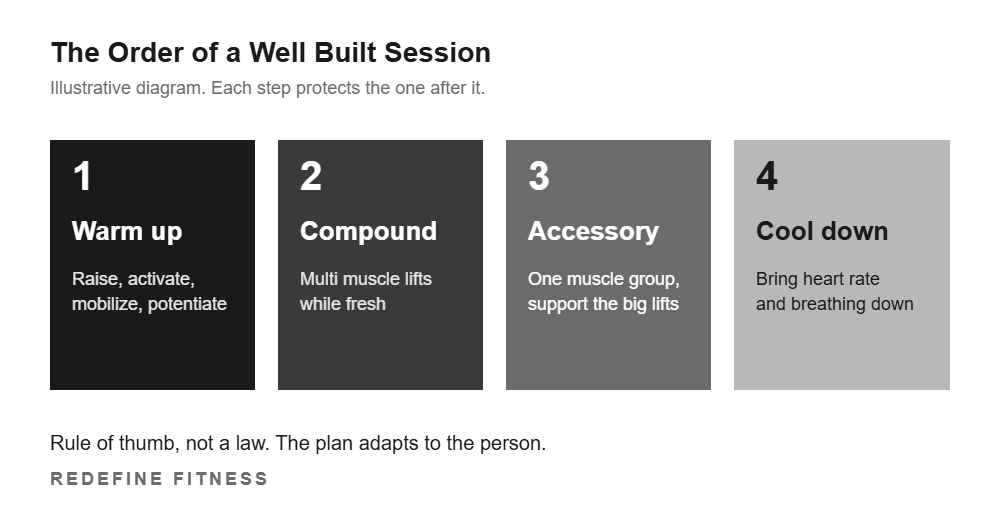
Step 1: The Warm Up (Raise, Activate and Mobilize, Potentiate)
A good warm up follows a simple sequence known as RAMP. Raise body temperature and heart rate with a few minutes of light cardio. Activate and mobilize the muscles and joints you are about to load, using dynamic movement rather than long static holds. Then potentiate: perform one or two light sets of the main lift you plan to do, so the nervous system and the working muscles are primed.
The potentiate step is the one people skip, and it matters most. Walking straight up to a heavy load is a reliable way to strain something. Even an experienced lifter planning a heavy bench press starts with the empty bar. If you want the full breakdown, read our guide to how the warm up works.
In real life, time is limited and plans get disrupted. A practical solution is a short, repeatable dynamic routine of roughly three to five minutes that applies to almost any session, then a lighter ramp up on the first lift. Consistency beats an elaborate routine you skip.
Step 2: Compound Movements First
Compound movements use several muscle groups and joints at once. They are the core of most sound programs because they train patterns you use in daily life: getting out of a chair, lifting a bag, pushing yourself off the floor, pulling a door open. A useful way to organize them:
- Upper push: push ups, bench press, overhead press
- Upper pull: rows, lat pulldowns, pull ups
- Lower push: squats, lunges, leg press
- Lower pull: deadlifts, hip thrusts, good mornings
These map onto the broader set of seven movement patterns that a balanced program covers.
Why first? Because of pre exhaustion. Imagine you plan to bench press but you have already fatigued your triceps with isolation work. Your body compensates, the chest and shoulders take on more than they should, and technique drifts. Keeping the stabilizing and assisting muscles fresh for the big lift lowers that risk. There are exceptions: a high intensity interval day, a recovery day, or a person with a very specific goal may reorder things on purpose. Think of compound first as a rule of thumb, not a law.
Step 3: Accessory Work That Serves the Main Lift
Isolation or accessory exercises train one muscle group at a time. Their job is to support the compound lifts, not to fill space. The best accessory choice usually comes from a weak link you observed in the main lift.
For example, if grip gives out before the legs and back do during deadlifts, forearm and grip work earns its spot. If the knees cave inward during squats, hip strength work earns its spot. A Fitness Specialist watching your movement can spot these patterns quickly, which is one reason private, one on one sessions are different from following a template online.
Accessories also lend themselves to circuits. Pairing or grouping exercises that use different muscles lets one area recover while another works. You fit more useful work into a limited window and keep your heart rate up, without sacrificing form. Some people prefer longer rests, and that is fine. The right format depends on the person.
Step 4: The Cool Down
The purpose of a cool down is to bring heart rate and breathing back toward baseline and ease the transition out of the session. A slow walk and some gentle stretching or soft tissue work is typical.
Here is the honest nuance: if a session was moderate, a long cool down adds little. Many people get more value by using the final minutes for a bit more effort, such as trunk work or a short conditioning finisher, and then walking out. If the session was demanding, a few minutes of easing down is sensible. Match it to the effort, not to a script.
Reading the Session in Real Time: Progress, Hold, or Regress
A structure is only a starting point. During the session, the person leading it adjusts based on cues, because no one can feel your effort from the outside. Three that matter:
- Speed of the concentric phase. The lifting portion of a repetition slows down as a muscle fatigues. A sharp slowdown suggests the load is near your limit for that set.
- Muscle shake. Visible tremor can indicate a muscle is working near its capacity. A little is expected. A lot, paired with breakdown in form, is a signal to stop or lighten.
- Breathing. Breath holding, gasping, or strain in the face and neck are signs to reduce the demand or lengthen the rest.
When you handle all three well, it is usually time to progress. When form degrades, regress. Progression can come from several levers, often summarized as FITT: frequency, intensity, time, and type. Changing one at a time keeps cause and effect clear. This is the practical side of progressive overload.
The Weekly Plan: Where Single Sessions Fit
One session is a piece of a larger pattern. Two guidelines shape most well designed weeks.
Train each major muscle group about twice per week. Hitting a muscle once per week is workable, but twice gives more practice and more stimulus for the same total effort. This is widely used in strength training guidance, and individual needs vary.
Leave about 48 hours between sessions that load the same muscles. Adaptation happens during recovery, not during the workout. After a hard session, performance dips, then rebuilds to a level slightly above where it started. That rebound is called supercompensation. Train again too soon and you may never reach it. Wait too long and the gains fade, a principle called reversibility. Our guide on recovery and supercompensation goes deeper.
How those guidelines play out depends on how often you train:
- One to two sessions per week: full body each time. Volume per session stays modest, but every area gets covered, which beats leaving gaps and creating imbalances.
- Three sessions per week: an upper, lower, full body rotation works well because everything gets hit twice. A classic push, pull, legs split trains each area only once weekly at this frequency.
- Four or more sessions per week: more options open up, including upper and lower alternation, or days with a different emphasis such as strength, power, or recovery work.
There is no single perfect split. The goal is to balance enough training volume to keep progressing with enough rest to avoid piling up fatigue.
Individuality: Why Your Plan Should Not Match Anyone Else’s
Everything above is a framework. Individuality is the reason it bends. Two people can follow the same plan and respond differently because of age, training history, sleep, stress, medications, joint health, and goals. A powerlifter needs to progress strength. An athlete may need to progress explosiveness. An older adult may need to progress balance and the ability to get up from the floor. A busy parent may need consistent, simple full body sessions.
This is why a health history matters before the first workout. Past injuries, surgeries, and current conditions shape which exercises are appropriate, which need modifying, and which should wait. Your physician or physical therapist remains the authority on your medical care. A fitness program should fit around their guidance, and ask for it when needed.
A Quick Self Check on Your Own Sessions
If you train on your own, run through these questions:
- Do I warm up with a ramp up set of my first lift, or do I jump straight into working weight?
- Do my hardest, most technical exercises come first, while I am fresh?
- Does each accessory exercise have a reason tied to a main lift?
- Am I training each major muscle group about twice a week, with rest between?
- Am I changing one variable at a time when I progress?
- If something hurts in a sharp or unusual way, do I stop and ask a qualified professional?
If you answered no to two or more, small changes to order and spacing can improve both results and safety. People over 55 should also read our guide on strength training after 55.
How This Looks at Redefine Fitness
Redefine Fitness is a medical fitness company, not a gym. Sessions are private and one on one, built from your health history, with a Registered Dietitian on the plan and a Nurse Practitioner Clinical Advisor behind our standards. Our Fitness Specialists train through an apprenticeship curriculum approved by New York State, which is where the session structure above comes from. We work with you, and we build it to a done for you standard. You can see the details on our pricing page, or visit our Mount Sinai and Stony Brook studios.
A complimentary consultation comes first. No obligation. We learn your health history and goals at our Mount Sinai or Stony Brook studio, then build the plan around you. Book Your Complimentary Consultation
This article is for general education and does not provide medical advice, diagnosis, or treatment. Talk with your healthcare provider before starting or changing an exercise program.