Heel pain that is at its worst in the first ten steps of the morning is one of the most common complaints we hear at our Long Island studios, and one of the most commonly waited out. People stretch the sore spot, buy a more supportive shoe, and hope it settles. Sometimes it does. Often it comes back, because the tissue that hurts is rarely the tissue that created the problem.
This guide covers what is happening under your foot, why the ankle above it is usually the more important place to intervene, and how a strength program is built around all of it. This is education, not a diagnosis. Foot and heel pain has many possible causes and some of them need a physician. Our job is the fitness side of the equation, alongside your care team rather than instead of it.
Your feet are the base of everything above them
Every step starts at the ground. The foot is the first structure to accept load, the first to absorb impact, and the first to tell the rest of the body what the surface underneath it is doing. When it does that job well, nothing upstream has to think about it. When it does not, everything upstream compensates.
Picture a clock full of gears, with one gear bent slightly out of shape. Its path is altered, wear stops being evenly distributed, and eventually the whole system runs badly. Bodies work the same way. When one joint loses the range it is supposed to have, the joints around it change how they move to cover the difference. Those substitute patterns are inefficient, awkward, and they raise injury risk over years.
The structures that matter, in plain terms
The plantar aponeurosis is one large ligament running from the base of the heel out to the toes. It is the band under your arch, and it is built to be stiff, because a stiff arch is what lets you push off the ground efficiently.
The Achilles tendon attaches the calf to the heel. The calf is two main players. The gastrocnemius is the visible one and it originates above the knee, at the femur. The soleus sits underneath and originates below the knee, at the head of the fibula. That difference matters more than it sounds, and we will come back to it.
The tibialis posterior and the peroneal muscles run down the inside and outside of the lower leg into the base of the foot. Between them they control whether the foot rolls inward or outward under load.
The intrinsic foot muscles live entirely inside the foot and control the arch and the toes. Almost nobody trains these, and almost everybody has spent decades in shoes that did the work for them.
What is usually going on with plantar fascia pain
If a provider has told you your heel pain is coming from the plantar fascia, the mechanical picture is generally that the tissue is being asked for more than it is currently prepared to give. It is not that the band is weak in some abstract sense. It is that the structures meant to share the load, the calf complex, the tibialis posterior, and the intrinsic foot muscles, are not holding up their share, so the band absorbs the difference on every step.
The fitness side of the equation looks like this: releasing the tissue under the foot with a golf ball or lacrosse ball, stretching the foot flexors, building the calf complex through slow eccentric calf raises, and directly strengthening the toes and the arch, often described as building the foot dome. While symptoms are still acute, one practical adjustment is to avoid walking barefoot on hard rigid surfaces such as tile and hardwood, which give the foot nothing to work with and everything to absorb.
None of that is a treatment for a diagnosed condition. It is a change in the demands placed on the tissue and a build up of the structures around it. That distinction is the entire job.
Four other complaints that show up constantly
Shin splints. Aching along the front of the shin that worsens with running or jumping, driven by repetitive impact and poor shock absorption. The work is strengthening the tibialis anterior and improving dorsiflexion.
Overpronation. Arches collapsing inward, with discomfort on the inside of the foot under load. The work is strengthening the arch, regaining control of the toes, and using barefoot balance and single leg stability work.
Oversupination. The opposite pattern, a high rigid arch carrying pressure on the outside of the foot. The work leans the other way: releasing and mobilizing the arch and ankle, strengthening the foot extensors.
Bunions. Extra bone formation at the base of the big toe, toes visibly compressed inward. Wide toe box footwear, restoring toe splay, and strengthening the arch.
Overpronation and oversupination call for close to opposite interventions. That is why generic foot advice fails so many people, and why a program built for one person does not transfer to the next.
Ankle stiffness is often the real constraint
Restricted dorsiflexion is one of the most common and least noticed limitations in the general population. There is a simple way to get a feel for it. Put your foot about five inches from a wall, drop into a half kneeling position, and drive your knee toward the wall. If your heel lifts off the floor to get there, dorsiflexion is likely restricted.
When it is, the body finds range somewhere else. The knee drifts inward, the torso pitches forward to reach depth in a squat, and the hips or low back absorb motion that should have come from the ankle. People feel it at the knee or the back and go looking for the answer there, several joints away from the actual constraint.
One useful detail: because the gastrocnemius originates above the knee, a calf stretch with a bent knee slackens it and shifts the stretch lower toward the Achilles, while a straight knee targets the gastrocnemius higher up. Knowing which one you are doing is the difference between stretching and going through the motions.
Balance at the ankle is also not passive. Stability is the body’s ability to resist, and it comes from opposing muscles working together. In the lower leg the calves and the shins are that pair: shift backward and the shins contract, shift forward and the calves contract, and often both contract at once to lock the position. An unstable body is a weak body and usually a body in some degree of pain, because instability disrupts joint mechanics on the simplest tasks, such as walking or carrying groceries in from the car.
What the training science says
Specificity and progressive overload. The body makes specific adaptations to imposed demands. If you want the intrinsic foot muscles and the calf complex to tolerate load, you have to load them, and the load has to keep climbing. Walking more is a different stimulus and will not produce the same adaptation, and the same three drills at the same difficulty for six months stop changing anything.
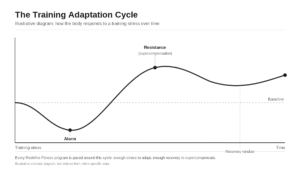
General adaptation syndrome and supercompensation. Training is a stressor. The body moves through an alarm phase where performance dips, then a resistance phase where it adapts and rebuilds above its previous baseline. Push past what recovery can absorb and you reach an exhaustion phase instead, where soreness stops being productive and progress goes backward. With connective tissue, which remodels more slowly than muscle, respecting that line matters.
Reversibility, individuality, and diminishing returns. Adaptations fade when the stimulus stops, so strength built over twelve weeks does not stay for free. Two people with identical symptoms can need opposite work, as overpronation and oversupination show. And the further along you get, the more precise the stimulus has to be to keep producing change. That is the practical case for private, one to one programming. When something has to change, the levers are the four in FITT: frequency, intensity, time, and type.
What a foot friendly session actually looks like
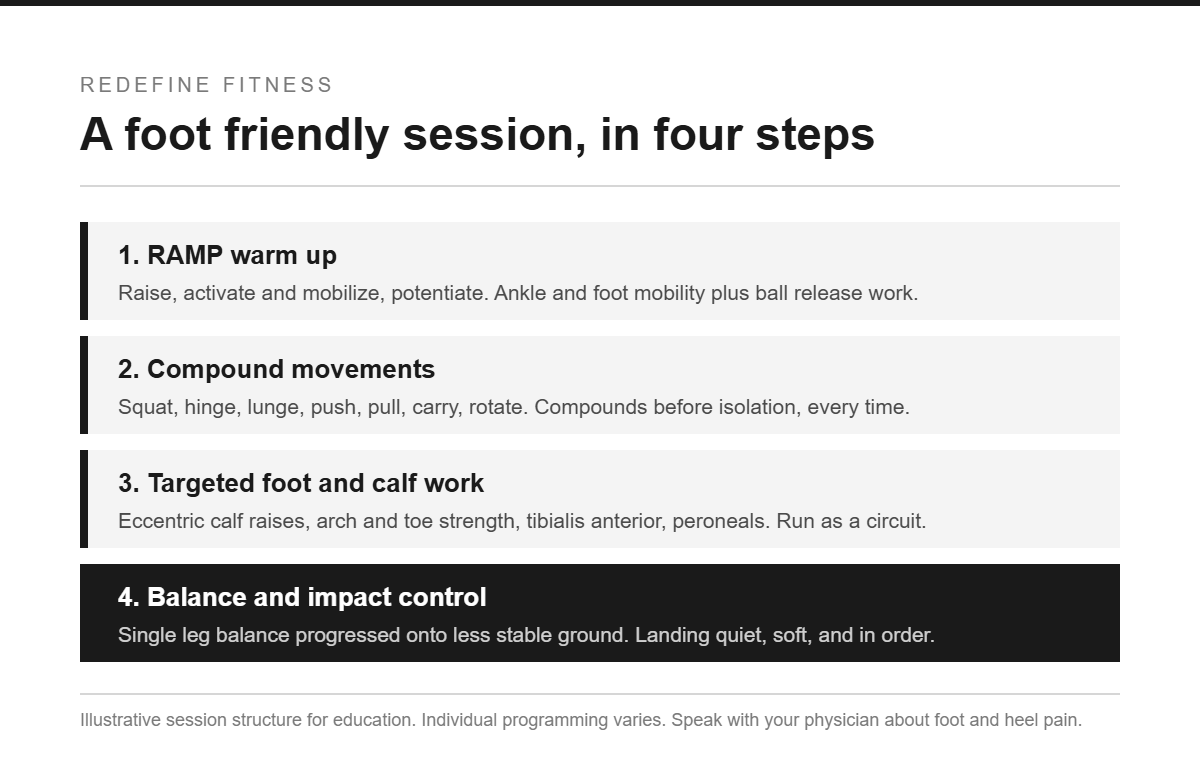
1. RAMP warm up. Raise heart rate and tissue temperature, activate and mobilize the joints about to be used, then potentiate with lighter versions of the movements to come. For this population the mobilize step centers on the ankle and foot, and ball release work often lands best here.
2. Compound movements first. Squat, hinge, lunge, push, pull, carry, and rotate are the patterns that cover the body. Compounds come before isolation work, because pre-fatiguing the small stabilizers and then asking them to hold you together under a heavier load is how sessions go wrong. Loaded carries earn a mention, since they train the foot, the arch, and the trunk under real load with none of the impact.
3. Targeted foot and calf work. Slow eccentric calf raises, toe and arch work, tibialis anterior strengthening, and peroneal and tibialis posterior work. Programmed as a circuit, this fits a limited window without losing volume.
4. Balance and impact control. The way to build stability at a joint is to introduce instability deliberately, which at the ankle means single leg balance progressed onto a less stable surface. Then there is landing, which is a skill. The ankle gives first, then the knee, then the hip, then the back, the way a car is engineered to crumple in a collision. A good landing is quiet and soft. Landing stiff sends everything straight into the joints.
Across a week, the general target is training each muscle group at least twice with roughly forty eight hours of recovery in between.
When this is not a fitness question
Burning, tingling, or numbness on the bottom of the foot points toward nerve involvement rather than simple tissue overload, often the posterior tibial nerve being compressed at the inside of the ankle, and that belongs with your physician first. So does pain getting worse week over week, pain following a specific injury event, and any sudden change in the shape or function of the foot. We work alongside physicians and physical therapists and we are direct about where the fitness side ends.
If you have finished physical therapy and are unsure what comes next, it is worth reading how post-rehabilitation training differs from physical therapy. If your interest is staying on your feet as you age, our guide to strength training after 55 covers the same ground from the other direction.
Training with us on Long Island
Redefine Fitness is a medical fitness company, not a gym. Every session is private and one to one with a Fitness Specialist. No classes, no semi private sessions, no online programming. The thinking is handled for you and you execute the system, which is what allows a program to be built around your ankle, your history, and your goals rather than a template. We have two Long Island studios: Mount Sinai at 271 Route 25A and Stony Brook at 1113 North Country Road, and you can see the full range of what we do on our services page.
If your feet have been the reason you have put off training, that is the conversation worth having. Book your call and we will walk through where you are and what a program built around it would look like.