Most women who come to us with a PCOS diagnosis have already been told to exercise. What almost none of them have been told is what kind, how often, how hard, or why. The advice usually stops at “lose weight and do more cardio,” which is not a training plan. It is a wish.
This guide covers what the exercise science actually supports, how a strength program is structured, and where the real leverage sits. Polycystic ovary syndrome is a medical diagnosis. It is diagnosed and managed by your physician, endocrinologist, or OBGYN, and nothing here changes that. This is education about training, offered alongside your care team rather than instead of it.
Start by separating the diagnosis from the training plan
PCOS is a clinical condition with a clinical workup behind it. Bloodwork, imaging, symptom history, and a provider who knows your case. That belongs to your medical team.
Training is a separate question with a separate body of evidence. It asks what physical stress you apply, how your body adapts to it, and whether that adaptation moves you toward strength, muscle, energy, and capacity. Those are fitness outcomes, and they are ours. Confusing the two is why so much PCOS exercise advice is useless. It gets written as though exercise were a prescription with a dose, when exercise is a stimulus with an adaptation.
Why skeletal muscle is the leverage point
Skeletal muscle is the largest tissue in the human body by mass and the largest single site of glucose uptake in it. That is textbook physiology, not a claim about any condition. When you build muscle, you build capacity: more tissue that works, more tissue that stores, more tissue that produces force.
It matters for training design because muscle is one of the few tissues you can meaningfully add to on purpose, over months of structured work. It also matters because muscle is the thing most commonly lost when someone approaches this the wrong way. A large calorie deficit paired with high volume cardio and no resistance training is a reliable way to lose weight and lose muscle at the same time. The scale moves. The body underneath it gets weaker. That is not what anybody wanted.
The reason cardio alone stops working
There is a principle in exercise science called SAID: specific adaptations to imposed demands. The body makes specific adaptations to specific stressors. It is not a philosophy. It is the most reliable rule in the field.
SAID cuts both ways. A body asked to sit on the couch all day becomes very good at sitting on the couch all day. A body asked to jog at the same pace for forty minutes becomes efficient at jogging at that pace for forty minutes, which is another way of saying it learns to do the same work for less. Wonderful for a distance runner. Frustrating for someone whose goal was to change their body composition.
None of this makes cardiovascular work bad. Conditioning is genuinely valuable and belongs in the week. The mistake is treating it as the whole plan and expecting an adaptation it was never going to produce. If you want more muscle, you have to impose a demand for more muscle.
The principles that actually govern your results
Five principles decide whether a program works. They are not optional and they do not care how motivated you are.
Specificity. The body adapts to what you ask of it. Ask clearly.
Progressive overload. The stimulus must increase over time for adaptation to continue. The same three sets of the same weight for the same ten reps, forever, is maintenance work. Nothing is wrong with maintenance. Just do not expect it to be progress.
Individuality. No two people respond to the same stimulus in the same way. This is the principle that most online programs violate on purpose, because a template cannot know you. Your recovery capacity, your history, your symptoms, your schedule, and your starting point all change what the correct program is.
Diminishing returns. As you progress, the rate of progression slows. The first six months are the fastest six months you will ever have. Expecting that rate to hold at year three is how people quit.
Reversibility. Progress regresses if it is not purposefully maintained. Detraining is real and it is faster than anyone wants it to be.
Underneath all five sits FITT: frequency, intensity, time, and type. Those four levers are how you apply progressive overload. Train more often, train harder, train longer, or change what you train. Most people only ever pull the intensity lever, and then wonder why they are exhausted and stuck.
Training harder is not the same as training better
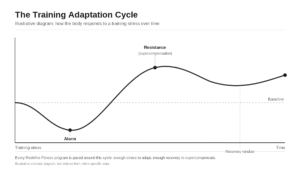
This is the section that matters most for anyone dealing with fatigue. General adaptation syndrome describes how a body responds to a stressor in three phases. The alarm phase is the stress itself, the training session, where performance temporarily drops. The resistance phase is where the body recovers and adapts, rebuilding to a point slightly above where it started. That overshoot above baseline is called supercompensation, and it is the entire reason training works.
The exhaustion phase is what happens when the stress keeps coming and adaptation never gets to complete. Performance drops below the original baseline. You are more sore, more tired, weaker, and more likely to get hurt, while doing more work than the person making steady progress.
A well built program sits deliberately in that narrow band between resistance and exhaustion. Enough stimulus to force adaptation, enough recovery to let it happen. Someone already fatigued has less room in that band, not more. The instinct to answer a plateau with more sessions and more intensity is usually the exact wrong move.

What a well built session looks like
A session has a shape, and the shape is not arbitrary.
Warm up. The RAMP protocol: raise, activate and mobilize, potentiate. Light cardio to raise heart rate. Dynamic stretching and soft tissue work to activate and mobilize the joints and muscle groups the session needs. Then one or two light sets of the day’s main lift to potentiate. That last part is the one people skip, and it is the one that keeps you healthy. If you are going to lift something heavy, you still start with something light.
Compound movements first. Compounds use multiple muscle groups at once, and they come first so that nothing involved in them is pre-exhausted. If you fatigue your triceps before you press, your chest overcompensates and your injury risk goes up. Compounds also produce the most adaptation per minute, which matters when you have limited time.
Accessory work in circuits. Isolation movements target one muscle group and exist to improve the compounds. Programming them as circuits lets one muscle group rest while another works, which packs more quality work into less time and keeps the heart rate up. You get resistance training and conditioning out of the same twenty minutes.
These are rules of thumb, not laws. A recovery focused day, a corrective exercise phase, or a specific limitation will change the order on purpose. The point is that deviations should be deliberate.
Structuring the week
Two rules govern the week. Train every muscle group at least twice, and allow a minimum of 48 hours of recovery for a muscle group between sessions that target it.
Everything else is negotiable. Two days a week is typically full body. Three days opens up push, pull, legs or an upper, lower, full split. Four days allows real specialization, including a dedicated mobility and recovery day. Consistency at two well built sessions beats four inconsistent ones. Reversibility is the principle at work: a program you keep doing for two years beats the perfect one you abandon in March.
The movement patterns worth building
Rather than thinking in body parts, think in the seven functional movement patterns: squat, hinge, lunge, push, pull, carry, and rotate. Every one maps onto something real. Getting off the floor, climbing stairs, putting a bag in an overhead bin, carrying groceries, turning to look behind you. Progress inside those patterns and your body gets more capable in a way that transfers. A program organized around them will always beat one organized around a list of machines.
When this is not a fitness question
Some things are outside our lane, and we will tell you so directly.
New or worsening pelvic pain, irregular or heavy bleeding that concerns you, chest pain, dizziness or fainting during exertion, unexplained shortness of breath, and any symptom that is new since you started training all belong with a physician first. So does the question of whether you are cleared for exercise at all, particularly if you have other diagnoses or are taking medication that affects heart rate, blood pressure, or blood sugar.
Training is not a treatment for a diagnosed condition and we do not present it as one. It works best in a lane next to your medical care, not on top of it.
How we approach this at Redefine Fitness
Redefine Fitness is a medical fitness company, not a gym. Every session is private and one on one with a Fitness Specialist. No classes, no semi private sessions, no online programming. Our Fitness Specialists are trained through a New York State approved apprenticeship curriculum, which is the same curriculum the principles in this article are drawn from.
That structure exists because of the individuality principle. A template cannot account for your history, your symptoms, your recovery capacity, or the fact that some weeks are harder than others. A Fitness Specialist watching you move in real time can. The thinking is handled for you. You execute the system.
We operate two Long Island studios: Mount Sinai at 271 Route 25A and Stony Brook at 1113 North Country Road. If you are earlier in the process or over 55, our guide to strength training after 55 covers the same principles applied to a different starting point, and you can see the full list of what we do on our services page.
Where to start
If you have been told to exercise without being told how, the next step is not a harder workout. It is a plan built around your body, your history, and what your physician has told you.
See if you’re a fit. We will talk through your goals, your history, and what a structured program would look like for you. No pressure, no obligation.
Common questions
Does strength training help with PCOS?
International PCOS guidance recommends regular physical activity including muscle strengthening on two non consecutive days a week, as part of overall management. Training builds skeletal muscle, which is the largest site of glucose uptake in the body. That is physiology, not a treatment claim. Your diagnosis and any medication remain with your medical team.
Is cardio or weights better for PCOS?
Both have a place, but a plan built only on cardio tends to stall. Adding resistance training preserves and builds muscle, which changes the body doing the work rather than only the calories burned during the session.
How many days a week should you train with PCOS?
Guideline level activity is at least 150 minutes of moderate activity a week plus muscle strengthening on two days. In practice, two to three well structured resistance sessions with activity on the other days is a realistic and effective starting point.
Will strength training make you bulky if you have PCOS?
No. Building substantial muscle mass takes years of deliberate training and a calorie surplus. What most people notice first is better strength, better energy and a firmer shape at a similar or lower body weight.
Sources
- 2023 International Evidence-based Guideline for the Assessment and Management of PCOS
- Physical Activity Guidelines for Americans, 2nd edition — U.S. Department of Health and Human Services
Educational content from the Redefine Fitness specialist team. Not medical advice, and not a substitute for diagnosis or treatment by your physician.